Build a Vendor Availability Board Before AI Promises Repairs
AI is getting good at turning a messy transaction thread into a clean recommendation. That is useful until the recommendation depends on a contractor who is unavailable, a bid that is stale, or a scope that was never approved by the client. For real estate teams, the dangerous moment is not when AI drafts the message. It is when AI implies certainty about repair timing, vendor quality, or expected cost before the operations layer has earned that certainty.
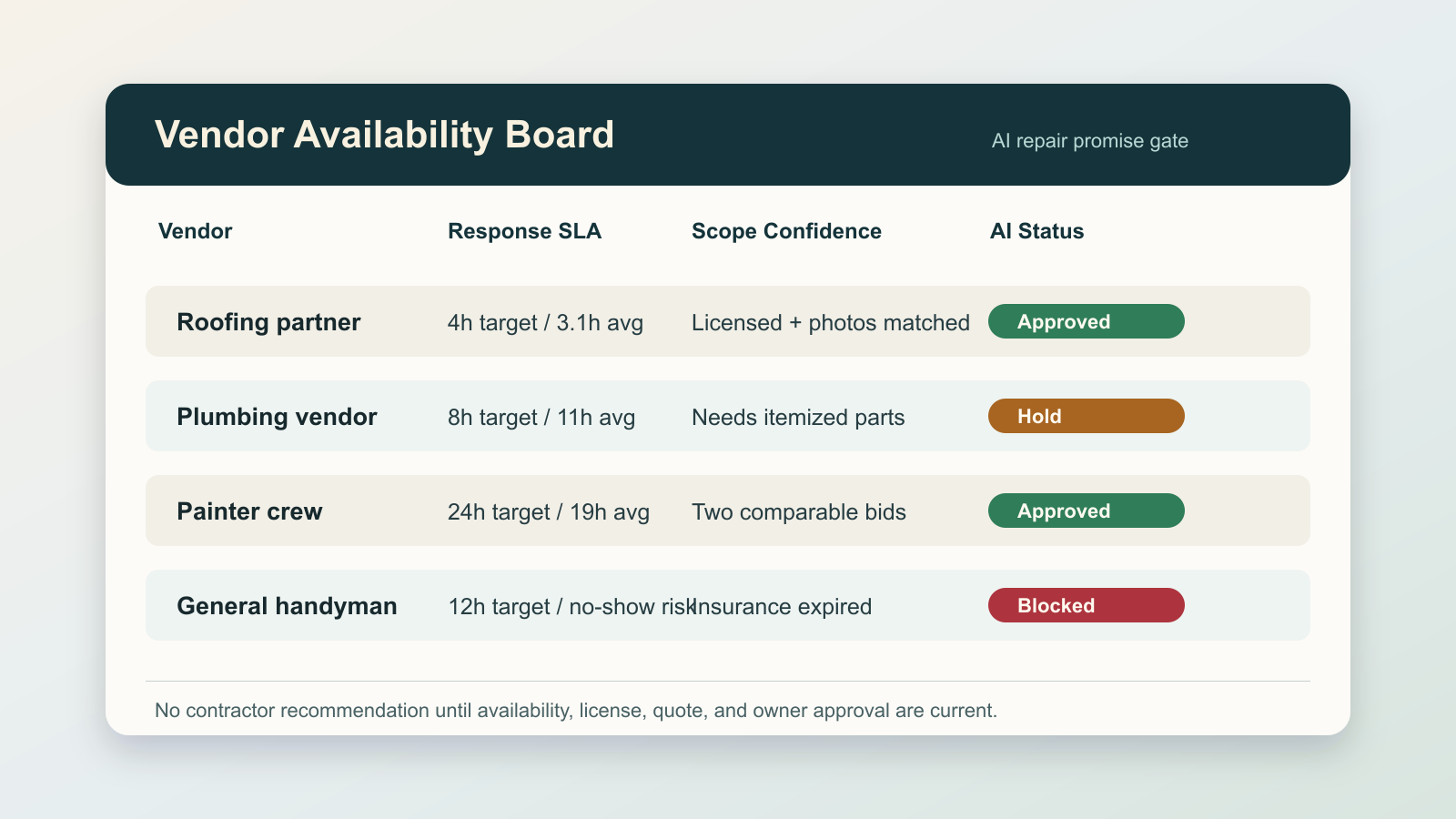
That is why a vendor availability board belongs upstream of any AI assistant that schedules repairs, recommends contractors, prepares seller concessions, or tells a buyer what will happen next. The board is not a generic vendor list. It is a live service-level surface that shows which vendors can respond, what they are qualified to touch, how current their insurance and license evidence is, whether comparable bids exist, and which client approvals are still missing.
The timing matters. NAHB said on May 4, 2026 that remodeling has become a larger share of residential construction firms and employment, with remodelers representing 56% of residential building construction establishments in the first quarter of 2025 and 49% of related payroll workers in 2024. The same sector still has positive sentiment: NAHB's first-quarter 2026 Remodeling Market Index was 62, above the 50 break-even mark, even as backlog and inquiry measures softened. Houzz's 2026 renovation planning survey found that 93% of homeowners planning renovations expect to work with professionals, while 25% expect difficulty finding available professionals. Harvard's Joint Center for Housing Studies also projects owner improvement and maintenance spending to reach $518 billion by the end of 2026, even with slower growth later in the year.
For a real estate operator, that combination means vendor capacity is neither dead nor frictionless. There is enough work in the market to keep good professionals busy, enough cost pressure to make clients sensitive, and enough availability risk to make casual AI promises expensive.
What the board should show
Start with the questions a transaction coordinator, listing manager, or buyer specialist already asks under pressure.
Can this vendor respond inside the timeline? Track response targets and actual response history separately. A contractor who usually replies in three hours is not the same operational asset as one who replies in two days, even if both do good work. The board should show last contact, average response time, current capacity note, and a next follow-up deadline.
Is the vendor qualified for this scope? Do not let the CRM reduce every professional to a name and phone number. Store trade type, service area, license or registration evidence where applicable, insurance status, W-9 status if your team needs it, and the work types the vendor should not touch. AI should not recommend a general handyman for roof, electrical, mold, structural, or permit-sensitive work just because the person is responsive.
Is the quote comparable? A useful board separates rough estimates, walk-through bids, written scopes, and final approved proposals. It should flag whether the estimate includes labor, materials, permit assumptions, exclusions, warranty language, scheduling constraints, and cleanup. If there is only one bid, AI can help draft the next request, but it should not describe the price as market-tested.
Who approved the next step? Vendor work often crosses client consent, listing strategy, repair negotiations, escrow deadlines, and risk tolerance. The board should show whether the seller, buyer, property manager, broker, or attorney has approved the spend, the scope, and the communication. AI can summarize options, but it should not schedule work from an inferred approval buried in a text thread.
The AI rule: no operational certainty from stale vendor data
The simplest policy is also the most useful: AI may draft vendor-related language only from records that have passed freshness checks. A vendor row should expire unless availability was confirmed within a defined window. A quote should expire unless the vendor confirmed it still holds. Insurance and license evidence should expire on its actual date, not when someone remembers to review it.
This matters because AI language tends to smooth uncertainty. A human might say, "I think the painter can get there Friday." An assistant may turn that into, "The painter is scheduled for Friday." That shift creates a promise. The vendor board gives the assistant controlled language: confirmed, requested, awaiting response, quote received, quote expired, client approval missing, broker review required, or do not use.
The workflow that makes it practical
Do not start with automation. Start with the board fields and the human update rhythm.
Every vendor record should have a responsible owner. That owner does not have to perform the work; they keep the relationship current. Every active repair or prep item should have one primary status, one next action, one due date, and a source link back to the message, inspection item, seller note, or listing-prep task that created the need.
Then add three automations.
First, stale-record alerts. If a vendor has not confirmed availability in the required window, the board should move that vendor out of the "AI eligible" pool for active client promises.
Second, bid-comparison prompts. When only one quote exists for a non-urgent item above your threshold, the system should create a task to request another bid or mark why a single-vendor path is justified.
Third, client-approval guards. If the scope changes, cost changes, or timeline changes, the system should require a fresh approval marker before AI drafts a confident client update.
That is enough. You do not need a perfect procurement suite to reduce risk. You need a small operational surface that prevents stale vendor assumptions from becoming polished AI messages.
How to score vendors without turning the board into bureaucracy
Use scores only where they change behavior. A simple vendor quality score can combine on-time response, on-time completion, documentation quality, change-order frequency, client complaint history, and scope fit. Keep subjective notes separate from measurable events. "Great attitude" may matter, but it should not outweigh expired insurance, repeated no-shows, or vague quotes.
The highest-value score is often not overall quality. It is fit for this job under this deadline. A roofer with excellent workmanship and a two-week backlog may be the wrong recommendation for a closing next Thursday. A smaller vendor with verified availability and a narrow, well-documented scope may be safer. The board lets AI explain that tradeoff without pretending there is one universal best contractor.
What to tell the team
The internal rule should be blunt: AI can accelerate vendor coordination, but it cannot create vendor readiness. Before AI recommends a contractor, promises a timeline, or frames a repair option, the board must show current availability, qualified scope, quote confidence, and approval status.
That turns AI from a confident guesser into a disciplined coordinator. It also gives clients a better experience. They hear fewer reversals, see clearer options, and understand when the team is waiting on a real external dependency instead of hiding behind vague follow-up language.
The real advantage is not a prettier vendor directory. It is a transaction operation where every repair promise has evidence behind it.

Written by
Ben Laube
AI Implementation Strategist & Real Estate Tech Expert
Ben Laube helps real estate professionals and businesses harness the power of AI to scale operations, increase productivity, and build intelligent systems. With deep expertise in AI implementation, automation, and real estate technology, Ben delivers practical strategies that drive measurable results.
View full profile