Turn Unstructured Real Estate Work Into AI-Ready Data
Most real estate teams already have enough operational data to make AI useful. It is just trapped in the worst possible formats: call notes, inbox threads, property updates, lease summaries, inspection comments, vendor texts, showing feedback, and one-off spreadsheets.
That matters because the next AI advantage is not another prompt. It is the ability to turn messy operational work into a trusted layer of reusable context.
Current research points in the same direction. McKinsey's April 2026 infrastructure analysis argues that scaling agentic AI depends on turning unstructured data into governed assets that systems can interpret and trust. NAREIM's 2026 Technology, Data & AI Survey says institutional real estate has already bought the tools, but rates its own governance readiness at just 5.1 out of 10 and data quality at 6.2 out of 10. NAR's February 2026 RPR survey found that 92% of surveyed agents are using or planning to use AI, while accuracy remains the top concern.
The pattern is clear: adoption is moving faster than the data layer underneath it.
The Hidden Bottleneck Is Not the Model
When AI fails inside a real estate business, people often blame the model first. The output was generic. The assistant missed context. The summary was incomplete. The follow-up was not specific enough.
Sometimes the model is the problem. More often, the system never gave the model a clean operating picture.
A residential team might have one version of a lead's intent in the CRM, another version in a text thread, a third version in a call transcript, and a fourth version in a lender update. A commercial or property management team might have asset notes in email, maintenance history in a work-order tool, lease obligations in PDFs, and budget decisions in meeting notes. Each source is useful. None is reliably packaged for automation.
That is why unstructured data needs to be treated as operational infrastructure, not background noise.
What AI-Ready Data Actually Means
AI-ready does not mean every document is perfect. It means the business can answer a few practical questions every time data enters the system.
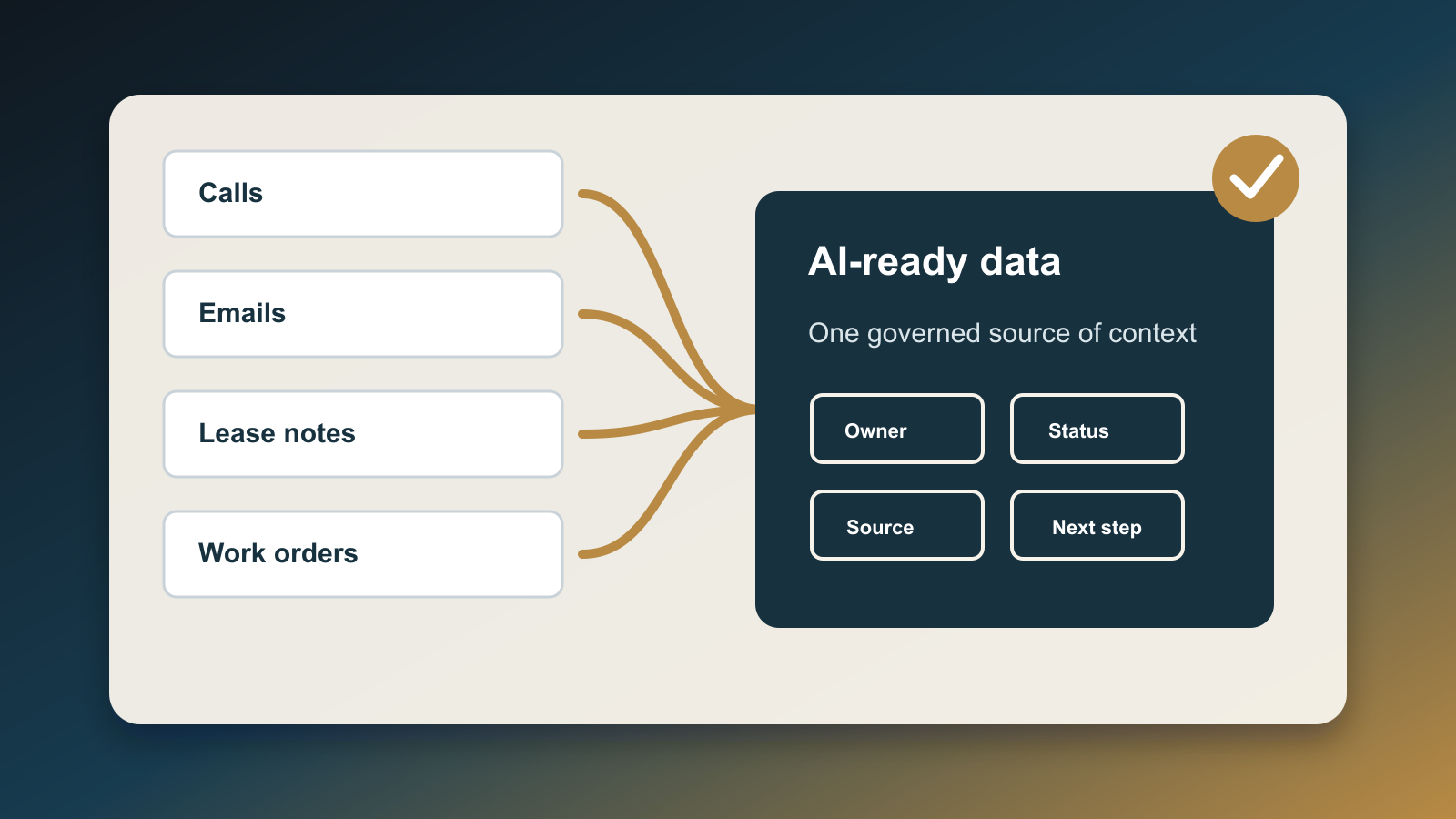
Who or what is this about? What workflow does it belong to? What decision or next action does it affect? Who owns it? How current is it? What is the source of truth? What should an AI system be allowed to do with it?
Those questions convert unstructured work into useful records. A call transcript becomes a lead-intent update, not just a blob of text. A vendor email becomes a maintenance status event. A lease clause becomes an obligation with a trigger date, owner, and risk level. A showing note becomes buyer preference evidence that can improve the next recommendation.
The goal is not to store more content. The goal is to create structured meaning around the content the business already produces.
Start With One Workflow, Not the Whole Company
The fastest way to make this practical is to choose one high-friction workflow and build a simple data contract around it.
For a brokerage, that workflow might be new lead intake. For a property manager, it might be maintenance triage. For an investor, it might be asset update collection. For a marketing team, it might be campaign performance review.
Pick the workflow where work already crosses too many channels. Then define the minimum useful record that every message, call, document, or AI summary should produce.
For lead intake, that record might include source, contact identity, buying or selling intent, timeline, price range, geography, financing status, urgency, last human touch, next action, and confidence level.
For maintenance triage, it might include asset, unit, tenant, issue type, severity, vendor assignment, access constraints, owner approval status, promised response time, and open risk.
For asset management, it might include property, source document, update type, variance, decision needed, owner, deadline, and downstream reporting impact.
This is deliberately boring. It is also what makes AI usable. Once the record exists, AI can summarize, route, draft, recommend, alert, and compare against policy without guessing what matters.
Human Review Should Be Built Into the Data Flow
Real estate work has too many compliance, client, and money risks to let AI write directly into core systems without review. The right pattern is not all manual or all autonomous. It is staged authority.
Low-risk fields can be suggested automatically. Medium-risk fields can be queued for review. High-risk actions should require explicit approval and leave an audit trail.
A call summary might be allowed to update a contact's preferred neighborhood after review. It should not automatically change representation status, financing assumptions, fair housing-sensitive fields, or legal conclusions. A lease abstraction might create candidate obligations, but a human should approve the clauses that affect notices, renewals, penalties, or tenant communications.
This is where AI-ready data becomes a management system. The team sees which records are complete, which are uncertain, which need human approval, and which upstream channels are producing bad inputs.
Measure Completeness Before Autonomy
Teams usually ask when AI can take over more work. A better first question is whether the data is complete enough to support the next action.
For each chosen workflow, track a few operating metrics:
- Percentage of records with a known owner and next step
- Percentage of AI-generated updates reviewed within the target window
- Fields most often missing from call, email, or document extraction
- Number of conflicting values across CRM, inbox, and source documents
- Actions blocked because source evidence is unclear
These metrics turn vague AI anxiety into an operating backlog. If 40% of lead records lack timeline or financing context, the fix may be a better intake script, not a larger model. If work orders often lack access instructions, the fix may be a tenant message template. If lease abstractions create too many low-confidence obligations, the fix may be document standardization.
The point is to make data quality visible inside the workflow, not as an annual cleanup project.
The Competitive Advantage Is Reuse
The same AI-ready record can power multiple outcomes.
A clean lead-intent record can support follow-up reminders, listing alerts, agent handoffs, audience segmentation, and pipeline forecasting. A clean maintenance event record can support tenant communication, vendor routing, insurance documentation, and owner reporting. A clean asset update record can support investor memos, budget review, risk registers, and portfolio dashboards.
That reuse is where the economics improve. Instead of paying for one-off automations that each parse the same messy inputs differently, the business builds a shared context layer that every automation can use.
This is also how smaller teams can compete. They do not need a massive data platform on day one. They need consistent definitions, clear ownership, source links, review states, and a habit of converting important unstructured work into records the business can trust.
The Practical Starting Point
Do not begin by asking, "What AI agent should we buy next?" Start with a workflow table.
List the five most common unstructured inputs in that workflow. Define the fields each one should produce. Decide which fields AI can suggest, which require review, and which should never be inferred. Attach every record back to the source message, transcript, document, or system event. Then review the exception queue weekly.
That is the foundation for useful automation. It gives AI the context to act, gives humans a clear review surface, and gives the business a way to improve over time.
The firms that win with AI in real estate will not be the ones with the most scattered assistants. They will be the ones that turn everyday work into durable, governed operational data.

Written by
Ben Laube
AI Implementation Strategist & Real Estate Tech Expert
Ben Laube helps real estate professionals and businesses harness the power of AI to scale operations, increase productivity, and build intelligent systems. With deep expertise in AI implementation, automation, and real estate technology, Ben delivers practical strategies that drive measurable results.
View full profile