#Business Systems
Insights tagged with Business Systems — AI, real estate, and business innovation from Ben Laube.
View all insights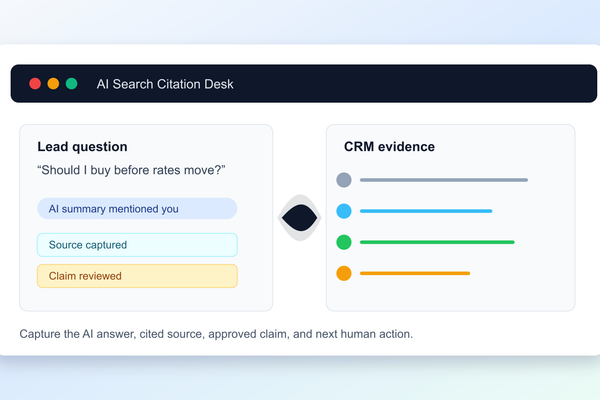
Build an AI Search Citation Desk Before Leads Trust the Summary
AI Search is turning buyer and seller discovery into synthesized answers before the first click. A citation desk gives CRM, marketing, and compliance teams a practical way to capture what leads saw, verify claims, and route safer follow-up.
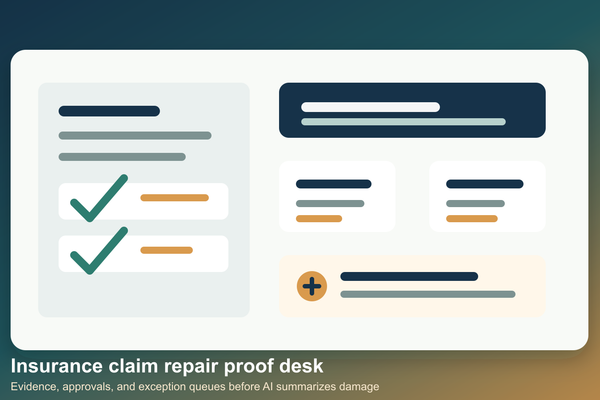
Build an Insurance Claim Repair Proof Desk Before AI Summarizes Damage
AI can help real estate teams coordinate claim repair files, but only after receipts, scopes, settlement letters, contractor proof, and approval gates are structured.
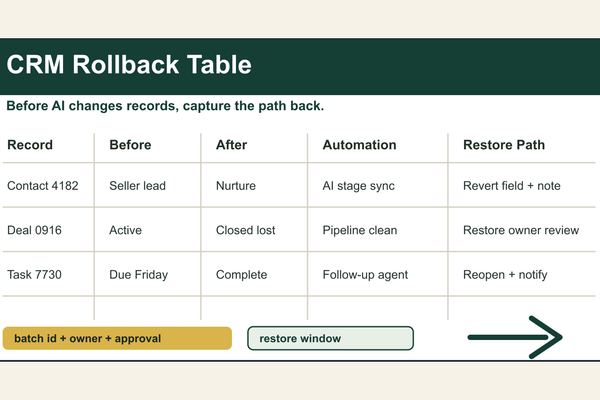
Build a CRM Rollback Table Before AI Changes Records
AI can clean CRM records quickly, but teams need a rollback table that captures before values, batch IDs, approval, restore paths, and downstream pauses before production data changes.
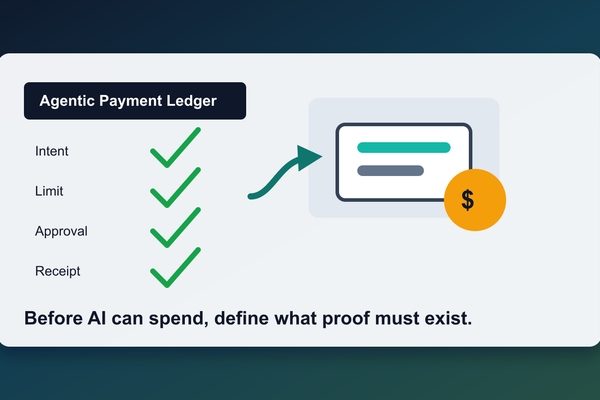
Build an Agentic Payment Approval Ledger Before AI Buys Anything
AI agents are getting closer to real payment authority. Before they buy ads, renew tools, pay vendors, or trigger B2B spend, businesses need a ledger that ties every transaction to intent, limits, evidence, approval, and rollback.
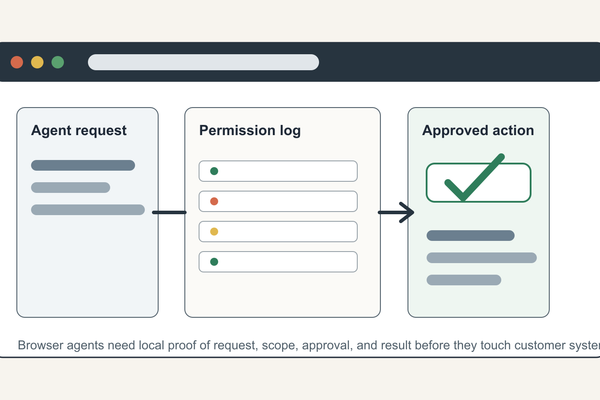
Build a Browser-Agent Permission Log Before AI Uses Your CRM
Browser agents can click through real business systems, but platform safety gates do not replace a local permission log. Give CRM automation a record of request, scope, approval, result, and rollback before AI acts.

Build a School Boundary Evidence File Before AI Answers Buyers
HUD changed the school-quality conversation in April 2026. Real estate teams need objective school-boundary source files before AI drafts buyer-facing answers.
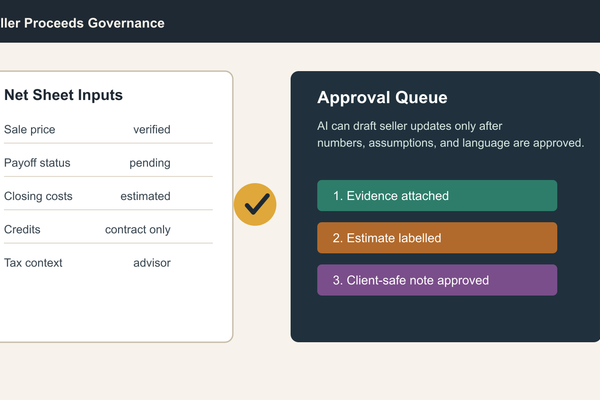
Build a Seller Net Sheet Approval Queue Before AI Talks Proceeds
AI can turn seller math into confident proceeds language too quickly. Build a net sheet approval queue so estimates, payoffs, closing costs, credits, and tax-sensitive caveats are verified before clients see a number.
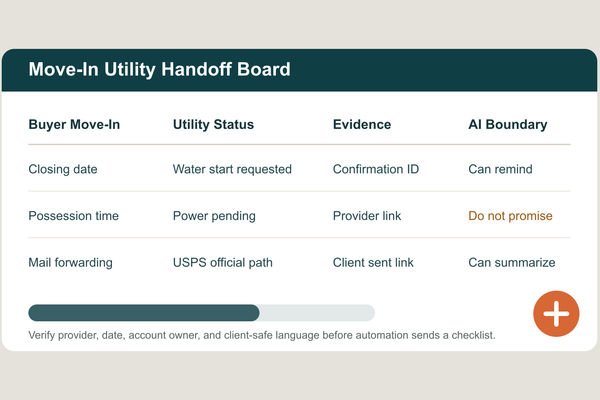
Build a Move-In Utility Handoff Board Before AI Sends Buyer Checklists
AI can personalize buyer move-in reminders, but utility setup needs verified provider, date, status, and scam-safe language first. Build a handoff board before automation sends checklists.
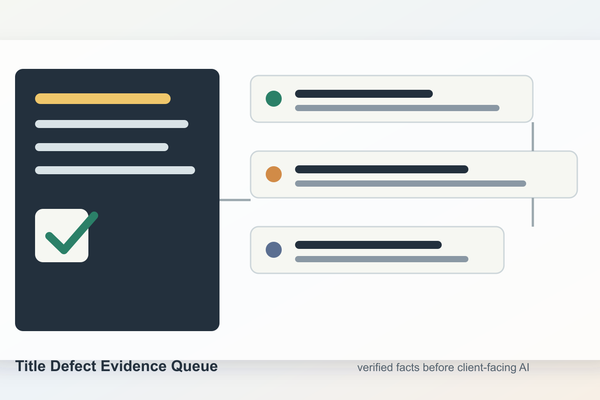
Build a Title Defect Evidence Queue Before AI Explains Closing Delays
AI can draft clearer closing updates, but title-sensitive language needs verified evidence first. Build a queue that separates defects, required cures, authority review, and client-safe status before any model explains delays.
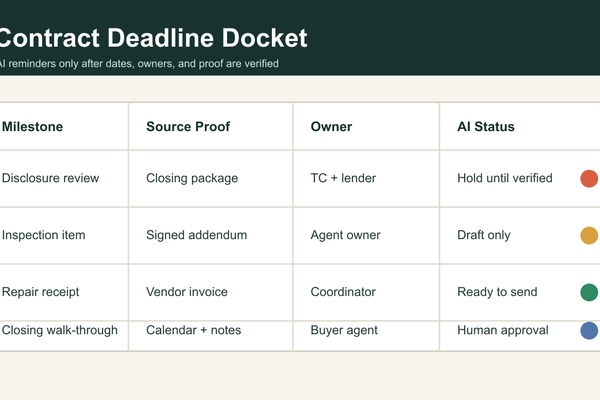
Build a Contract Deadline Docket Before AI Sends Transaction Reminders
AI can draft transaction reminders quickly, but real estate teams need a deadline docket that ties every client update to source documents, owners, approvals, and escalation rules first.
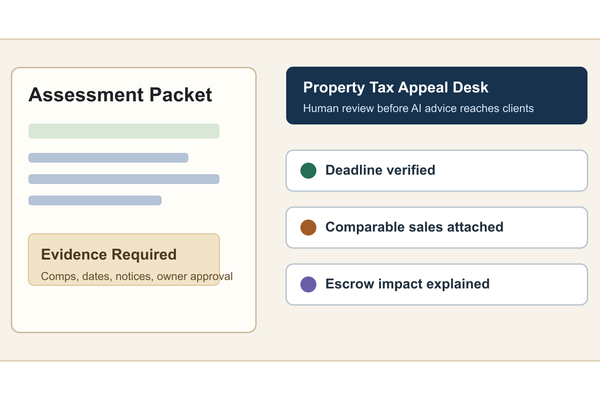
Build a Property Tax Appeal Desk Before AI Advises Homeowners
Property-tax and escrow questions can turn into risky AI advice fast. A simple appeal desk separates document explanation, evidence review, local deadlines, and human approval before any homeowner receives a recommendation.
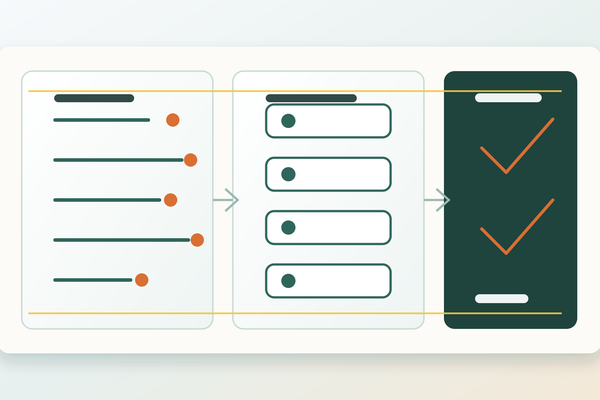
Build an HOA Document Triage Board Before AI Answers Buyer Questions
AI can summarize HOA rules quickly, but real estate teams need a document triage board that verifies source documents, financing impact, fair-housing risk, and human approval before buyers get answers.
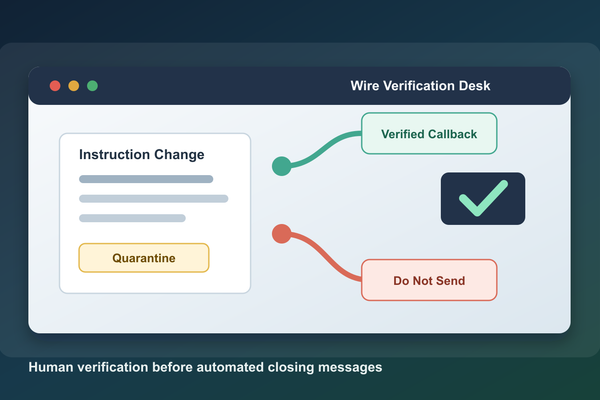
Build a Wire-Instruction Verification Desk Before AI Sends Closing Updates
AI can speed up closing communication, but real estate teams need a wire-instruction verification desk before automated updates touch payment-risk workflows.
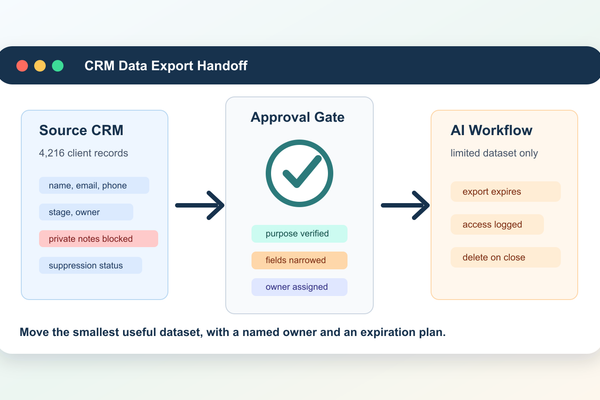
Build a Data Export Handoff Before AI Moves CRM Records
Real estate teams need a CRM data-export approval step before AI syncs, enriches, or moves client records into new tools.
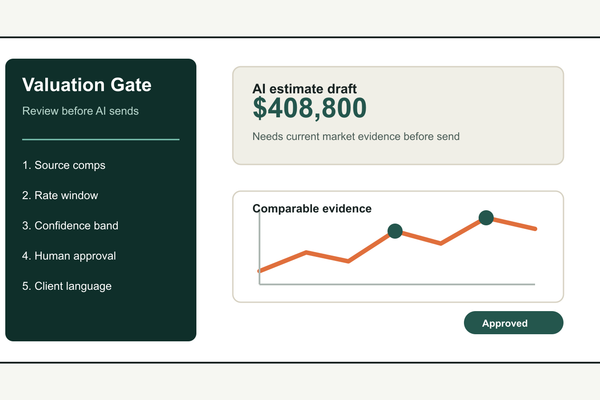
Build a Valuation Review Gate Before AI Sends Home Estimates
AI can draft home estimates quickly, but real estate teams need a valuation review gate that checks sources, confidence, market context, and approval before clients see a number.
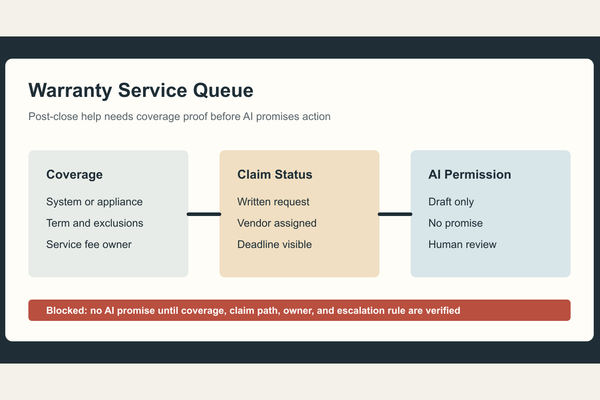
Build a Home Warranty Service Queue Before AI Promises Help
AI can speed up post-close service, but real estate teams need a warranty service queue that verifies coverage, claim paths, owners, and approved language before clients see promises.
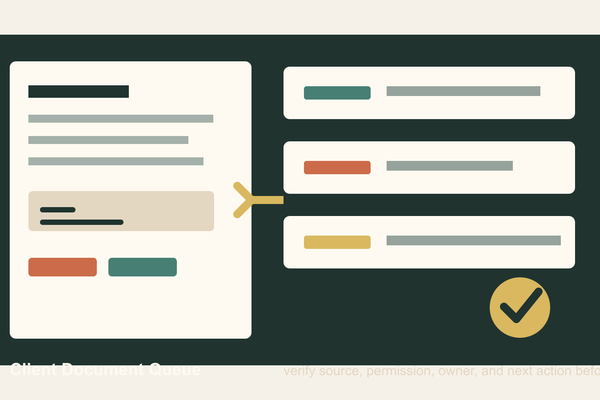
Build a Client Document Queue Before AI Chases Missing Files
AI can speed up real estate document follow-up, but only after missing-file requests have source evidence, sensitivity rules, owners, and approved client-facing actions.
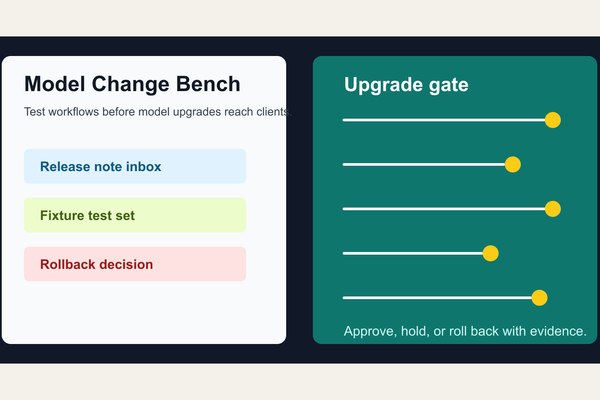
Build a Model Change Bench Before AI Upgrades Your Workflows
AI models change faster than business workflows. A model-change bench gives teams release-note tracking, test fixtures, approval gates, and rollback evidence before upgrades affect clients or CRM data.
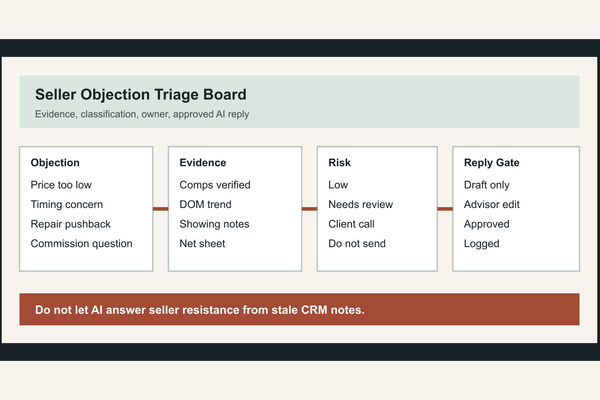
Build a Seller Objection Triage Board Before AI Replies to Pushback
Seller pushback should not be answered from stale CRM notes. A triage board keeps objection type, evidence, owner, risk, and AI permission visible before replies go out.
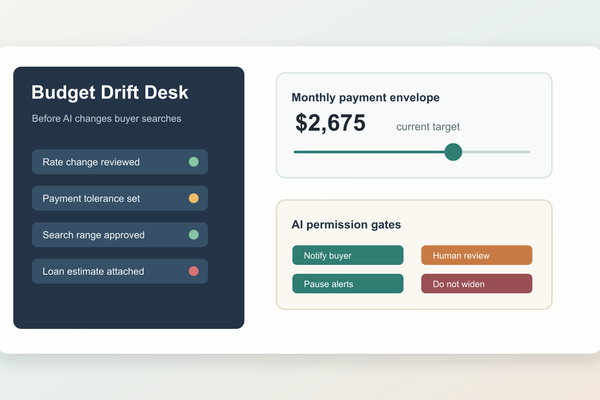
Build a Buyer Budget Drift Desk Before AI Changes Searches
AI can adjust buyer searches only after the CRM knows which budget signals are verified, stale, or waiting for human review.
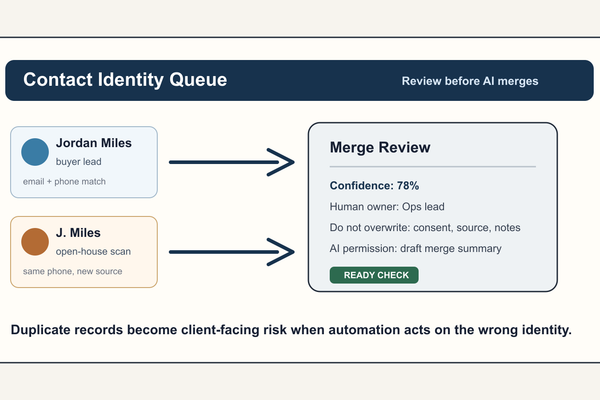
Build a Contact Identity Queue Before AI Merges Your CRM
AI deduplication can clean a CRM or quietly break client trust. A contact identity queue keeps source history, consent, households, and human approval visible before records merge.
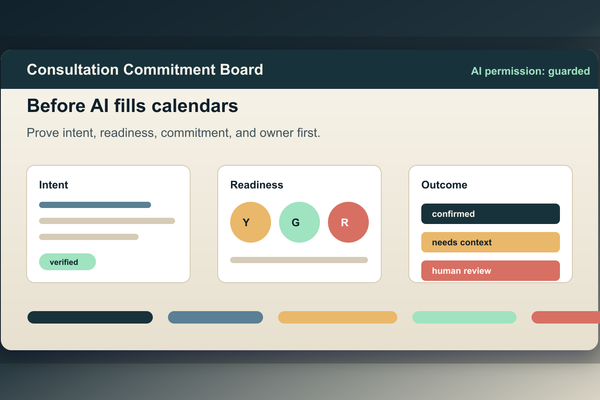
Build a Consultation Commitment Board Before AI Fills Calendars
AI booking tools should not treat every calendar slot as equally ready. A consultation commitment board keeps intent, readiness, reminders, and no-show recovery visible before automation confirms meetings.
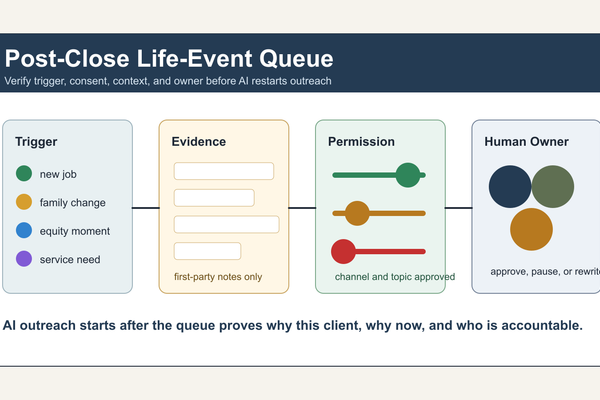
Build a Life-Event Queue Before AI Restarts Past-Client Outreach
Past-client AI outreach needs verified life-event triggers, contact permission, current context, and a human owner before automation restarts the relationship.
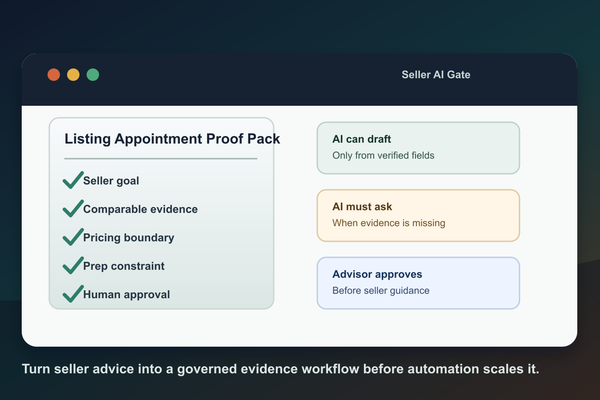
Build a Listing Appointment Proof Pack Before AI Advises Sellers
Before AI drafts seller pricing guidance, build a CRM proof pack that separates verified market evidence, seller boundaries, and advisor approval.
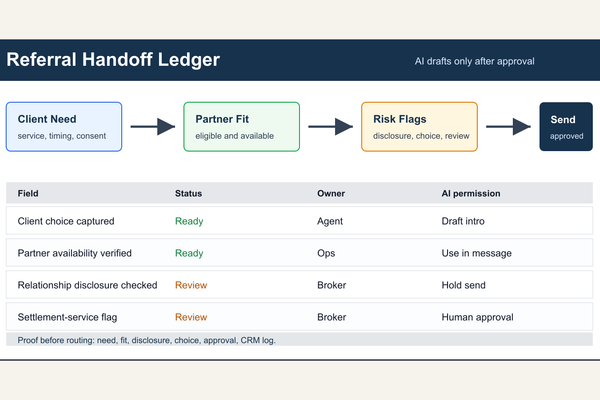
Build a Referral Handoff Ledger Before AI Routes Clients
AI should not route clients to referral partners from stale CRM habits. Use a referral handoff ledger to prove fit, choice, disclosure, availability, and human approval first.
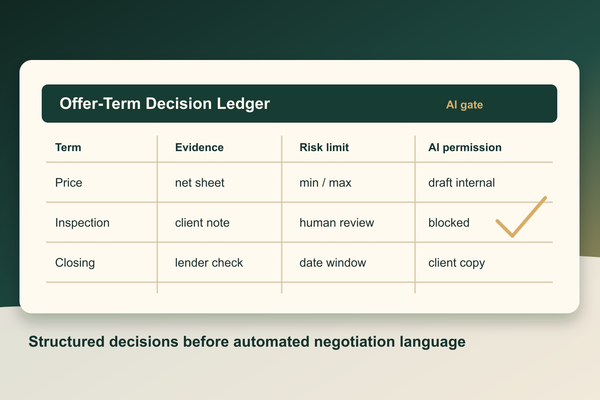
Build an Offer-Term Decision Ledger Before AI Drafts Counteroffers
AI should not draft counteroffer language from scattered deal notes. Use an offer-term decision ledger to prove priorities, tradeoffs, risk limits, and approval first.
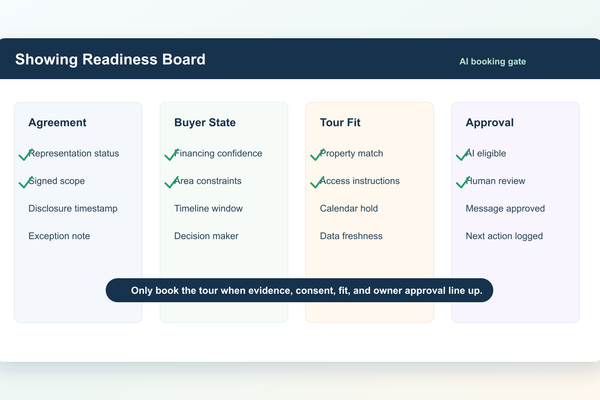
Build a Showing Readiness Board Before AI Books Buyer Tours
AI scheduling should not book buyer tours from scattered CRM notes. Use a showing readiness board to prove agreement status, buyer context, property fit, and approval first.
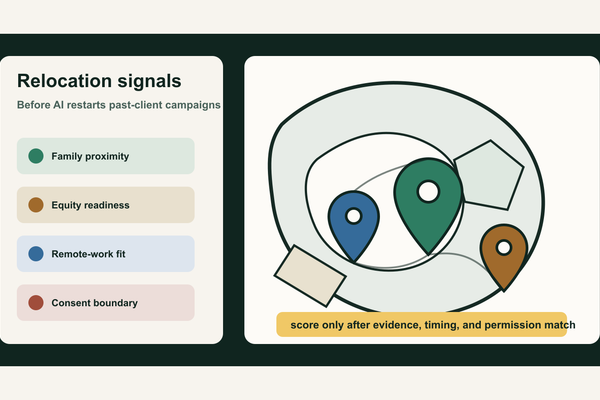
Build a Relocation Signal Board Before AI Sends Move-Ready Campaigns
AI should not infer relocation intent from stale CRM notes. Build a relocation signal board first so move drivers, timing, permission, and human ownership are clear before past-client campaigns restart.
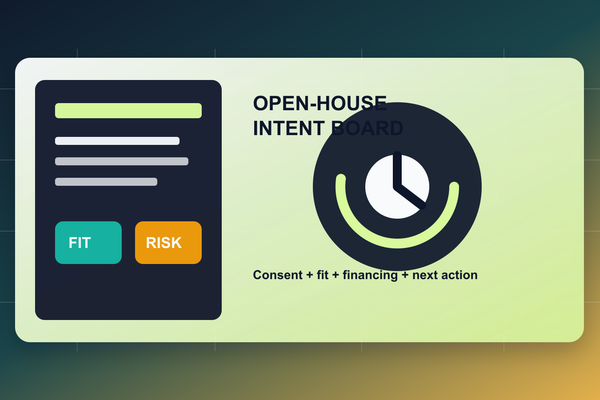
Build an Open-House Intent Board Before AI Scores Visitors
Open-house AI follow-up needs more than a sign-in sheet. Build an intent board first so visitor consent, fit, financing, and next action are verified before AI scores the lead.
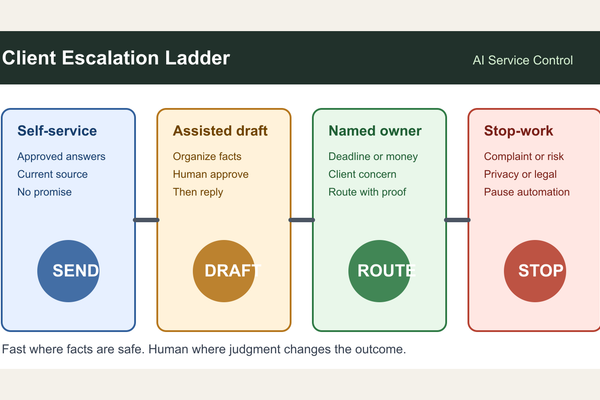
Build a Client Escalation Ladder Before AI Handles Service Replies
AI can answer routine service questions quickly, but real estate teams need an escalation ladder first so client risk, deadlines, complaints, and trust moments reach the right human owner.
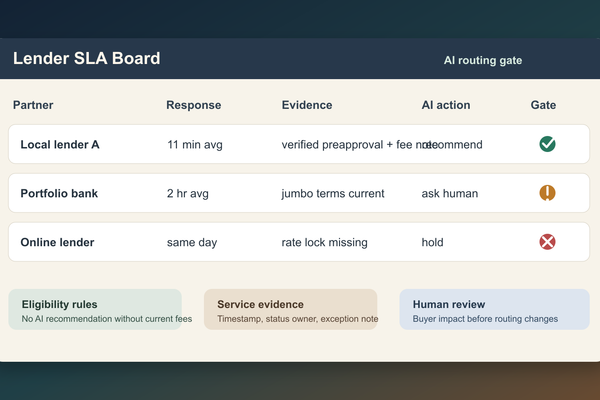
Build a Lender SLA Board Before AI Recommends Financing Partners
AI should not recommend lenders from stale CRM memory. A lender SLA board gives real estate teams current service evidence, eligibility gates, and human review before financing advice reaches buyers.
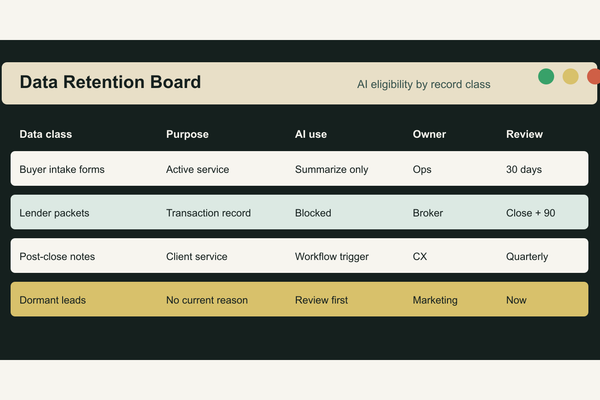
Build a Data Retention Board Before AI Learns From Client Files
AI workflows should not treat every old CRM note, transaction file, and client document as approved context. Build a retention board first so client data has purpose, ownership, AI eligibility, and review dates.
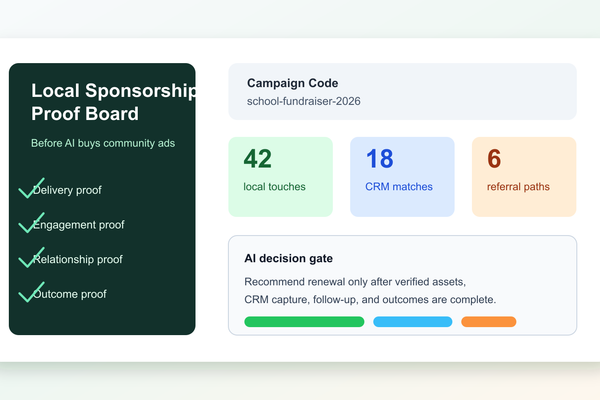
Build a Local Sponsorship Proof Board Before AI Buys Community Ads
Before AI reallocates local marketing spend, give community sponsorships a proof board that connects delivery, engagement, CRM follow-up, and outcomes.
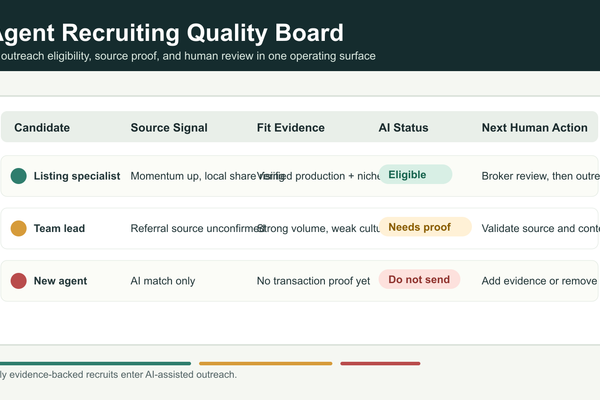
Build an Agent Recruiting Quality Board Before AI Sends Outreach
AI can help brokerages find and message recruiting prospects, but it should not turn weak signals into confident outreach. An agent recruiting quality board keeps production evidence, source context, fit, consent, and human review visible before AI touches the candidate.
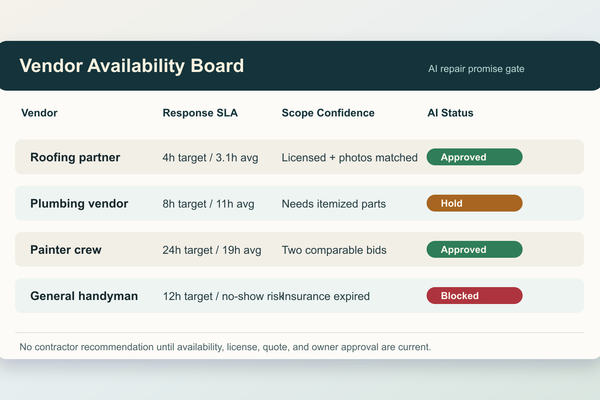
Build a Vendor Availability Board Before AI Promises Repairs
AI should not recommend contractors or promise repair timelines from stale vendor notes. A vendor availability board gives real estate teams the service-level evidence, scope confidence, and approval status needed before AI drafts client-facing repair updates.
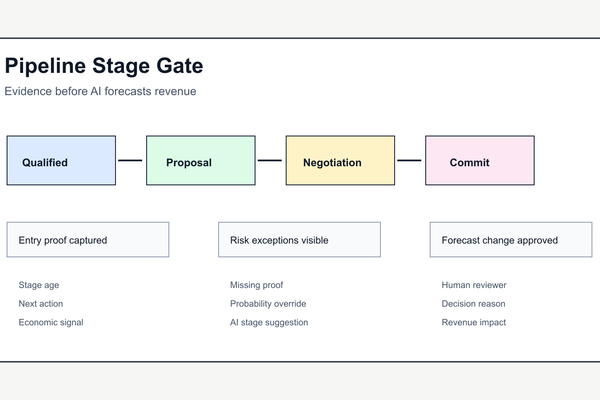
Build a Pipeline Stage Gate Before AI Forecasts Revenue
AI can forecast from CRM data, but teams need a pipeline stage gate first so revenue predictions are based on verified evidence instead of loose labels.
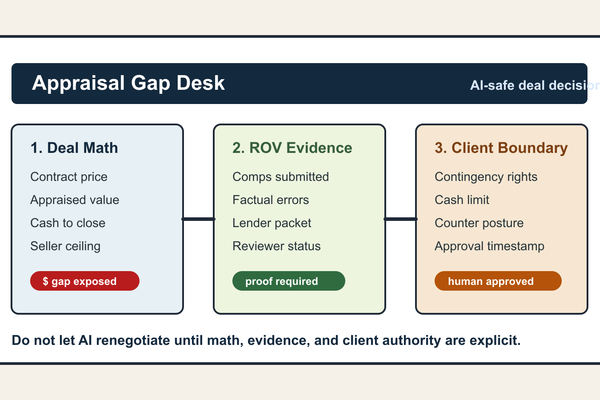
Build an Appraisal Gap Desk Before AI Renegotiates Deals
AI can explain a low appraisal, but real estate teams need an appraisal gap desk before it drafts renegotiation, ROV, or client guidance.
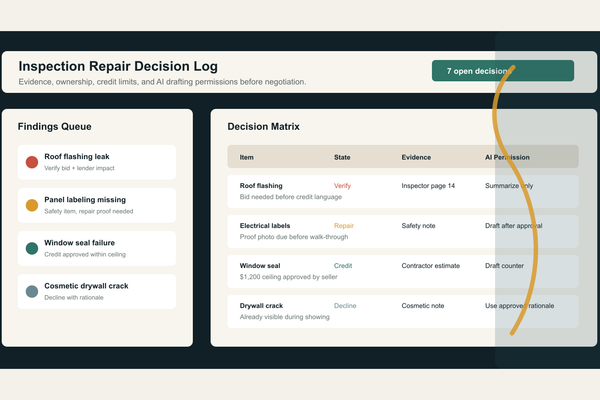
Build an Inspection Repair Decision Log Before AI Negotiates Credits
AI can summarize inspection reports, but real estate teams need a repair decision log before it drafts credits, counters, or client negotiation language.

Build an Insurance Readiness Ledger Before AI Advises Offers
Home insurance is now a buyer qualification variable. Real estate teams need a structured insurance-readiness ledger before AI drafts affordability guidance or offer strategy.

Build a Financing Readiness Tracker Before AI Advises Buyers
AI can help buyers understand affordability, lender options, and offer strategy, but real estate teams need a financing readiness tracker first so advice is grounded in verified loan evidence instead of optimistic assumptions.
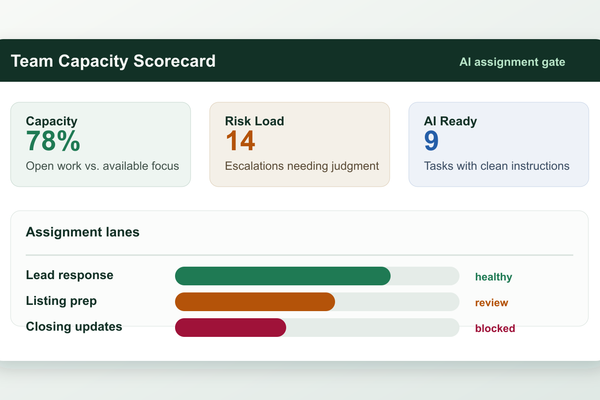
Build a Team Capacity Scorecard Before AI Assigns Work
AI can route real estate work quickly, but teams need a capacity scorecard first so assignments reflect workload, risk, missing inputs, and human accountability instead of simple round-robin rules.
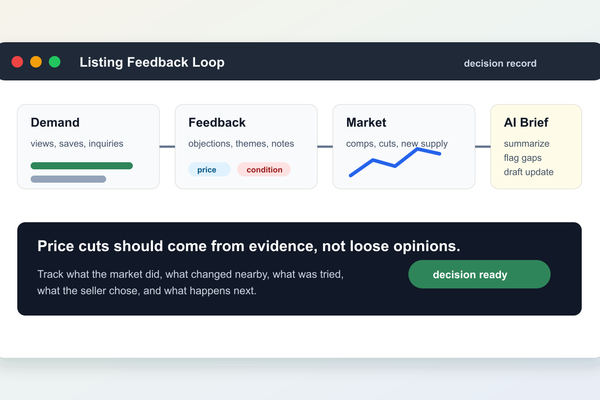
Build a Listing Feedback Loop Before AI Suggests Price Cuts
AI can help sellers understand pricing, showings, objections, and next steps, but real estate teams need a structured listing feedback loop first so price-cut advice is based on buyer behavior instead of loose opinions.
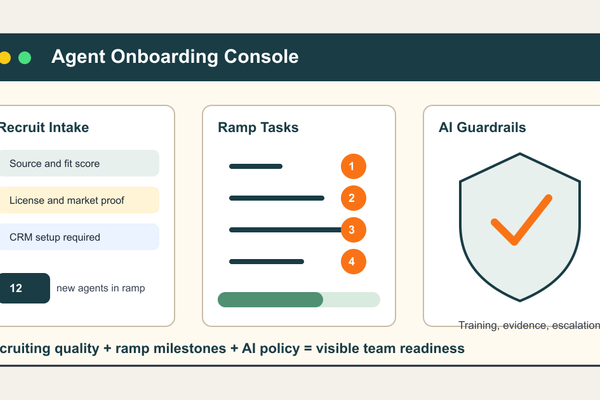
Build an Agent Onboarding Console Before AI Coaches the Team
AI can help train, coach, and support real estate agents, but brokerage teams need a visible onboarding console first so recruiting promises, ramp milestones, CRM setup, policy guardrails, and human coaching stay connected.
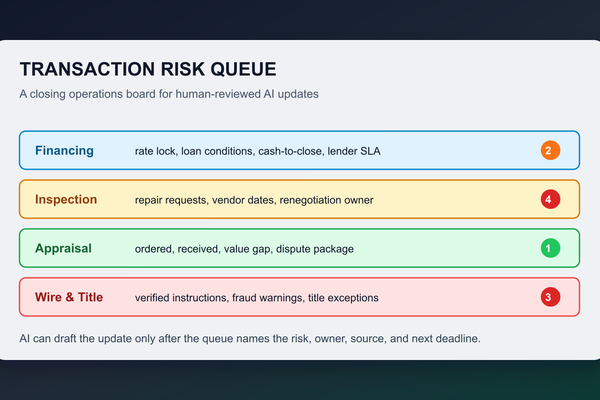
Build a Transaction Risk Queue Before AI Updates Closings
AI can draft polished closing updates, but real estate teams need a transaction risk queue first so financing, appraisal, inspection, title, and wire risks stay visible before clients hear from automation.
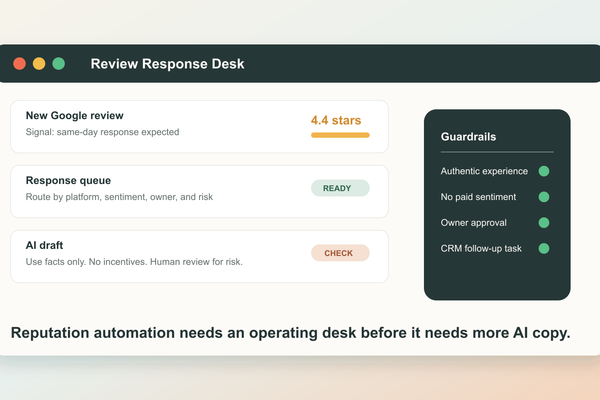
Build a Review Response Desk Before AI Manages Reputation
AI can help draft review replies, but real estate and local service teams need a response desk first so reputation work stays timely, personal, compliant, and tied to CRM follow-up.
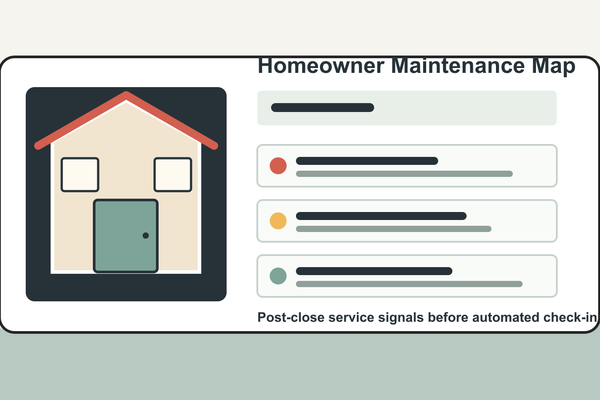
Build a Homeowner Maintenance Map Before AI Sends Check-Ins
AI past-client follow-up works better when the CRM knows the home, the owner, the service moment, and the consent boundary before it writes the message.
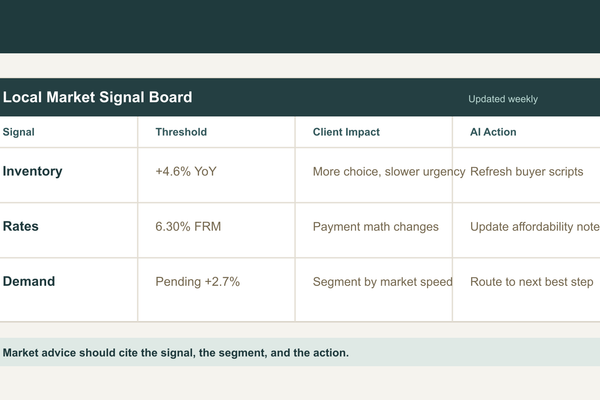
Build a Market Signal Board Before AI Writes Local Advice
AI can draft local market updates quickly, but real estate teams need a market signal board first so advice reflects current inventory, rates, demand, and client segment rules.

Make AI Marketing Prove Incremental Revenue, Not Cheaper Clicks
AI can optimize campaigns faster than a human team, but business owners still need a measurement system that separates real revenue lift from recycled attribution noise.
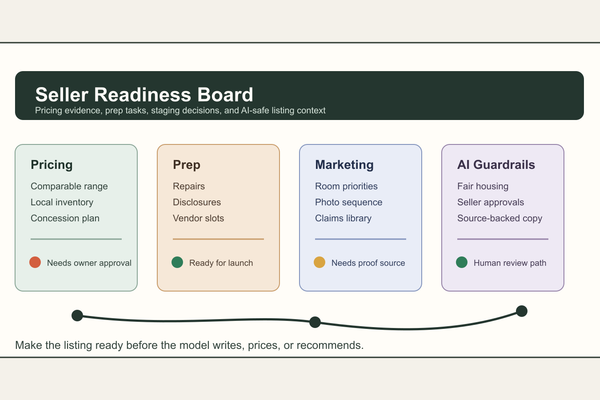
Build a Seller Readiness Board Before AI Touches Listing Prep
AI can draft listing copy and summarize comps, but sellers need a stronger operating layer first. A seller readiness board turns pricing, prep, staging, disclosures, and approvals into structured context before automation touches the launch.
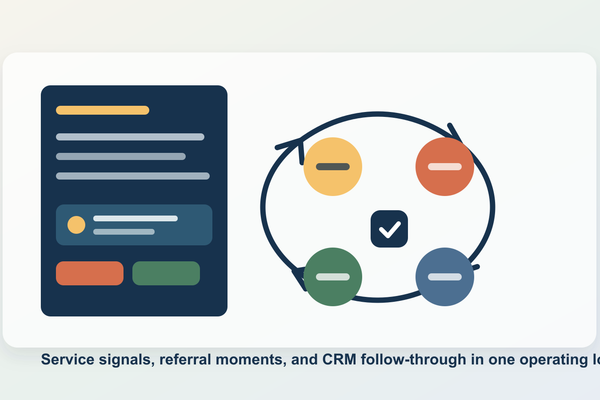
Build a Service-to-Referral Loop Before AI Handles Clients
AI can shorten service work, but real estate growth still depends on trust signals. A service-to-referral loop captures client moments, routes human follow-through, and protects referrals from generic automation.
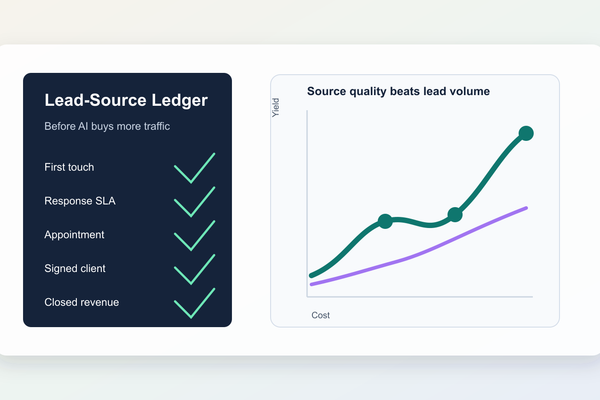
Build a Lead-Source Ledger Before AI Buys Traffic
AI can scale real estate marketing spend quickly. A lead-source ledger makes sure the CRM can tell which sources create appointments, clients, and revenue before automation optimizes for volume.
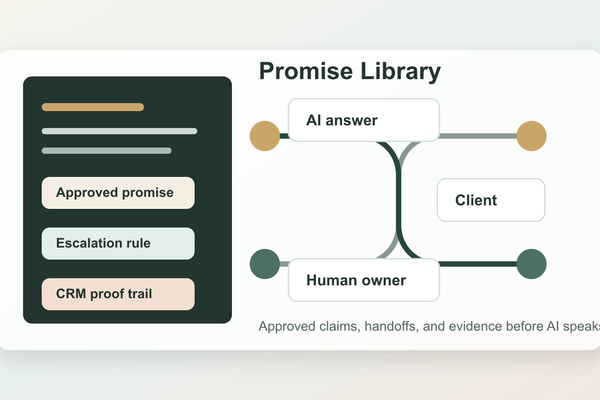
Give Customer-Facing AI a Promise Library
Customer-facing AI should not improvise guarantees, timelines, fees, or next steps. A promise library tells every chatbot, voice agent, CRM assistant, and marketing automation what it may say, when it must escalate, and where proof lives.
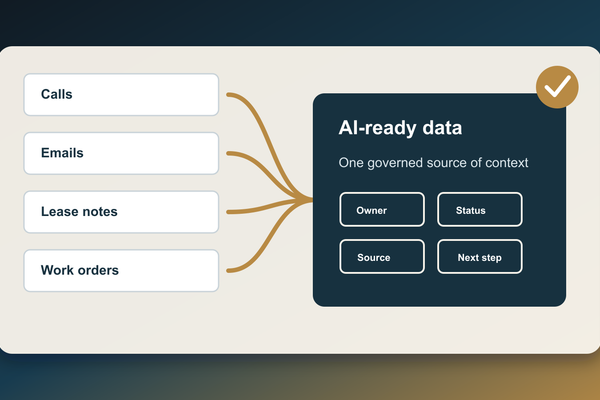
Turn Unstructured Real Estate Work Into AI-Ready Data
Real estate teams already have the raw material for better AI: calls, emails, lease notes, work orders, and showing feedback. The advantage comes from turning that mess into governed operational records.

Ask AI Vendors for Workflow Proof, Not Another Demo
AI demos are easy to polish. Real estate teams should ask vendors to prove the workflow with CRM writes, permissions, exceptions, audit trails, and business outcomes before buying.
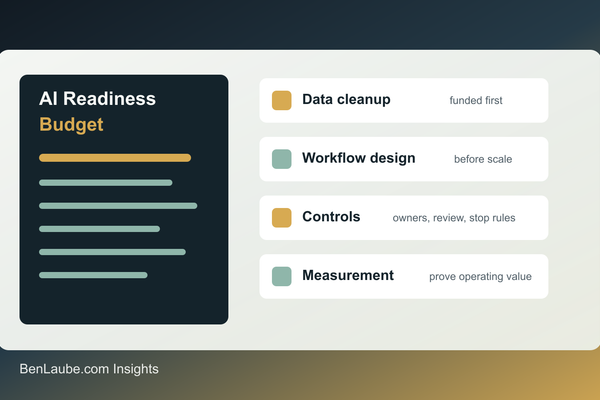
Put AI Readiness in the Real Estate Budget
AI tools are spreading faster than the operating work needed to support them. Real estate teams should budget for data cleanup, workflow design, controls, training, and measurement before automation scales.
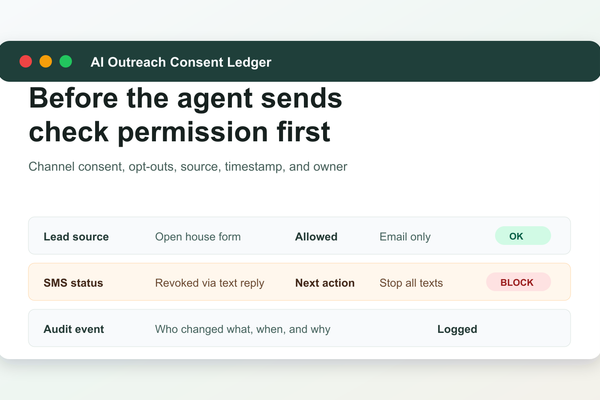
Give AI Outreach a Consent Ledger Before It Scales
AI follow-up needs more than better copy. Real estate teams need a consent ledger that tells every agent, CRM workflow, and marketing tool which channel is allowed before outreach scales.
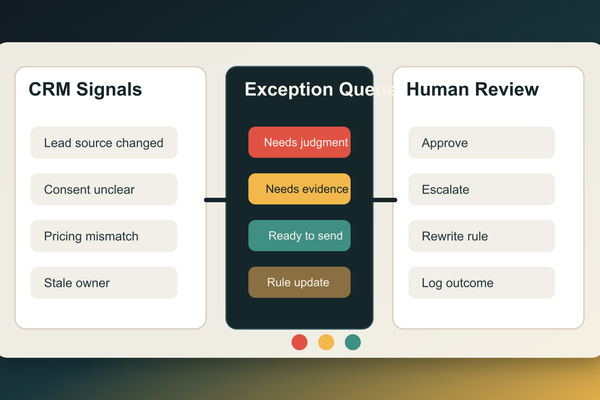
The Exception Queue Is the AI Agent Interface
AI agents should not make every judgment inside the workflow. Real estate teams need exception queues that route risk, capture evidence, and turn edge cases into better operating rules.
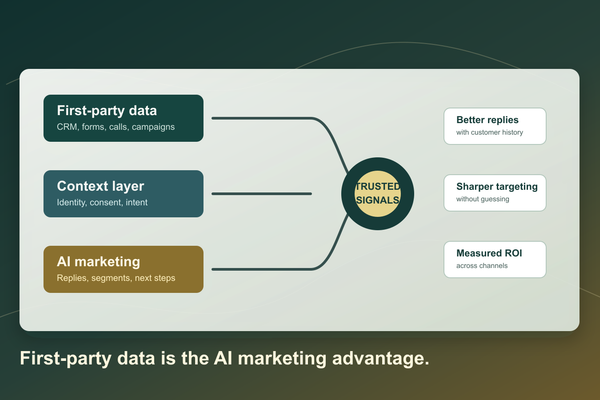
First-Party Data Is the AI Marketing Advantage
AI marketing is no longer scarce. Real estate teams win by connecting CRM, consent, source, and outcome data before adding more agents or campaigns.
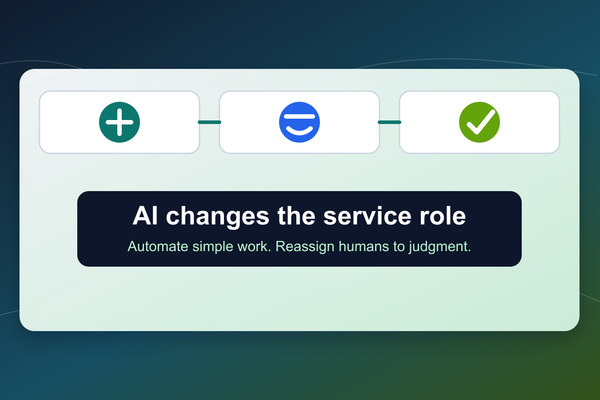
AI Is Rewriting Real Estate Service Roles
AI should not just make real estate teams faster at replying. The practical opportunity is to redesign service roles around judgment, context, exceptions, and client trust.
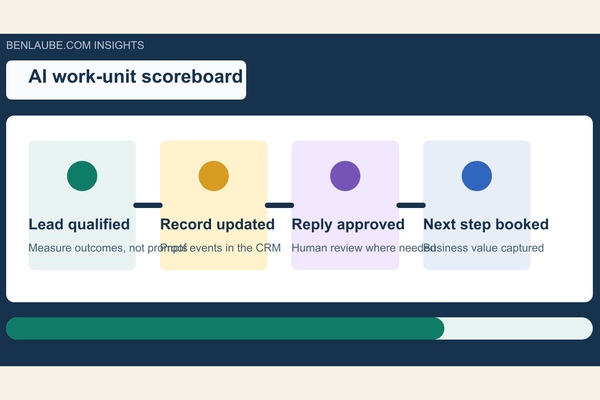
Measure AI Agents by Work Completed, Not Prompts Run
AI agents should be judged by completed business actions with proof in the CRM, not by prompts, drafts, or vague time-saved claims. Build a work-unit scoreboard first.
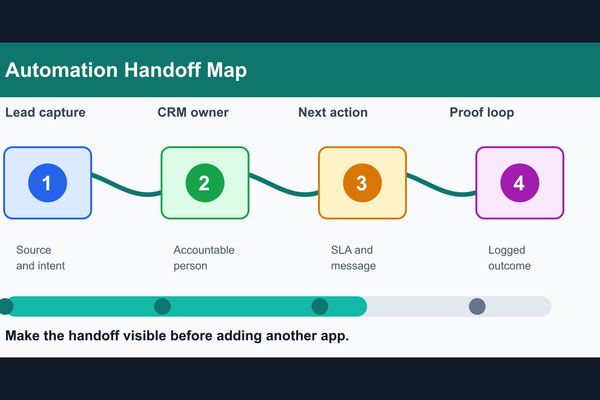
Real Estate Automation Breaks at the Handoff
Most real estate automation does not fail inside the tool. It fails between lead capture, CRM ownership, follow-up, and proof. Build a handoff map before adding another app.
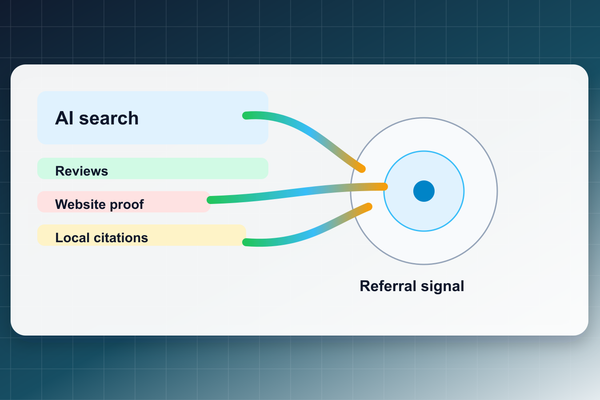
AI Search Is Becoming a Real Estate Referral Channel
AI search is becoming a local referral layer for real estate teams. The operators who win will keep reviews, citations, local proof, and website evidence fresh enough for both AI systems and cautious clients to verify.

AI in Business: Why 2026 Is an Operating System Shift, Not a Tool Upgrade
AI is no longer just a productivity add-on. In 2026, leading teams are redesigning workflows, decisions, and accountability around AI as a business operating system.

From Chaos to Systems: Building Your AI-Powered Real Estate Business
Transform your real estate chaos into a systematic, AI-powered operation. A practical framework for building scalable business systems that work without you.