Put AI Readiness in the Real Estate Budget
AI readiness is becoming a real estate operating expense, not a side project.
That sounds less exciting than another agent demo, but it is the difference between AI that improves the business and AI that quietly adds fragility. Real estate teams already have plenty of places for AI to show up: CRM cleanup, lead scoring, market reports, listing preparation, ad copy, transaction summaries, client updates, recruiting, training, and back-office coordination. The constraint is no longer access to tools. The constraint is whether the business has funded the work that makes those tools reliable.
NAREIM's April 2026 Technology, Data and AI Survey makes the gap visible in institutional real estate. The industry rated its AI maturity at 5.7 out of 10, data quality at 6.2, and governance readiness at 5.1. At the same time, 91% of firms had already deployed Microsoft Copilot and more than half were using ChatGPT or Claude. Most important for operators: 58% still did not have a formal technology budget model.
That is the operating lesson. AI adoption is moving faster than the budget lines required to support it.
For a brokerage, team, property manager, investor, or real estate service business, the same pattern shows up at smaller scale. Someone buys an AI meeting assistant. Someone connects a CRM enrichment tool. Someone starts generating listing copy. Someone experiments with automated follow-up. None of those purchases looks large enough to justify a formal program. Together, they create a new operating layer that needs funding, ownership, training, review, and measurement.
The answer is not a bigger software wish list. It is an AI readiness budget.
What the budget should actually cover
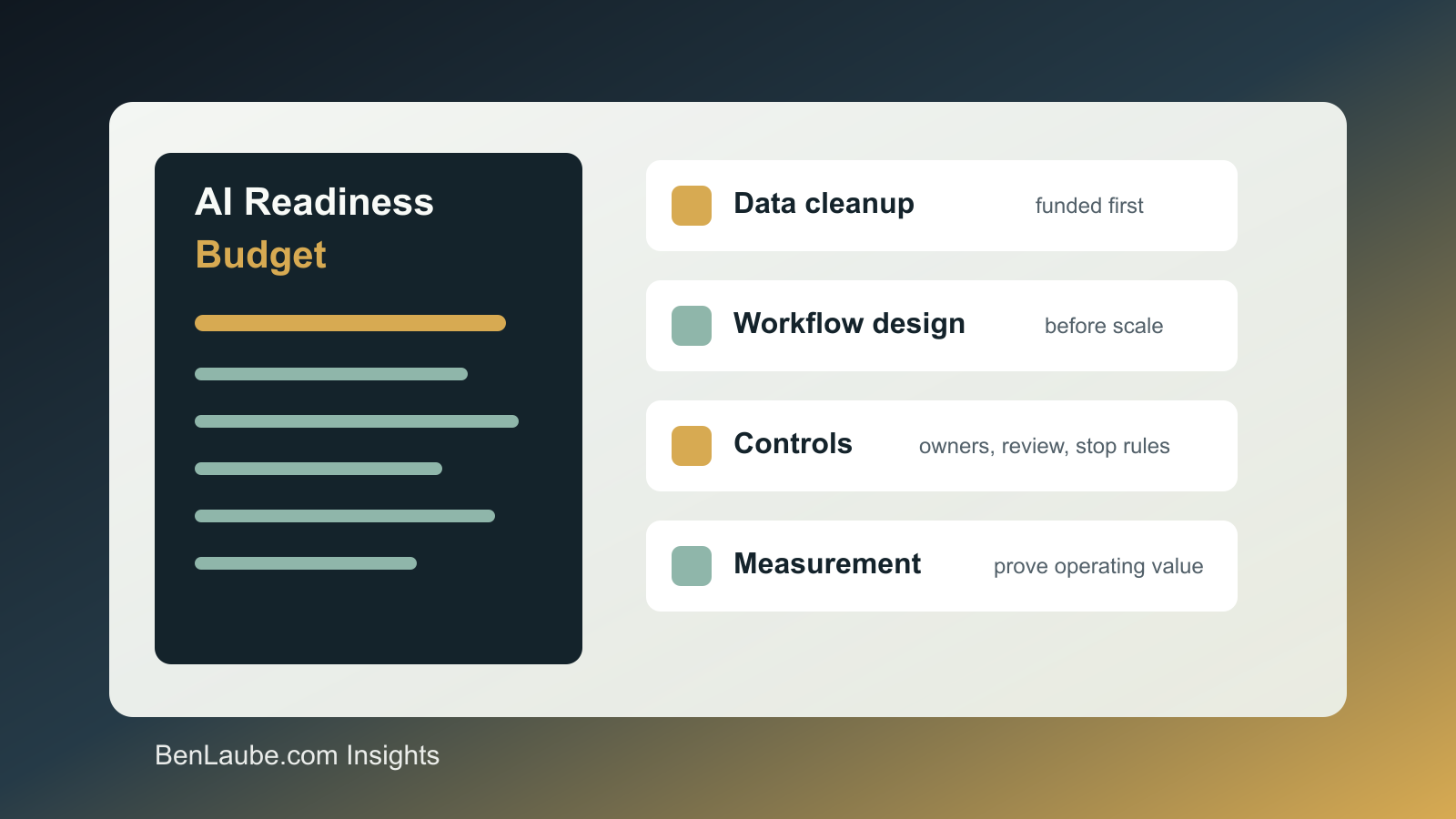
An AI readiness budget is not just the subscription cost for tools. It is the money and time set aside to make AI usable in production workflows. The first version can be simple, but it should cover five categories.
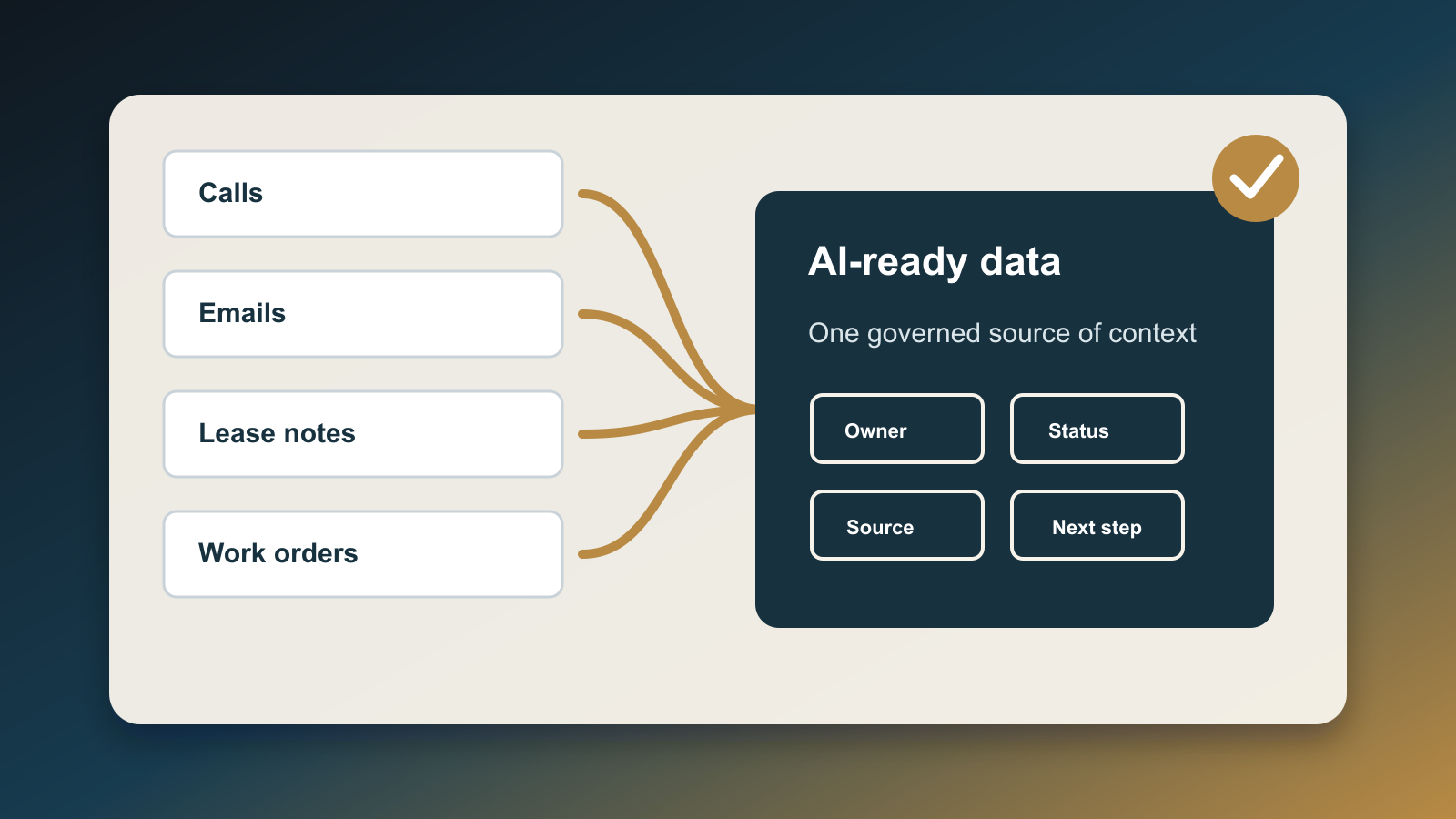
First, data readiness. This includes duplicate cleanup, field standardization, lead source discipline, contact permissions, pipeline stage definitions, property and transaction data hygiene, and basic reporting definitions. Salesforce's 2026 State of Sales research shows why this matters: 51% of sales leaders with AI said disconnected systems were slowing down AI initiatives, and 74% of sales professionals were focusing on data cleansing to maximize AI returns. Real estate teams feel the same pain when lead notes, showing feedback, lender updates, inspection items, and client preferences live in different tools.
Second, workflow redesign. AI does not create durable value when it is bolted onto a broken process. McKinsey's State of AI research found that organizations seeing impact are redesigning workflows, embedding AI into business processes, assigning governance, tracking KPIs, and building feedback loops. A real estate version is practical: define how a new lead moves from form fill to qualification, who reviews AI-drafted follow-up, where the approved note lands in the CRM, and what event proves the workflow worked.
Third, governance and review. Grant Thornton's 2026 AI Impact Survey calls this the AI proof gap: many organizations are scaling AI they cannot explain, measure, or defend. The firm reported that 78% of business executives lacked strong confidence they could pass an independent AI governance audit within 90 days. Real estate teams do not need enterprise bureaucracy, but they do need a way to answer basic questions: who owns the AI workflow, what data can it access, when does a human approve output, what happens when it fails, and how is the result measured?
Fourth, training. NAR's February 2026 RPR survey showed that AI is already in day-to-day real estate work, with 92% of surveyed agents using AI or planning to use it. The same survey found that accuracy was the top concern for 63% of respondents, followed by compliance or legal issues and misinterpretation of market data. That is a training signal. Teams need short, role-specific operating guidance, not generic prompt tips. Listing coordinators, inside sales reps, agents, marketers, and admins each need different rules for source checking, client-facing language, CRM updates, and escalation.
Fifth, measurement. Every funded AI workflow should connect to one operating metric. Not usage. Not prompts run. Not how many tools were activated. Use metrics such as response time, appointment set rate, stale lead recovery, duplicate reduction, listing preparation cycle time, review request completion, transaction milestone accuracy, or staff hours moved out of repetitive work.
Stop treating AI spend as miscellaneous software
The fastest way to lose control is to let AI purchases hide inside miscellaneous software spend.
That approach creates three problems. Nobody owns the total operating footprint. Nobody compares tool spend against workflow outcomes. Nobody funds the unglamorous readiness work because the budget was consumed by licenses.
A better structure is to separate AI spend into four buckets.
| Budget bucket | What belongs there |
|---|---|
| Tools | AI-enabled CRM, marketing, document, reporting, voice, and workflow products. |
| Data work | Cleanup, standardization, deduplication, migration, tagging, permissions, and reporting definitions. |
| Operating controls | Review rules, policy updates, audit logs, approval queues, incident response, and vendor risk checks. |
| Enablement | Training, SOP updates, adoption support, role-specific examples, and workflow measurement. |
This makes the tradeoff visible. If the team wants to buy another AI tool, it also has to ask whether the data, controls, and training budget can support the tool. If the answer is no, the tool stays in sandbox mode.
A practical readiness scorecard
The budget conversation gets easier when the team scores readiness before approving new automation. Use a 1 to 5 score for each category.
- Data quality: Are the fields, sources, statuses, and ownership rules clean enough for the AI to use?
- Workflow clarity: Can the team describe the process before and after AI enters it?
- Risk level: Can the workflow affect clients, compliance, money, contracts, ads, or public content?
- Human review: Is there a clear approval point before the workflow touches a client or system of record?
- Measurement: Is there a metric that will decide whether the workflow scales, changes, or stops?
- Owner: Is one person accountable for output quality and maintenance?
- Training: Does the affected role know how to use, challenge, and override the workflow?
Any workflow scoring low on data quality, owner, or human review should not get production budget yet. It can stay experimental. It can draft. It can summarize. It should not send messages, update records, change pipeline stages, publish content, or trigger client-facing actions.
Where real estate teams should fund first
Start with workflows where readiness work will pay back even if the AI tool changes later.
Lead intake is usually first. Clean source tracking, required fields, routing rules, response-time reporting, and lost-lead reasons help every sales process. AI can then help classify, draft, or summarize without guessing from messy inputs.
CRM hygiene is second. Duplicate contacts, stale stages, missing contact preferences, inconsistent tags, and unclear ownership all reduce the value of AI. Cleaning them improves follow-up, reporting, marketing, and client service whether or not a new agent is deployed.
Listing and marketing production is third. Brand facts, property facts, source photos, fair housing review, approval steps, and performance metrics matter more than the model. Once those inputs are organized, AI can speed up copy, ads, email, and social content without inventing unsupported claims.
Transaction coordination is fourth. Milestone definitions, responsibility owners, document locations, client update templates, and escalation rules create a structure AI can summarize and monitor. Without that structure, an AI assistant just becomes another place where partial information can drift.
Recruiting and training can come next. AI can help summarize calls, draft follow-ups, prepare onboarding paths, and answer SOP questions, but only if the team has current materials and clear review ownership.
The CFO-friendly argument
The budget case should not be framed as "AI transformation." That language is too broad to manage.
Frame it as operational risk and capacity. The business is already spending time on manual cleanup, repeated explanations, slow follow-up, inconsistent handoffs, and preventable rework. AI can reduce that load, but only when the supporting system is funded. Otherwise the team pays twice: once for the tool and again for the cleanup when outputs are wrong.
A useful budget proposal has four lines:
- The workflow being improved.
- The readiness work required before AI touches production.
- The operating metric that will prove value.
- The stop rule if the workflow does not improve.
For example: fund CRM source cleanup and lead routing rules before deploying an AI lead qualifier; measure median response time and appointment conversion; stop or redesign if the workflow increases bad assignments or unworked leads.
That is a decision a real operator can manage.
The real advantage
Real estate businesses do not need to outspend national platforms on AI. They need to make better local operating decisions.
The teams that win will not be the ones with the longest tool list. They will be the ones that budget for data cleanup, workflow redesign, review rules, training, and measurement before automation becomes invisible. That work is less glamorous than a demo, but it compounds.
AI readiness belongs in the budget because AI is no longer a lab experiment. It is becoming part of how leads are handled, clients are updated, listings are marketed, teams are trained, and operations are measured. When the budget only funds licenses, the business gets activity. When the budget funds readiness, the business gets control.
Sources

Written by
Ben Laube
AI Implementation Strategist & Real Estate Tech Expert
Ben Laube helps real estate professionals and businesses harness the power of AI to scale operations, increase productivity, and build intelligent systems. With deep expertise in AI implementation, automation, and real estate technology, Ben delivers practical strategies that drive measurable results.
View full profile