Give Customer-Facing AI a Promise Library
Customer-facing AI is moving from back-office helper to front-line representative. It writes listing copy, drafts follow-up, answers intake questions, qualifies leads, summarizes market context, and increasingly speaks inside chat, email, SMS, and voice workflows.
That shift creates a new operational problem: the AI is not just producing text. It is making promises.
A promise can be obvious, like a stated response time, refund policy, fee, showing window, service guarantee, or next step. It can also be subtle, like implying that a home value is reliable, that a pre-approval path is simple, that a listing strategy always works, or that a team can do something by a certain date. Once an AI assistant says it to a lead or client, the business owns the expectation.
The answer is not to ban customer-facing AI. The answer is to stop letting it improvise business promises. Every real estate team, local service business, or growth-focused operator using AI in client communication needs a promise library.
What a Promise Library Is
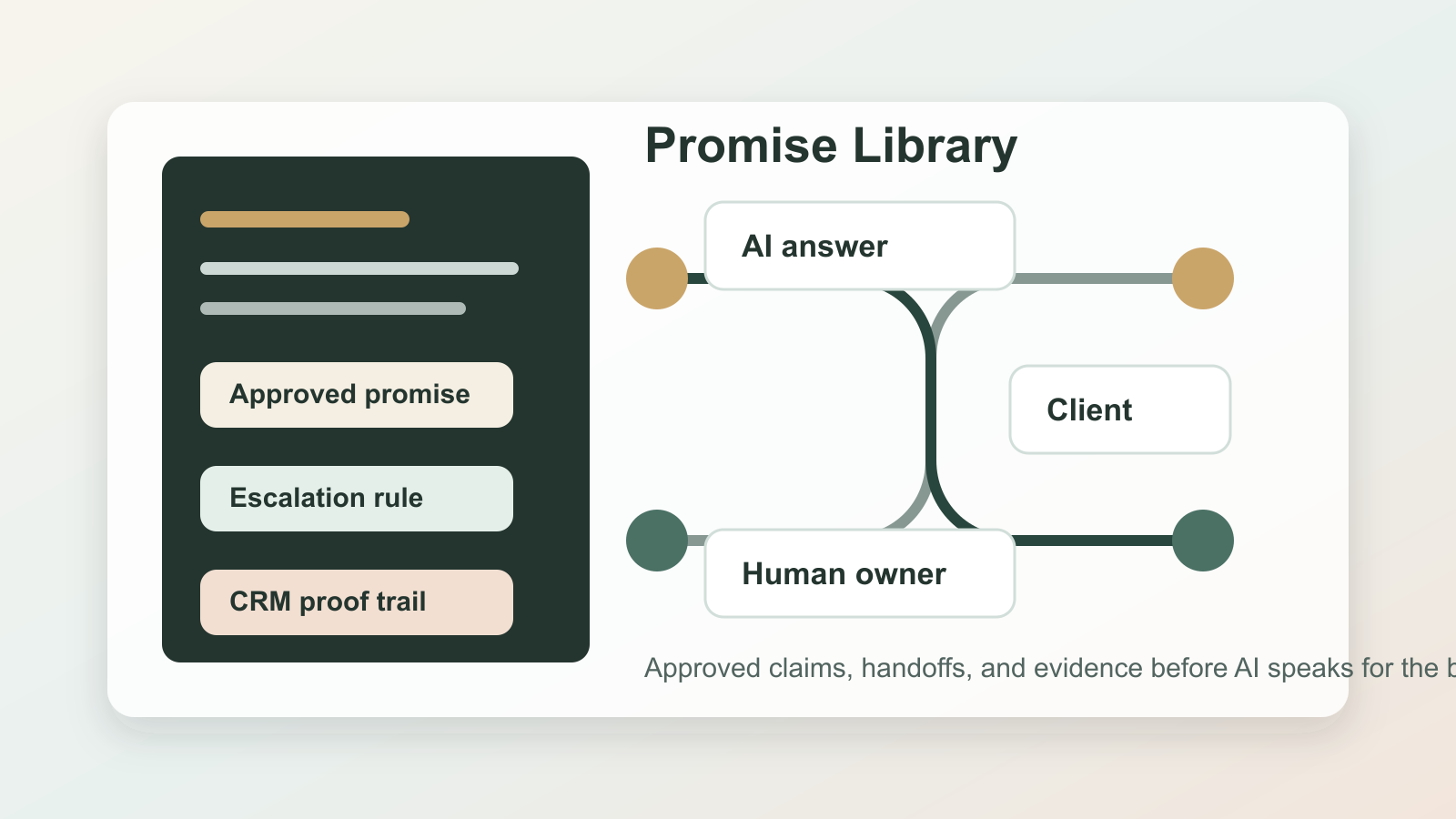
A promise library is a controlled source of truth for what automated systems are allowed to say about offers, timelines, service levels, pricing, guarantees, policies, handoffs, and escalation paths.
It is not a brand voice guide. It is not a generic knowledge base. It is the operational contract between your business and every AI surface that talks to the market.
The library should answer questions like:
- What can the assistant promise without human approval?
- What must it phrase as an estimate, not a guarantee?
- What claims need a citation, policy page, or approved script?
- What topics require escalation to a licensed professional, broker, manager, lender, attorney, or human support person?
- What follow-up window is actually backed by the team calendar?
- What offers are active, expired, market-specific, or conditional?
- What customer data may be used to personalize a response?
This matters because AI adoption is no longer the hard part. NAR's February 2026 RPR survey found that surveyed agents are already using or planning to use AI at high rates, but accuracy, compliance, market-data interpretation, and fair housing concerns remain prominent blockers. NAR's technology survey also shows why the pressure is real: agents adopt technology to save time and improve client experience, and CRM remains one of the top lead-generating technologies.
When AI plugs into those lead systems, weak promises become weak operations.
The Trust Gap Is Operational
Most AI conversations about trust focus on hallucinations. That is too narrow. In business workflows, the bigger trust issue is whether the system can represent the company accurately under pressure.
A chatbot that invents a feature is bad. A voice agent that schedules outside real availability is worse. A CRM assistant that tells a buyer, seller, tenant, or investor that a next step is guaranteed when it is only possible creates a service failure before a human has even entered the conversation.
Business.com's January 2026 Small Business AI Outlook reported fast AI investment among U.S. small businesses, but also a visible reputation concern among workers. That should be taken seriously. The practical risk is not that customers discover the company uses AI. The risk is that AI makes the company sound more certain, more available, or more capable than its actual operating system can support.
NAREIM's April 2026 Technology, Data & AI Survey points to the same gap from the institutional real estate side: tools have spread faster than data quality, governance readiness, technology budgeting, and talent readiness. The smaller operator version of that problem is simple. The team has a chatbot, automations, AI email drafts, and a CRM. It does not yet have one approved place where promises are defined.
The FTC Signal: Claims Need Proof
Customer-facing AI also changes the compliance posture of marketing claims. In March 2026, the FTC announced a settlement involving Air AI after alleging deceptive claims about business growth, earnings potential, refund guarantees, and the nature or performance of services. The lesson for operators is broader than one company: AI-enhanced sales and marketing claims still need substantiation.
A promise library gives teams a practical way to separate approved claims from risky improvisation.
For example, an AI assistant should not say:
- "We will sell your home in 30 days."
- "This automation will double your lead conversion."
- "You qualify for the best financing option."
- "Our valuation is accurate."
- "You can cancel anytime" if the actual agreement has conditions.
It can say approved versions:
- "We will review your pricing strategy and marketing plan with you before launch."
- "The next step is a human review of your lead sources and conversion data."
- "This estimate is a starting point, not an appraisal or lending decision."
- "Here is the cancellation policy that applies to this offer."
Those small wording differences are not cosmetic. They protect the business from overpromising and give customers a cleaner expectation.
Build the Library Around Decisions, Not Departments
The worst version of this system is a spreadsheet no one uses. The useful version is organized around moments where AI might create a binding expectation.
Start with five buckets.
First, service promises. Define response windows, coverage hours, booking rules, handoff timing, escalation thresholds, and what happens when the team is unavailable.
Second, offer promises. Capture active offers, eligibility rules, geography, expiration dates, included services, excluded services, and required disclaimers.
Third, market promises. Define how AI may describe pricing, demand, days on market, rent potential, renovation upside, mortgage affordability, and local trends. Require source links or human review where the answer depends on current market data.
Fourth, compliance promises. Define phrases that are prohibited or restricted around fair housing, financing, legal advice, tax advice, property condition, investment returns, and professional licensing boundaries.
Fifth, workflow promises. Map what the system is allowed to do after the conversation: create a CRM task, send a recap, book a consultation, assign a lead, trigger a campaign, or request documents.
This turns the library into a routing layer, not a static document. The AI can answer only when the matching promise is approved. If the promise is missing, outdated, or conditional, the system escalates.
Connect Promises to the CRM
A promise library becomes powerful when it is connected to customer records.
Every AI-assisted conversation should leave behind three fields in the CRM: promise made, proof source, and next owner. That creates a trail a human can trust.
For a real estate team, that might look like:
- Promise made: "Agent will review valuation assumptions before sending CMA."
- Proof source: "Seller intake workflow, version May 2026."
- Next owner: "Listing coordinator."
For a service business, it might be:
- Promise made: "Operations audit delivered within five business days after kickoff."
- Proof source: "Client onboarding policy."
- Next owner: "Implementation lead."
For a marketing system, it might be:
- Promise made: "Lead magnet download triggers one educational sequence, not sales outreach."
- Proof source: "Consent and nurture policy."
- Next owner: "Marketing operations."
That record turns AI from a loose communication tool into an accountable business system. It also helps managers inspect where promises are drifting from reality.
Assign an Owner and a Review Cadence
A promise library cannot be owned by the AI tool vendor. It belongs to the business.
Assign one operational owner for each bucket. Marketing owns offer language. Sales or brokerage leadership owns service commitments. Compliance owns restricted claims. Operations owns handoff timing. The CRM owner or automation lead owns the fields that capture the promise after it is made.
Then set a review cadence. High-risk promises should be reviewed monthly. Seasonal offers, market claims, and event-specific campaigns should expire automatically. Evergreen service promises should be tested against actual response-time data, not optimism.
The most useful review question is simple: did the AI promise anything the team could not fulfill?
If yes, fix one of three things. Tighten the allowed language, improve the workflow behind the promise, or remove the AI's permission to answer that topic.
The Practical Standard
Customer-facing AI is worth using when it makes the business faster and clearer. It is dangerous when it makes the business sound more organized than it is.
The promise library is the bridge. It lets AI answer quickly without inventing commitments. It lets marketing move faster without making unsupported claims. It lets sales and service teams inherit conversations with context instead of cleanup. It gives compliance and leadership a concrete artifact to inspect.
Before adding another chatbot, voice agent, or CRM assistant, write down the promises your business is willing to make in public. Then connect those promises to your workflows, evidence, and owners.
AI can help deliver a better client experience, but only after the business defines what it is allowed to promise.

Written by
Ben Laube
AI Implementation Strategist & Real Estate Tech Expert
Ben Laube helps real estate professionals and businesses harness the power of AI to scale operations, increase productivity, and build intelligent systems. With deep expertise in AI implementation, automation, and real estate technology, Ben delivers practical strategies that drive measurable results.
View full profile