Build a Contact Identity Queue Before AI Merges Your CRM
AI makes CRM cleanup feel deceptively easy. A tool finds two contacts with the same phone number, three leads with similar names, a spouse attached to the wrong household, or an old portal inquiry that looks like a duplicate. The automation offers to merge the records, enrich the profile, and move on.
That is useful only when the identity decision is correct. When it is wrong, the team does not just lose a clean database. It can send the wrong message, erase the original source, confuse consent history, hide an active opportunity, or make AI personalize from a blended record that never represented one real client.
That is why real estate teams should build a contact identity queue before AI merges CRM records, assigns household relationships, deduplicates imports, or enriches client profiles at scale.
The timing matters. Cotality's April 2026 AI in Housing research found that buyers increasingly expect AI somewhere in the transaction, but they want transparency, validated information, and human safeguards when decisions affect the homebuying process. The same pattern applies inside the CRM. Clients may accept faster service, but they will not forgive a team that confuses their identity, budget, relationship, consent, or transaction history.
AI adoption inside real estate is also no longer theoretical. NAR's February 2026 coverage of an RPR survey said most surveyed agents are using or planning to use AI, while accuracy and compliance remain top concerns. A contact identity queue turns those concerns into an operating control. It gives AI a narrow job: surface possible duplicate or related records, summarize evidence, and route uncertain merges to the right person.
The queue is not a cleanup spreadsheet
A cleanup spreadsheet is a one-time project. A contact identity queue is an always-on decision layer between every source that creates contacts and every automation that acts on them.
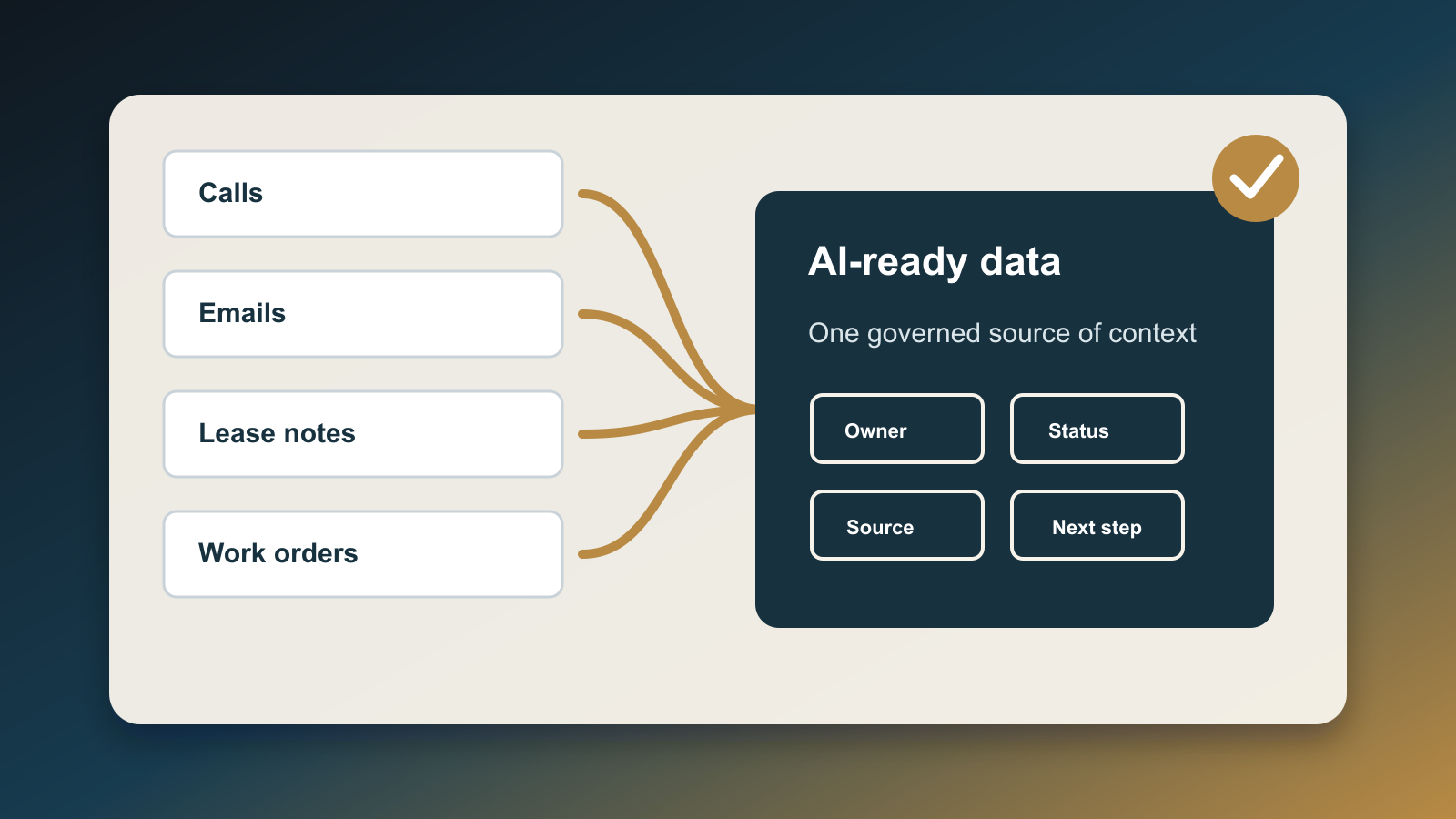
The queue should receive potential identity conflicts from web forms, open-house scans, portal leads, CSV imports, transaction platforms, email sync, phone systems, newsletter tools, showing software, and third-party enrichment. It should not wait for a quarterly database cleanup. By then, bad merges may already have touched live campaigns, AI follow-up, lead routing, and transaction work.
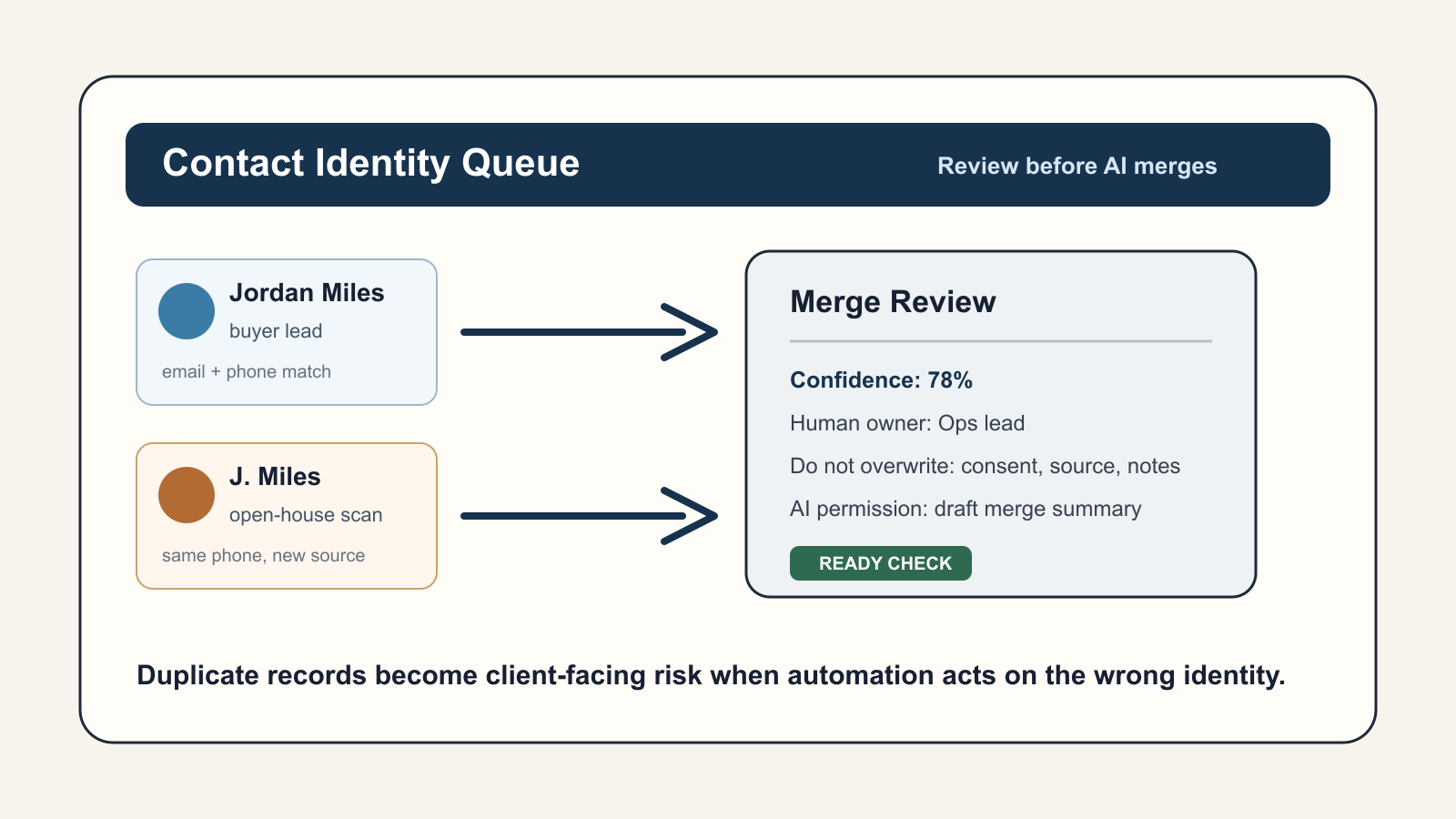
The queue exists to answer one question: should these records become one operational identity, remain separate, or be linked without merging?
That third option matters. In real estate, related people are often connected but not identical. Spouses, partners, co-buyers, adult children, trustees, investors, assistants, and referral sources can share phone numbers, addresses, email domains, or transaction context. A simple merge can destroy useful relationship data. The queue should let the team link records into a household, relationship, company, deal, or referral group without collapsing them into one person.
Start with identity evidence
Every possible merge needs an evidence bundle. Do not make the reviewer hunt through the CRM.
The bundle should show exact email match, phone match, normalized phone match, mailing address match, property address match, form source, lead source, campaign, last activity, assigned owner, active deal, transaction role, consent status, newsletter subscription, and notes from the most recent human interaction.
It should also show conflict signals. Conflicts include different first names, different household roles, different transaction stages, conflicting consent, different preferred channels, multiple active owners, separate referral sources, or one record marked as past client while another is a new anonymous lead.
HubSpot's current deduplication documentation is a useful reminder that CRM identity is more nuanced than name matching. HubSpot describes automatic deduplication around email addresses and company domains, manual deduplication using record IDs, and custom unique values for imports. The lesson for a real estate team is not to copy HubSpot's exact feature set. The lesson is to make the identity key explicit before records are allowed to merge.
Give AI a permission level
The most important field in the queue is AI permission.
Use four simple levels:
- Suggest only
- Draft merge summary
- Merge after human approval
- Auto-merge allowed
Most records should start at suggest only. AI can identify likely duplicates, explain why they were flagged, and show the fields that would be kept or overwritten. It should not merge anything that touches active clients, transaction records, consent status, household relationships, property notes, financial readiness, or legal deadlines without a human review rule.
Auto-merge should be reserved for narrow, boring cases. For example, two brand-new web form records with the same verified email, no conflicting owner, no active deal, no subscription conflict, and no notes may qualify. A portal inquiry that shares a phone number with a spouse, a seller, or an old referral source should not.
This is where AI helps most. It can reduce the review burden by grouping low-risk candidates, writing a short evidence summary, and identifying the exact fields that need human attention. It should not pretend that high confidence is the same thing as business safety.
Protect source and consent history
The queue must preserve source history. A record merge that keeps only the newest source can make marketing reports lie. A merge that keeps only the oldest source can hide renewed intent. A client who first arrived from a referral, then later registered at an open house, is not just a duplicate. That is a timeline.
Keep source events as a child table or timeline, not as one fragile field. Preserve original source, latest source, campaign, form, event, owner at capture, and timestamp. AI follow-up should be allowed to reference the latest context, but reporting should still show how the relationship began and how it reactivated.
Consent deserves the same treatment. The FTC's consumer privacy guidance emphasizes honoring privacy promises and being clear about data use. For a CRM merge queue, that means consent should never be guessed away during cleanup. If one record opted into newsletter emails and another opted out of SMS, the merged identity needs the strictest safe communication rule until a human resolves it.
A clean-looking record is not clean if it hides the permission trail.
Treat households as relationships, not duplicates
Real estate CRMs often fail at households because they try to make every person fit a lead-centric pipeline. AI can make that worse by treating shared addresses, last names, or phone numbers as duplicate proof.
The queue should support relationship types: spouse, partner, co-buyer, co-seller, investor entity, attorney, assistant, parent, adult child, referral source, landlord, tenant, trustee, and vendor. It should let a reviewer choose link, merge, split, or ignore.
That distinction changes client experience. If a husband asks about listing timing and a wife asks about school zones, merging notes into one generic contact may erase useful context. If a parent is helping an adult child buy, AI should not assume the parent is the buyer. If a trust owns the property, the trustee and beneficiary may need linked but distinct profiles.
The contact identity queue should make these relationship choices visible before AI writes messages, assigns leads, or scores opportunities.
Create a merge preview
Before approval, the queue should show a merge preview. The preview lists the surviving record, the records to be absorbed, fields that will be retained, fields that will be overwritten, relationship links that will be created, automation triggers that will fire, and campaigns that will pause.
This preview is not bureaucracy. It prevents silent damage.
For example, merging records may trigger a welcome sequence, change lead owner, update lifecycle stage, enroll a client in a past-client campaign, or remove a duplicate from a transaction checklist. Those downstream effects should be visible before the merge, especially if AI is about to act on the final profile.
The preview should also include a rollback note. If the merge creates a problem, the team needs to know what changed and how to reconstruct the prior state. At minimum, store the pre-merge IDs, key fields, source events, owner assignments, consent values, and relationship links.
Review cadence
Make the queue part of daily operations. A good cadence is simple:
- Review high-risk identity conflicts before new AI outreach runs.
- Approve low-risk merges in batches.
- Route household or relationship questions to the assigned advisor.
- Escalate consent conflicts to operations.
- Audit one random batch each week for false positives and missed duplicates.
Do not let the queue become a junk drawer. Every item should have status: new, needs owner review, needs consent review, approved to merge, linked but not merged, rejected, or archived.
Use aging rules. If a potential duplicate sits unresolved for seven days and either record is active, automation should treat both records as identity-risk records. That means no AI-generated personal outreach, no auto-assigned campaign, and no merge until the conflict is cleared.
The practical schema
Start with these fields:
- Candidate group ID
- Record IDs
- Contact names
- Email, phone, address, and property match status
- Active deal or transaction status
- Household or relationship hypothesis
- Source timeline
- Consent conflicts
- Owner conflicts
- AI confidence score
- AI evidence summary
- Risk level
- Recommended action
- AI permission level
- Human reviewer
- Decision and timestamp
- Rollback snapshot reference
This schema can live in a CRM custom object, an operations table, or a lightweight internal admin view. The platform matters less than the rule: AI cannot merge identities unless the queue says the merge is allowed.
The payoff
A contact identity queue will not make CRM hygiene glamorous. It will make AI safer to use.
The real win is not fewer duplicate records. It is fewer client-facing mistakes: no blended spouses, no lost referral attribution, no erased opt-outs, no confused transaction roles, no AI messages built from the wrong profile.
AI can help real estate teams clean records faster, but speed is not the goal. The goal is a CRM where each client identity has evidence, history, permission, and accountability. Build that queue first. Then let AI assist the merge instead of owning the decision.

Written by
Ben Laube
AI Implementation Strategist & Real Estate Tech Expert
Ben Laube helps real estate professionals and businesses harness the power of AI to scale operations, increase productivity, and build intelligent systems. With deep expertise in AI implementation, automation, and real estate technology, Ben delivers practical strategies that drive measurable results.
View full profile