Build a Consultation Commitment Board Before AI Fills Calendars
AI booking sounds harmless because it feels administrative. A buyer wants a consultation, a seller asks for a pricing call, a past client clicks a calendar link, and the system finds an open slot. The risk is that AI can make the calendar look full while the pipeline becomes less reliable.
A real estate team does not need more meetings. It needs more committed conversations with the right person, the right context, and a next step that still makes sense when the appointment starts. That is why teams should build a consultation commitment board before letting AI assistants book, confirm, reschedule, or recover meetings at scale.
This is not just a scheduling problem. Current market conditions make every live conversation more expensive. NAR's 2025 Profile shows first-time buyers at a record-low share of the market, more cash buyers, larger down payments, and continued reliance on agents for guidance. When qualified clients are harder to earn, a missed consultation is not a small calendar defect. It is a breakdown in the operating system that converts intent into advisory work.
AI also raises the stakes because adoption is already here. NAR's 2025 Technology Survey found agents using AI-generated content and other digital tools while clients generally respond positively to technology in the transaction. RPR's 2026 AI survey, covered by NAR, found that most surveyed agents are using or planning to use AI, but accuracy and compliance remain major concerns. The lesson is simple: automation can help, but it needs a visible control layer before it touches client-facing commitments.
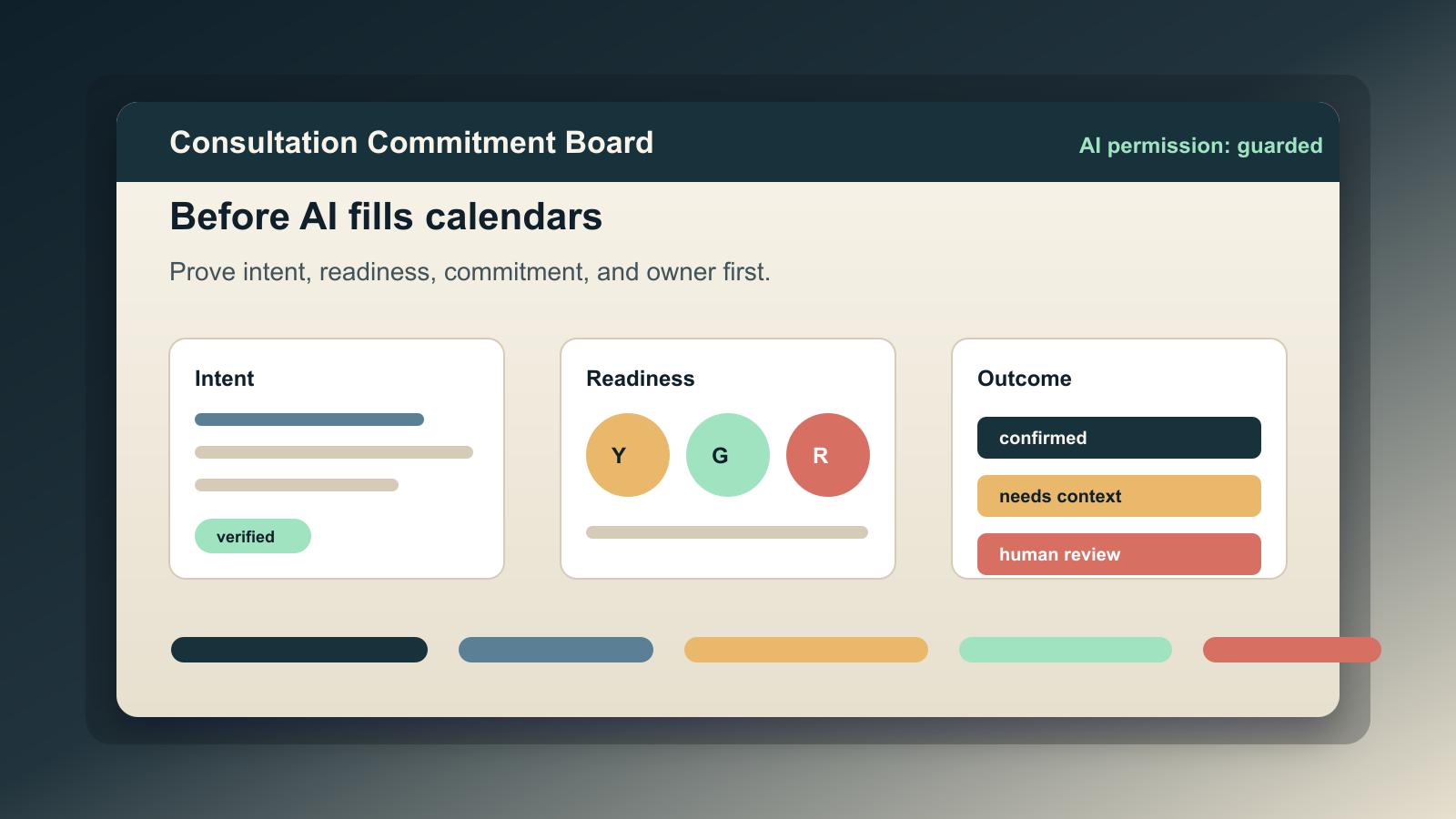
A consultation commitment board is that control layer. It is a CRM view or lightweight table that sits between lead capture, scheduling software, calendar events, and human advisors. Its job is to answer one question before AI fills another slot: is this meeting still worth confirming, and what evidence proves it?
The board should start with meeting intent
Every booked consultation needs an intent label that is more specific than buyer call, seller call, or follow-up. A good board separates first-contact qualification, buyer strategy, listing timing, relocation planning, pricing review, investment analysis, referral handoff, post-close service, and urgent transaction support.
The label matters because the confirmation logic changes by intent. A first-contact buyer consultation may need preapproval status, representation status, search area, and timeline. A seller pricing call may need property address, ownership situation, target move date, and whether a valuation has already been requested. A post-close service call may need the original transaction record, preferred communication channel, and consent boundary.
AI should not infer all of that from scattered notes. It should read a structured intent field, ask for missing inputs, and stop when the meeting type is too ambiguous.
Add readiness, not just availability
Calendars only show time. They do not show whether the client is ready, whether the advisor is prepared, or whether the meeting has enough context to produce a useful result.
The board should include a readiness score with a short evidence trail. For a buyer, readiness might include financing confidence, preferred area, decision timeframe, tour availability, and whether they understand the current market. For a seller, it might include address verified, property condition known, equity or payoff estimate requested, motivation documented, and decision makers identified.
Keep the score operational. A simple red, yellow, green status is enough if each status has rules. Green means AI can confirm and send the prep note. Yellow means AI can request missing context or offer a softer exploratory call. Red means the meeting needs human review, rescheduling, or disqualification.
This protects the team from a common automation failure: booking polished appointments that start with missing basics.
Track commitment signals before confirmation
A booked time is not the same as commitment. Teams should track the signals that make attendance and usefulness more likely.
Useful fields include source, last human touch, last client reply, reply quality, confirmed channel, required attendees, calendar invite accepted, reminder status, reschedule history, and whether the client completed a short pre-meeting form. If a lead books from a high-intent referral, replies to the confirmation, and completes the intake form, AI can confidently keep the appointment moving. If a lead books from a cold ad, never replies, skips the form, and has already rescheduled twice, AI should not blindly treat that slot as equal.
Calendly's March 2026 no-show documentation is a useful signal for how modern scheduling systems are evolving: no-show status can be marked after a meeting and included in exports, and workflows can target no-shows for rebooking. That matters because attendance history should become CRM data, not a private memory inside a scheduling tool.
The commitment board should pull those signals into the same place where advisors decide what deserves attention.
Make AI earn the right to confirm
Once the board exists, AI can help with confirmations. The mistake is letting it confirm every meeting the same way.
Give AI a confirmation policy. For green meetings, it can send a concise confirmation with date, time, location or video link, purpose, materials to bring, and the next step. For yellow meetings, it should ask one or two missing-context questions before sending a full confirmation. For red meetings, it should create a task for a human, not send a confident message.
The content should also change by intent. A buyer strategy call should not receive the same prep language as a seller valuation call. A post-close service call should not sound like a new-lead sales sequence. AI can personalize quickly, but only after the board tells it what promise it is allowed to make.
This is where many teams over-automate. They use AI to make confirmations sound warmer while the underlying workflow stays weak. Better wording does not fix unclear intent, stale CRM data, or a missing handoff.
Treat no-shows as diagnosis, not annoyance
No-shows should create structured learning. The board should capture whether the meeting was missed, canceled, rescheduled, attended late, attended by the wrong person, or completed but unproductive. Each outcome should have a reason code when known.
The reason codes do not need to be complex. Start with not ready, wrong service, timing changed, financing unclear, spouse or decision maker missing, duplicate booking, bad contact info, lead quality low, advisor unavailable, and unknown. Over time, this shows whether the team has a marketing problem, a qualification problem, a reminder problem, or a scheduling-capacity problem.
AI can help recover missed meetings, but it should not recover every no-show with the same cheerful rebooking link. A first missed appointment from a referred seller deserves a different response than a third missed consultation from an unresponsive portal lead. The board should decide which recovery playbook is allowed.
Protect advisor focus
Microsoft's 2025 Work Trend Index described a workplace where communication sprawl and last-minute meetings fragment attention. Real estate teams feel the same problem in a client-facing form: scattered texts, lead alerts, calendar links, voicemail, portal inquiries, and transaction deadlines all compete for the same advisor hours.
If AI simply books more appointments into that chaos, it accelerates the wrong thing. The commitment board should protect focus by adding daily meeting limits, prep buffers, owner assignment, and capacity rules. If the best listing advisor already has three high-stakes calls, AI should not add a vague consultation into the next open slot just because the calendar technically permits it.
Capacity rules are especially important for teams. The board should know which advisor owns which client type, when a handoff is required, and when a lower-intent meeting should move to a group webinar, buyer education room, or async intake instead of a live consultation.
A practical board schema
Start with these fields:
- Contact and household ID
- Meeting intent
- Source and campaign
- Assigned advisor
- Meeting date, time, and channel
- Readiness status
- Missing context
- Commitment signals
- Reminder plan
- Required attendees
- AI permission level
- No-show or outcome status
- Recovery playbook
- Next human owner
The AI permission level is the most important field. Use four options: draft only, ask for missing context, confirm automatically, and stop for human review. That one field turns the board from a reporting view into an operating control.
The operating cadence
A consultation commitment board should be reviewed twice a day by the person responsible for lead conversion or client experience. The morning review protects the day's calendar. The afternoon review handles tomorrow's yellow and red meetings before reminders go out.
The review should answer five questions:
- Which meetings are confirmed and ready?
- Which meetings need missing context before AI sends reminders?
- Which meetings should be rescheduled or downgraded to async intake?
- Which no-shows need human recovery?
- Which source or workflow is creating low-commitment bookings?
That cadence gives AI clear work. It can draft confirmations, ask targeted questions, summarize prep notes, update the CRM after attendance is marked, and recommend recovery language. It should not decide, on its own, that every open slot deserves a client conversation.
The payoff
The goal is not fewer appointments. The goal is fewer fake appointments: meetings that looked booked but were not ready, not attended, not owned, or not useful.
A consultation commitment board helps real estate teams use AI where it belongs. AI can reduce scheduling friction, personalize reminders, organize context, and recover missed opportunities. Humans still own judgment: which conversations matter, what promise the team is making, and when a client needs an advisor instead of another automated message.
That is the practical pattern for AI in real estate operations. Put the commitment layer in place first. Then let AI fill calendars with meetings the business can actually serve.

Written by
Ben Laube
AI Implementation Strategist & Real Estate Tech Expert
Ben Laube helps real estate professionals and businesses harness the power of AI to scale operations, increase productivity, and build intelligent systems. With deep expertise in AI implementation, automation, and real estate technology, Ben delivers practical strategies that drive measurable results.
View full profile