First-Party Data Is the AI Marketing Advantage
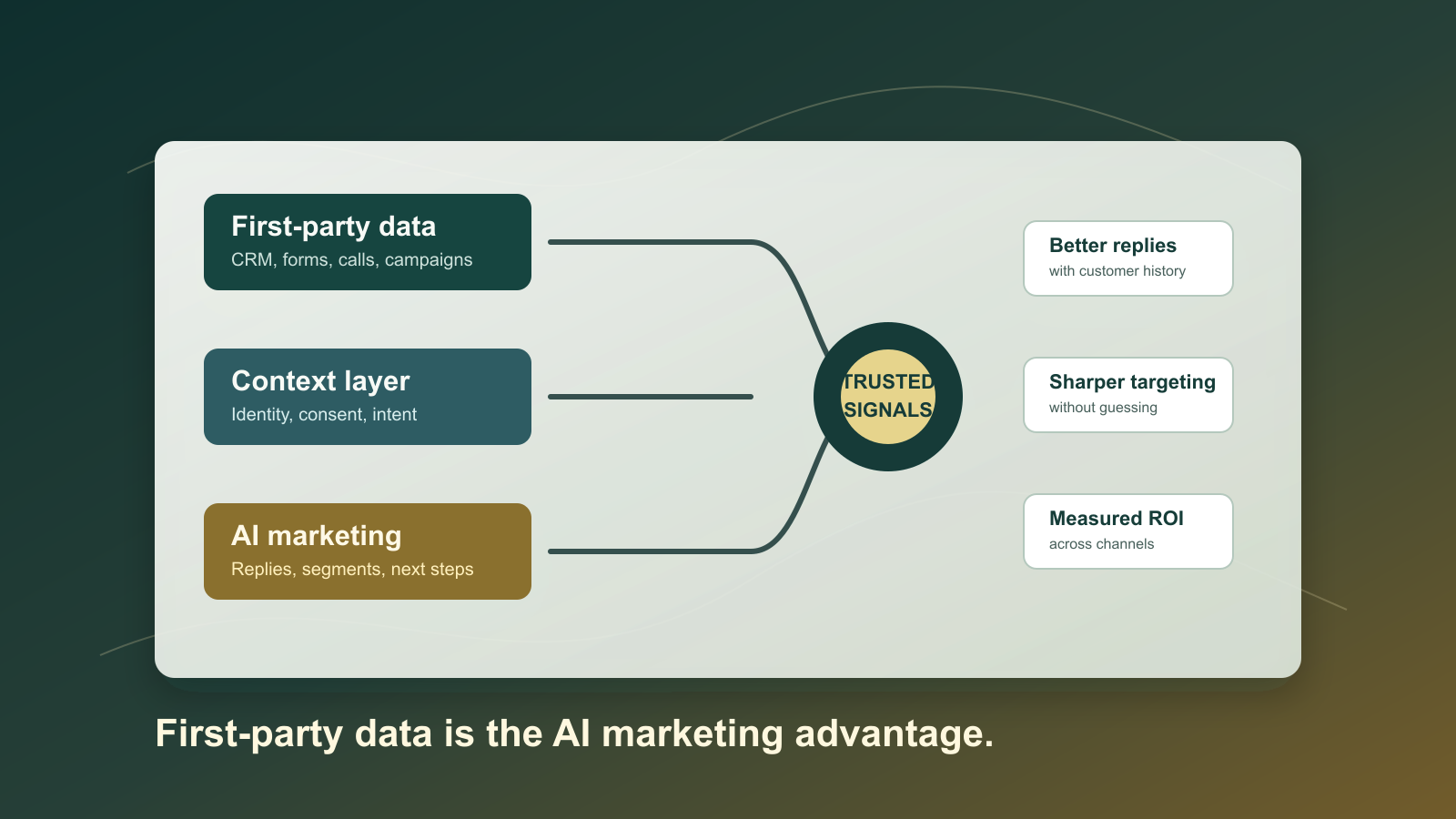
AI marketing is no longer scarce. Every brokerage, solo agent, and local service business can open a generative tool, ask for a campaign, and publish something by lunch. That access changes the competitive question. The advantage is not who can generate more copy. The advantage is who can give the system better customer context, cleaner permission, and a clearer map of what happened after the message went out.
Salesforce's February 2026 State of Marketing coverage makes the gap plain: marketers have broadly adopted AI, but many are still using it to send generic one-way campaigns. Salesforce reported that 75% of marketers had adopted AI, 84% still admitted to generic campaigns, and 69% struggled to respond promptly because they could not access the context they needed. The same research points to usable data as the constraint: marketers with unified customer data were more likely to respond regularly and more likely to use AI agents to scale their work.
That should sound familiar to real estate teams. The average operation already has enough tools: CRM, IDX leads, call tracking, text messages, email campaigns, social ads, showing notes, transaction milestones, and review requests. The problem is that those systems rarely agree on the same version of the customer. AI can make that problem louder. It can draft faster, segment faster, and reply faster, but it cannot reliably personalize a conversation when the underlying record is incomplete, stale, or split across five systems.
Why this matters now
The marketing channel mix is getting harder to read. IAB's February 2026 State of Data report describes measurement systems under pressure from privacy regulation, signal loss, platform optimization, and fragmented data environments. At the same time, AI is raising expectations for faster decisions and more automated measurement. Experian's 2026 State of Advertising material makes a related point: first-party data is expanding across CRM systems, social platforms, retail media, and owned media, creating short-term fragmentation before better connected infrastructure emerges.
For a real estate team, that means the old habit of treating the CRM as a contact list is too weak. The CRM has to become an operating record: who asked what, which channel they came from, what consent they gave, what property or neighborhood they cared about, what happened after the handoff, and which messages moved the relationship forward. Without that record, AI marketing turns into high-volume guessing.
NAR's 2025 technology coverage shows why this is practical, not abstract. In the 2025 REALTORS Technology Survey coverage, social media was the top lead-generating tool cited by agents at 39%, while CRM was next at 23%. NAR also noted that one in five agents reported using AI daily and another 22% weekly. Those numbers point to the real bottleneck: agents are already using digital channels and AI, but the lead source, relationship history, and next action often live in separate places.
First-party data is not just an email list
First-party data is the information a business earns directly through its own relationships. In a real estate operation, that includes form fills, valuation requests, saved searches, showing feedback, call outcomes, listing inquiries, event registrations, newsletter clicks, buyer agreements, seller timelines, preferred neighborhoods, budget ranges, and explicit communication preferences.
The word "earned" matters. Bought lists and scraped audiences may produce activity, but they do not give an AI system the relationship context needed to respond well. A buyer who downloaded a relocation guide, asked about school zones, opened three emails about inventory, and texted after a price reduction is not the same as a cold lead with only a name and email. A seller who attended a home-value webinar and has a leaseback constraint needs different outreach than a seller who clicked a generic ad.
The more specific the context, the less the AI has to invent. That is the core operating advantage. HubSpot's April 2026 Spring Spotlight framed its product direction around "Growth Context," arguing that AI works better when it knows the business. Its examples are instructive: AEO, prospecting, deal progression, and customer support all depend on CRM history, website analytics, customer records, pipeline definitions, and team workflow context. The same logic applies to a real estate team even if it is not using HubSpot. AI needs the business record, not just a prompt.
Build the data layer before the agent layer
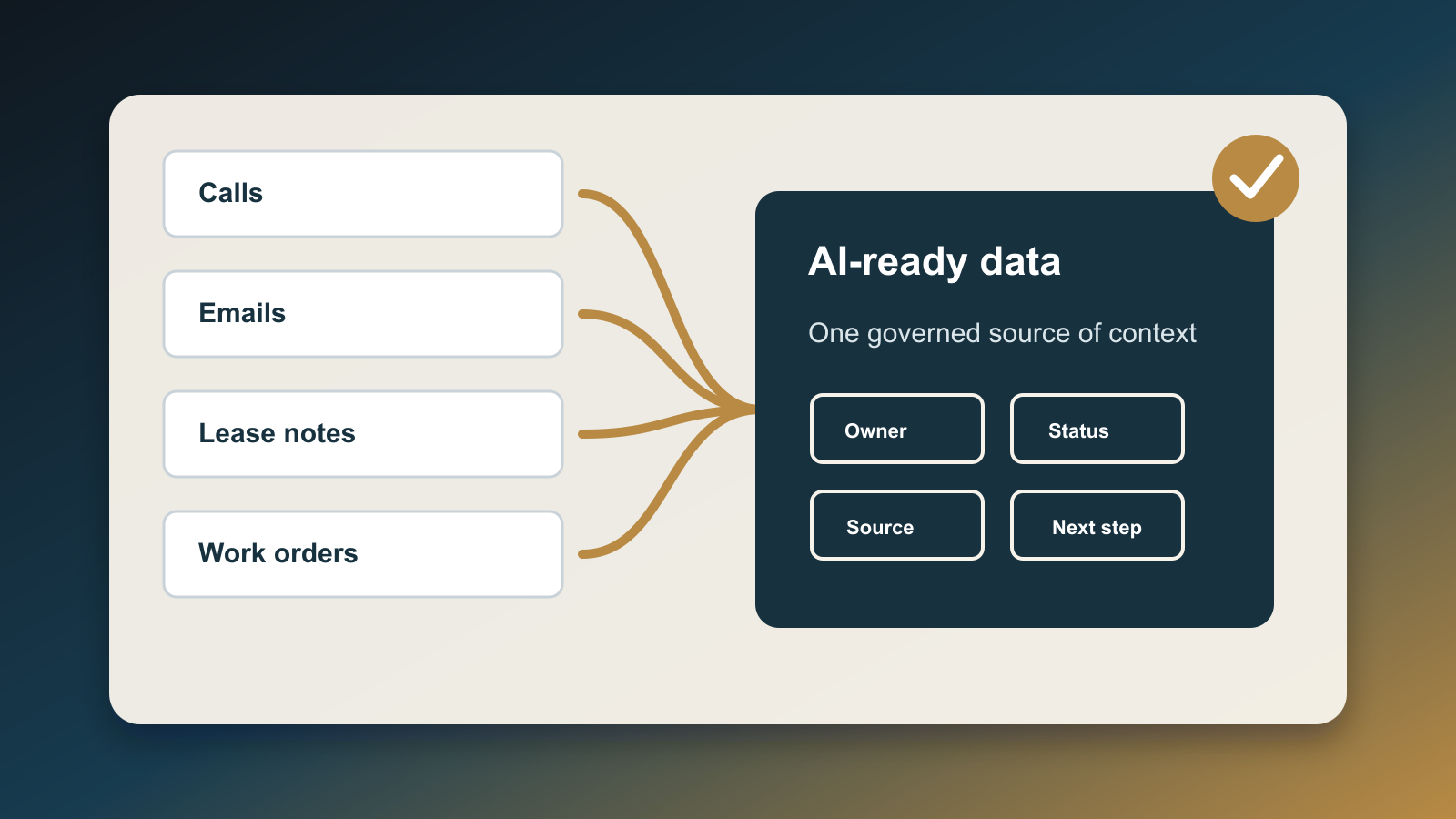
The practical move is to define a first-party data layer before adding more AI automations. That layer does not need to be complicated. It needs to answer six questions consistently.
First, where did the relationship start? Every contact should have an original source and a latest meaningful source. "Facebook" is not enough. Capture the campaign, offer, landing page, neighborhood, and intent signal when available.
Second, what permission exists? Store the communication channels the person opted into, the consent timestamp, and any suppression state. AI should not need to guess whether it is allowed to text, email, call, or retarget.
Third, what is the current intent? A lead can move from browsing to active search, from active search to under contract, or from seller curiosity to listing appointment. The CRM should expose that stage as a field the automation can read.
Fourth, what does the team know that would change the message? Timeline, location, price band, financing status, home-to-sell status, family constraints, investor criteria, and agent assignment are not trivia. They are the difference between relevant automation and obvious automation.
Fifth, what happened after outreach? The system should log replies, appointments, missed calls, unsubscribes, booked consults, signed agreements, accepted offers, and closed transactions. Without outcome data, AI cannot learn which campaigns actually create business value.
Sixth, who owns the next action? AI can recommend, draft, and route, but a live business still needs accountability. Store the owner, due date, escalation rule, and completion proof.
What to automate first
Once those fields are reliable, the first AI automations should be narrow. Start with enrichment and routing before fully autonomous outreach. For example: classify new leads by intent, summarize the last five touchpoints before an agent calls, recommend the next best question for a buyer, identify stale seller leads with renewed engagement, or draft a follow-up that uses only approved CRM facts.
The rule is simple: if the automation cannot cite which first-party fields it used, it is not ready for unattended execution. That standard protects the brand and improves output quality. It also makes debugging possible. When a message is wrong, the team can see whether the issue came from bad source data, missing context, an outdated rule, or the model's interpretation.
Marketing teams should also stop measuring AI by content volume. Measure whether first-party data made the campaign more useful. Useful metrics include response rate by intent stage, appointment rate by source, speed to first qualified reply, percentage of AI drafts edited by agents, duplicate-contact merge rate, unsubscribes by segment, and closed revenue influenced by owned channels. These are operating metrics, not vanity metrics.
The real estate implementation path
A realistic 30-day implementation starts with an audit. Export the last 90 days of leads and identify the fields that are empty, inconsistent, duplicated, or trapped outside the CRM. Then pick one high-value journey: buyer inquiry to consult, seller valuation request to appointment, past client to referral, or open-house visitor to nurture. Do not attempt to repair every workflow at once.
Next, define the minimum viable customer record for that journey. For a seller valuation workflow, that might include property address, ownership intent, timeline, estimated equity range, source campaign, communication preference, assigned agent, last touch, next action, and appointment status. For a buyer workflow, it might include price range, target location, financing status, home-to-sell status, saved-search behavior, showing requests, assigned agent, and next action.
Then connect the systems that create those fields. Forms, call tracking, landing pages, ad platforms, email tools, and CRM automations should write to the same record or to a staging table that can be reviewed and merged. The goal is not a perfect warehouse. The goal is a dependable operational record that an AI assistant can read without making up context.
Finally, add the AI layer as a supervised worker. Let it draft, summarize, classify, and recommend. Require a human approval step for external communication until the data is stable and the team trusts the exception handling. Over time, high-confidence tasks can move from draft mode to auto-send mode, but only after the measurement shows fewer errors and better outcomes.
The bottom line
The next phase of AI marketing will punish teams that confuse content production with customer understanding. Models are becoming widely available. Templates are easy to copy. Generic campaigns are getting cheaper by the week. The hard part is building a clean, consent-aware, outcome-connected first-party data system that tells the AI what is actually true about the relationship.
For real estate operators, this is good news. Most competitors will keep buying tools. The better move is to make the CRM more useful, connect the signals already being generated, and give AI a narrower job with better context. First-party data will not make every campaign perfect, but it will make every automation less generic, more measurable, and easier to trust.

Written by
Ben Laube
AI Implementation Strategist & Real Estate Tech Expert
Ben Laube helps real estate professionals and businesses harness the power of AI to scale operations, increase productivity, and build intelligent systems. With deep expertise in AI implementation, automation, and real estate technology, Ben delivers practical strategies that drive measurable results.
View full profile