Build a Title Defect Evidence Queue Before AI Explains Closing Delays
AI is useful for turning status notes into client-ready language. It is not a substitute for knowing whether a title issue is real, resolved, unresolved, lender-sensitive, or simply waiting on recording evidence. Before a real estate team lets AI draft explanations about closing delays, title work, liens, deed corrections, or seller payoff items, it needs a title defect evidence queue.
The reason is operational, not theoretical. NAR's 2025 technology survey found broad adoption of real estate technology, including eSignature, social media, drone media, and AI-generated content. That means clients increasingly expect quick, polished updates. But title problems are not marketing copy. CFPB guidance explains that title service fees include the title search and lender's title insurance, and that claims can arise from unpaid taxes or unpaid contractors. The same agency's owner's title insurance guidance explains that the deed transfers legal ownership and that title insurance can protect against pre-purchase claims against the home.
When AI summarizes this kind of issue without a controlled evidence layer, it can make the team sound certain before the title company, attorney, lender, or settlement agent has actually cleared the item. That creates three practical risks. First, the client may hear a delay as solved when only a request has been sent. Second, the buyer, seller, lender, and title company may each be operating from different versions of the same fact. Third, the team may lose the audit trail showing who verified the payoff, release, deed correction, survey exception, or recording update.
The fix is not to keep AI away from transaction communication. The fix is to make the evidence state machine explicit before AI writes anything outward-facing.
What belongs in the queue
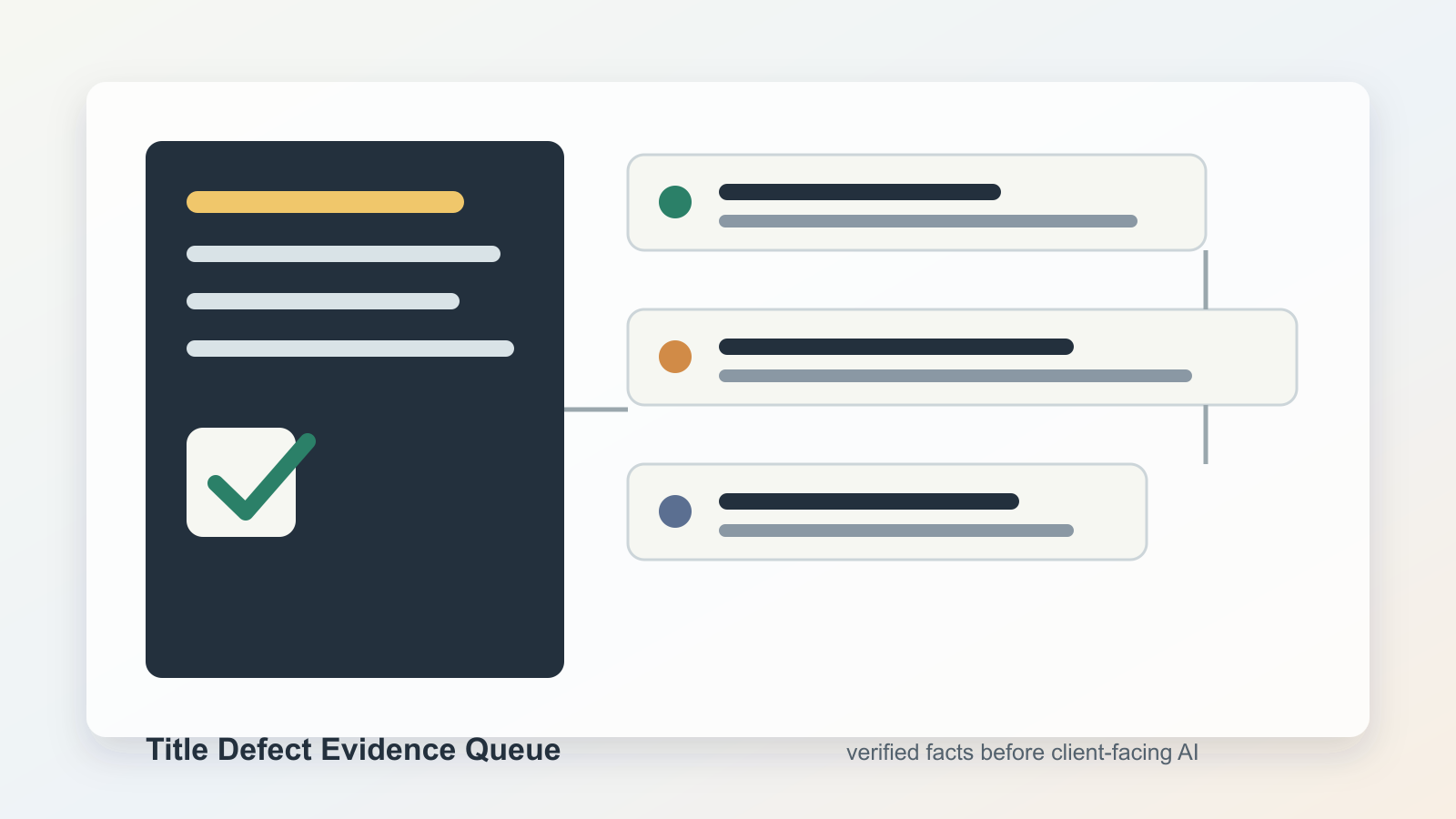
A title defect evidence queue is a small operations board that sits between transaction coordination notes and client communication. Each row represents one title-sensitive issue, not one message. The row should include the property, transaction side, defect type, source document, current owner, required evidence, responsible party, lender sensitivity, client-safe explanation, next review time, and final clearance artifact.
The defect type should stay concrete. Use categories such as unpaid tax, unreleased mortgage, contractor lien, judgment lien, HOA or municipal balance, deed name mismatch, missing signature authority, recording error, survey exception, easement question, probate or heirship question, or redemption-period concern. Fannie Mae's selling guide treats some title impediments as unacceptable and distinguishes minor impediments that do not materially affect marketability. A practical team does not need AI to interpret every lending rule; it needs the queue to flag when a title condition is lender-sensitive and must remain with the title, legal, or lending professional before client-facing language goes out.
The source document matters. A Slack note saying "title has an issue" is not enough. The row should point to the title commitment, preliminary report, payoff statement, municipal search, judgment search, survey, deed, estate document, association ledger, or closing disclosure section that raised the issue. If the team cannot name the source, the AI should not be allowed to draft a confident explanation.
The required evidence field is where the queue becomes useful. For an unreleased mortgage, the evidence may be a payoff letter, wire confirmation, release request, recorded satisfaction, or title company's clearance note. For unpaid taxes, it may be a tax bill, payoff amount, escrow instruction, paid receipt, or updated municipal record. For a deed issue, it may be a corrected deed, affidavit, power of attorney, entity authorization, or attorney approval. The AI can help turn these fields into plain English only after the status is precise.
Use statuses that prevent overstatement
Most transaction updates fail because their statuses are too vague. "Waiting on title" is true but not useful. "Issue cleared" may be premature. A better queue uses statuses that directly control what AI is allowed to say.
Start with "identified." This means the title or settlement process surfaced an issue, but the team has not yet assigned the required cure evidence. AI can say that a title item is under review, but it should not describe cause, cost, or timing beyond the verified source.
Move to "evidence requested." This means the responsible party has been asked for a specific document, payoff, release, correction, or approval. AI can summarize the request and the next expected checkpoint, but it should avoid implying that the document will satisfy the requirement.
Use "evidence received" only when the actual artifact is attached or linked. AI can say the team received the requested item and that it is being reviewed by the appropriate party. It should still avoid saying the problem is cleared.
Use "accepted by title" or "accepted by lender" only when the party with authority has confirmed acceptance. This is the first point where AI can explain that the item has been accepted for closing purposes, while still distinguishing title acceptance from final recording or final closing.
Use "recorded" or "closed out" only when the final artifact exists. The final artifact might be a recorded release, a revised commitment, a final title clearance note, a paid receipt, a closing package entry, or another record the team can retrieve later.
These statuses turn AI from a guesser into a formatter. The system does not ask the model to infer whether a title problem is resolved. It gives the model a verified status and a client-safe language boundary.
Separate internal facts from client language
The queue should hold two versions of every issue: the internal fact pattern and the client-safe explanation.
The internal fact pattern can be specific: "Title commitment shows prior mortgage release missing from county record; title has requested satisfaction from prior lender; seller side contacted servicer on May 6." The client-safe explanation should be calmer and narrower: "The title team is reviewing a prior-recording item and has requested the document needed to confirm clearance. We will update you after title reviews the response."
That distinction matters because title work often involves legal ownership, liens, taxes, payoff instructions, lender requirements, and settlement timing. AI-generated language can be polished enough to sound authoritative even when the team only has partial information. NIST's AI Risk Management Framework emphasizes managing AI risks through design, deployment, use, and evaluation practices. For a real estate operation, that means the communication workflow should decide what facts are eligible for model output before the model writes a sentence.
A useful prompt is short because the queue does the heavy lifting:
Draft a client update using only the approved client-safe explanation, current status, next checkpoint, and responsible party. Do not infer legal conclusions, payoff amounts, closing dates, title clearance, or lender approval unless those fields are marked accepted.
That prompt is not magic. It works because the queue constrains the inputs.
Design the queue around handoffs
Title defects usually cross team boundaries. The agent may learn about the issue first, the transaction coordinator may track the documents, the title company may control the commitment, the lender may control mortgage eligibility, and an attorney may control legal interpretation. A queue that only tracks "who owes what" misses the key operating question: who has authority to clear the item?
Add an authority field with values such as title company, closing attorney, lender, seller side, buyer side, municipality, association, prior lienholder, court, or county recorder. Add a "cannot say before authority review" checkbox for sensitive items. AI should treat that checkbox as a hard stop for certainty language.
Also add a "closing impact" field, but keep it conservative: unknown, no current impact, possible impact, confirmed impact, or cleared. Avoid letting a model convert possible impact into a predicted delay. If a closing date moves, the queue should point to the human decision or official notice that changed it.
Finally, add an audit field for every outgoing message: drafted by, reviewed by, sent by, channel, timestamp, and source row. If a client later asks why they were told something, the team can reconstruct the evidence that existed at the time.
The minimum viable workflow
Start with a shared board or CRM object. Do not begin with a complex integration. A title defect evidence queue needs five operating rules before it needs automation.
First, no client-facing AI title update can be sent unless the issue has a queue row. Second, every row needs a source document or named source authority. Third, every row needs one current status from the approved status list. Fourth, only accepted or closed-out statuses can use clearance language. Fifth, every sent message links back to the source row.
Once those rules are in place, automation can help. AI can convert title-company emails into draft row updates, identify missing evidence fields, produce plain-English client updates from approved facts, and generate a daily internal risk digest. The human still controls acceptance, escalation, and legal-sensitive language.
This is the practical line for real estate AI implementation: let the model speed up the language, not invent the clearance. A title defect evidence queue makes that line visible. It gives agents a faster way to communicate without asking software to decide whether a lien, recording error, tax item, deed issue, or survey exception is safe to explain as resolved.
The best outcome is not a more impressive AI message. It is a calmer transaction. Buyers and sellers hear what is known, what is being requested, who owns the next step, and when the next checkpoint will happen. The team keeps the evidence trail. The title and lending professionals keep authority over clearance. AI stays in the role where it is useful: translating verified operations into clear communication.

Written by
Ben Laube
AI Implementation Strategist & Real Estate Tech Expert
Ben Laube helps real estate professionals and businesses harness the power of AI to scale operations, increase productivity, and build intelligent systems. With deep expertise in AI implementation, automation, and real estate technology, Ben delivers practical strategies that drive measurable results.
View full profile