Build a Property Tax Appeal Desk Before AI Advises Homeowners
Property-tax questions are exactly the kind of work that makes AI look useful before the workflow is ready.
A homeowner receives an assessment notice, a tax bill, or an escrow analysis showing a higher monthly payment. They ask the team, "Can I appeal this?" An AI assistant can summarize the notice, explain the vocabulary, draft a checklist, and pull comparable sales. That feels helpful. It can also cross a line quickly if it recommends an appeal without knowing the local filing window, the legal basis for the challenge, the evidence standard, or whether the issue is really an escrow explanation rather than an assessment problem.
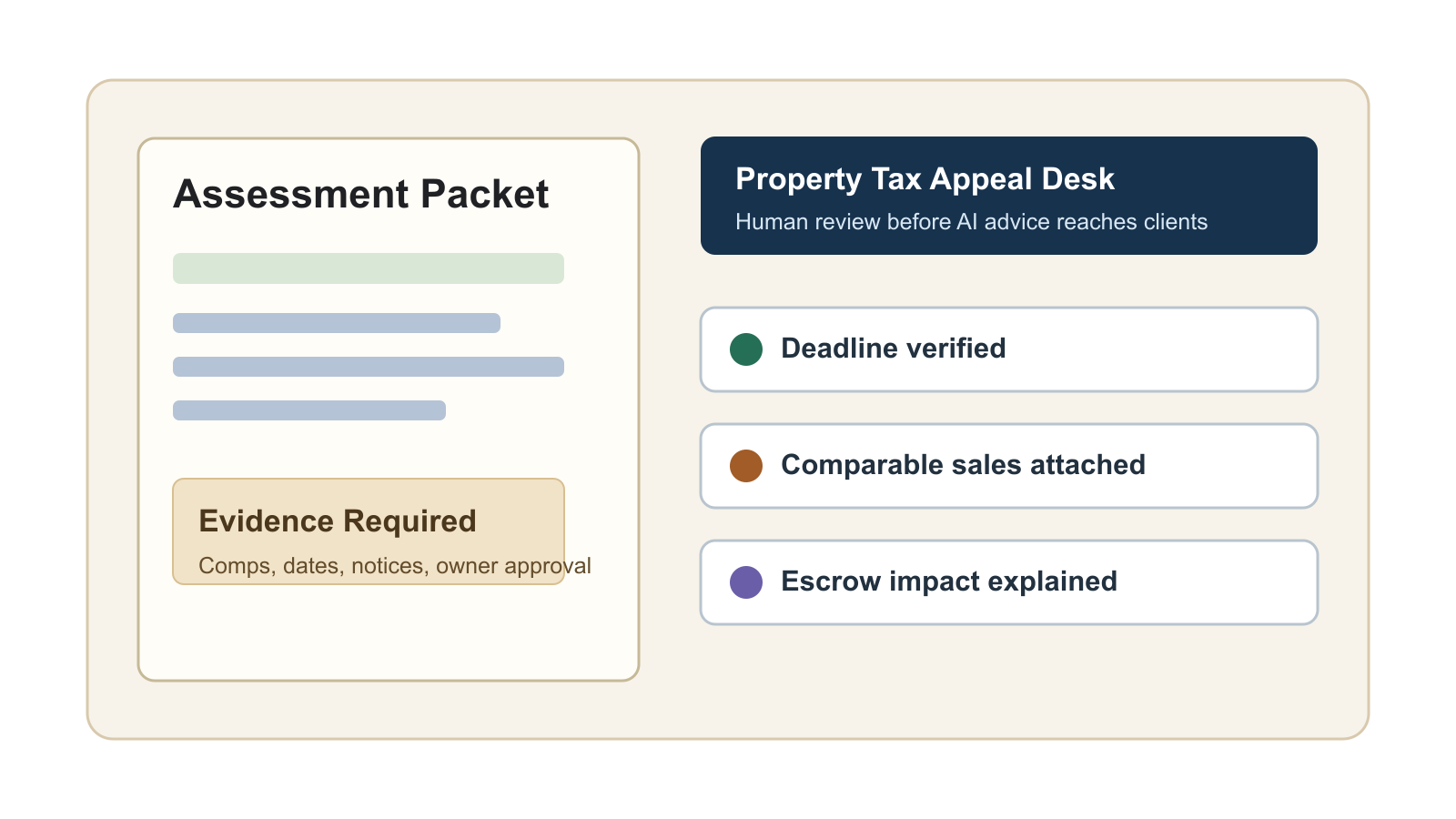
The practical answer is not to keep AI away from property-tax conversations. The practical answer is to build a property tax appeal desk before the assistant advises homeowners. The desk is a simple operating surface that separates document explanation from appeal guidance, separates tax-bill frustration from assessed-value evidence, and gives a human owner the final say before any client-facing recommendation goes out.
Why this is timely
Property taxes are not a background expense for homeowners anymore. ATTOM's April 2026 annual property-tax analysis reported that 2025 property taxes on single-family homes reached $396.8 billion across more than 89.6 million homes. The average single-family home generated a $4,427 tax bill, up 3 percent from the prior year, while the national effective tax rate rose to 0.9 percent.
That matters for real estate teams because tax pressure shows up in client conversations long after closing. It changes monthly affordability, post-close satisfaction, relocation decisions, investor hold periods, and seller expectations. It also shows up through escrow. The Consumer Financial Protection Bureau explains that escrow accounts collect monthly funds to pay property-related expenses such as property taxes and homeowners insurance, and that changes in taxes or insurance can change the total monthly mortgage payment.
In other words, when a homeowner says, "My mortgage went up," the answer may not be a mortgage answer. It may be a tax assessment answer, an insurance answer, an escrow analysis answer, or a documentation answer. AI needs a desk that forces that distinction.
The danger of a confident shortcut
An AI assistant can make a property-tax appeal sound cleaner than it is. It can say the home looks overassessed, produce a few nearby sales, and draft a message telling the owner to challenge the value. That may be directionally useful, but it is not enough.
State guidance makes the evidence problem clear. California's assessment appeal FAQ explains that an assessment appeal is a due-process mechanism for disputes over assessed value and that the appeals board hears evidence from both sides before deciding value. The same FAQ says the best support for many residential cases is comparable-property sales information, and that evidence needs to be presented in the hearing context, not merely collected somewhere else. Illinois guidance draws a similarly important boundary: the appeal is about assessed value, not the tax bill itself, and once the tax bill arrives it may be too late to appeal that year's assessment.
Those details are operationally important. The AI should not just ask, "Is the tax bill high?" It should ask, "What notice triggered this, what value is being challenged, what deadline applies, what evidence supports the requested value, who owns the recommendation, and what exact message is allowed?"
What the desk should track
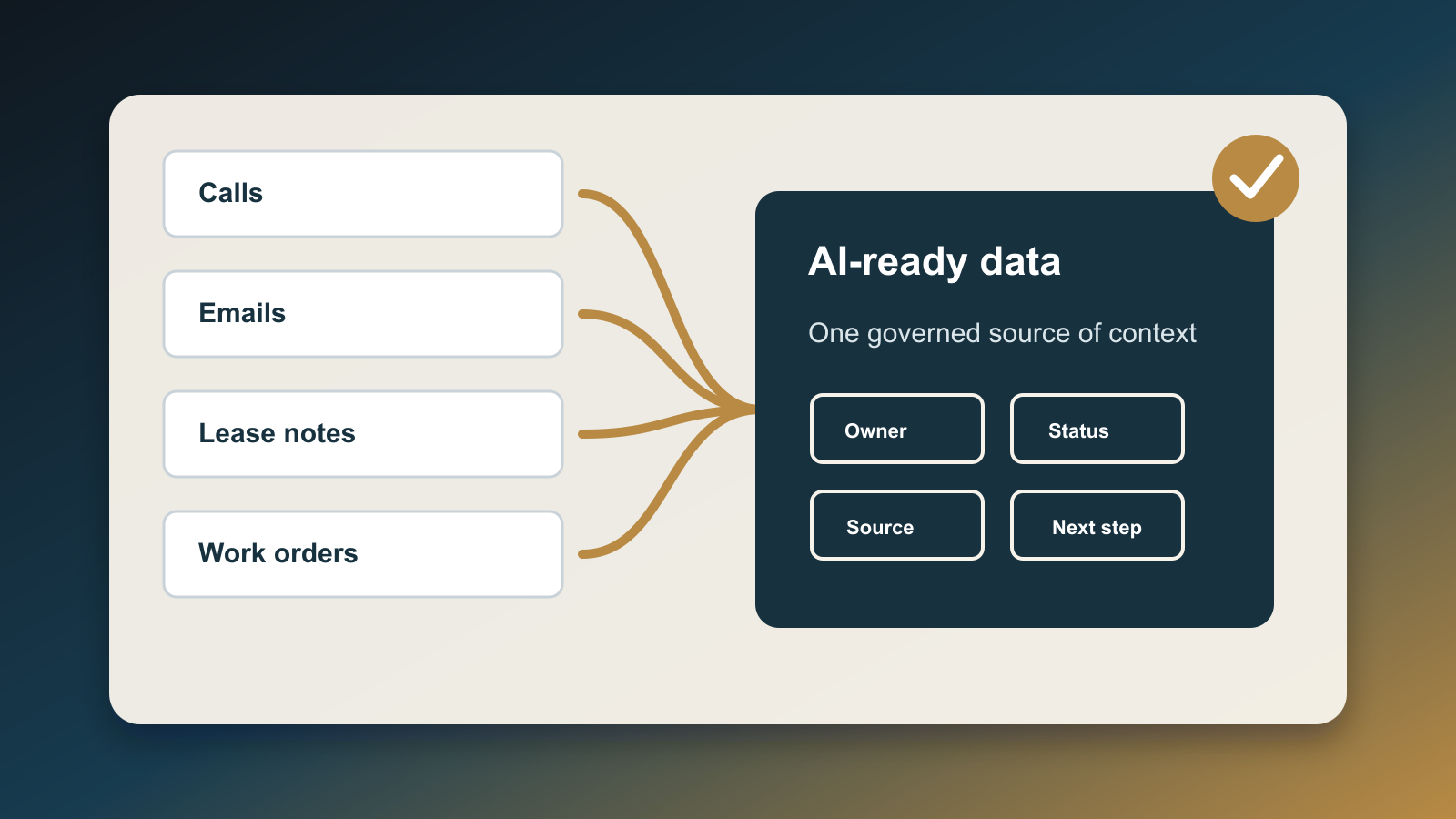
Start with one record per homeowner question. Do not let these requests disappear into email threads, CRM notes, or AI chat history.
The first field is the trigger. Label whether the client sent an assessment notice, tax bill, escrow analysis, insurance renewal, supplemental assessment, or general affordability question. A tax bill and an assessment notice are not interchangeable.
The second field is the issue type. Use simple categories: assessed value dispute, escrow payment explanation, exemption question, property-characteristic error, comparable-sales review, deadline check, or referral to a qualified tax professional. This keeps the AI from treating every complaint as an appeal.
The third field is the evidence packet. Require the current notice, prior-year value, property characteristics, recent purchase price if applicable, comparable sales, photos or condition notes when relevant, and the local filing deadline. If the client is only asking why the payment changed, the packet should include the escrow analysis, tax bill, insurance premium, and servicer notice instead.
The fourth field is owner approval. A real estate team can help organize facts, explain process, and suggest the right next step, but it should not let an AI system present legal or tax conclusions as if they are professional advice. Route high-risk items to the agent, broker, attorney, CPA, tax consultant, or county office depending on the situation.
The fifth field is the allowed client message. This is the approved wording the AI may use. It should distinguish facts from recommendations. "Your escrow payment may change when taxes or insurance change" is different from "you should appeal." "Here are the documents to review" is different from "your assessment is wrong."
What AI is allowed to do
The desk should make AI useful inside a controlled lane.
AI can summarize notices in plain English. It can list missing documents. It can compare the client's property characteristics against public records. It can draft questions for the assessor's office. It can organize comparable sales into a table for human review. It can explain the difference between a tax bill, assessment, escrow shortage, and appeal deadline. It can create a client-friendly checklist that says what the homeowner should gather before asking for professional guidance.
AI should not independently decide that an assessment is wrong. It should not promise savings. It should not file or submit appeal materials without explicit human handling. It should not tell a homeowner to skip timely payment while an appeal is pending. It should not invent local deadlines. It should not treat a generalized market estimate as formal appeal evidence.
NIST's Generative AI Profile is useful here because it frames AI risk as something to manage across the system lifecycle, not something to clean up after output appears. For a property-tax workflow, that means the controls belong before the client message: source checks, role limits, human review, recordkeeping, and clear escalation rules.
The minimum workflow
The property tax appeal desk can be lightweight.
Create a board with columns for intake, document review, deadline check, evidence packet, human recommendation, client message, and outcome. Add a required risk label: explain only, evidence review, appeal support, professional referral, or no action.
For each request, attach the primary document. If the document is an escrow analysis, the AI's first job is to explain payment math and identify whether taxes, insurance, or a shortage changed. If the document is an assessment notice, the AI's first job is to extract values, dates, parcel details, and stated appeal process. If the client only sent a screenshot or a vague question, the AI should request the missing document before drafting advice.
Then require a human to approve one of four actions: answer the escrow question, gather more evidence, refer the client to the county or a qualified tax professional, or prepare a factual support packet for the client to review. The AI can draft the message, but the desk decides which message is allowed.
The business payoff
NAR's 2025 technology survey shows that real estate professionals are already adopting AI tools in client service, including AI-generated content. That makes governance practical, not theoretical. Teams need systems that let AI reduce administrative load without turning every client question into an uncontrolled advisory moment.
A property tax appeal desk gives the team that system. It creates a repeatable intake path for post-close questions. It reduces confused handoffs between the agent, lender, servicer, assessor, and client. It helps the team respond faster without pretending that a chatbot can replace local rules, professional judgment, or evidence standards.
The best version is not a complex legal platform. It is a structured pause between "the client is upset about taxes" and "the AI sent advice." In that pause, the team verifies the document, classifies the issue, checks the deadline, attaches evidence, assigns ownership, and approves the exact client message.
That is how AI becomes useful in homeowner service: not by making property-tax decisions, but by making the team's evidence, timing, and communication discipline impossible to skip.

Written by
Ben Laube
AI Implementation Strategist & Real Estate Tech Expert
Ben Laube helps real estate professionals and businesses harness the power of AI to scale operations, increase productivity, and build intelligent systems. With deep expertise in AI implementation, automation, and real estate technology, Ben delivers practical strategies that drive measurable results.
View full profile