Build a Lead-Source Ledger Before AI Buys Traffic
AI is making it easier to generate ads, test creative, route leads, and personalize follow-up. That is useful only if the business can tell which lead sources create real conversations, real appointments, and real clients. If the CRM still treats every portal lead, social DM, referral, landing-page form, and open-house scan as the same kind of record, AI will mostly accelerate the existing blur.
The marketing market is moving in the opposite direction. IAB reported on April 16, 2026 that U.S. internet advertising revenue reached $294.6 billion in 2025, up 13.9% year over year, with social, digital video, commerce media, search, podcast, and display all competing for performance budgets. The same report points to automated buying and AI-driven media workflows becoming part of the operating infrastructure. More money is flowing through systems that optimize quickly, but those systems can only optimize toward the signal you give them.
Real estate teams already feel this in practical terms. NAR's REALTOR Technology Survey says social media remains the top lead-generating technology for REALTORS, followed by CRM and local MLS. That mix is not a clean funnel. A buyer might see a neighborhood video, click a property alert, reply to a text, attend an open house, and later come back through a search portal. If your CRM only remembers the final form fill, your reporting will over-credit the easiest field to capture and under-credit the work that built trust.
The answer is not another dashboard. The answer is a lead-source ledger: a small, durable operating table that records how a contact entered the business, what it cost to create that opportunity, what happened next, and which source should be allowed to influence future automation.
What the ledger should track
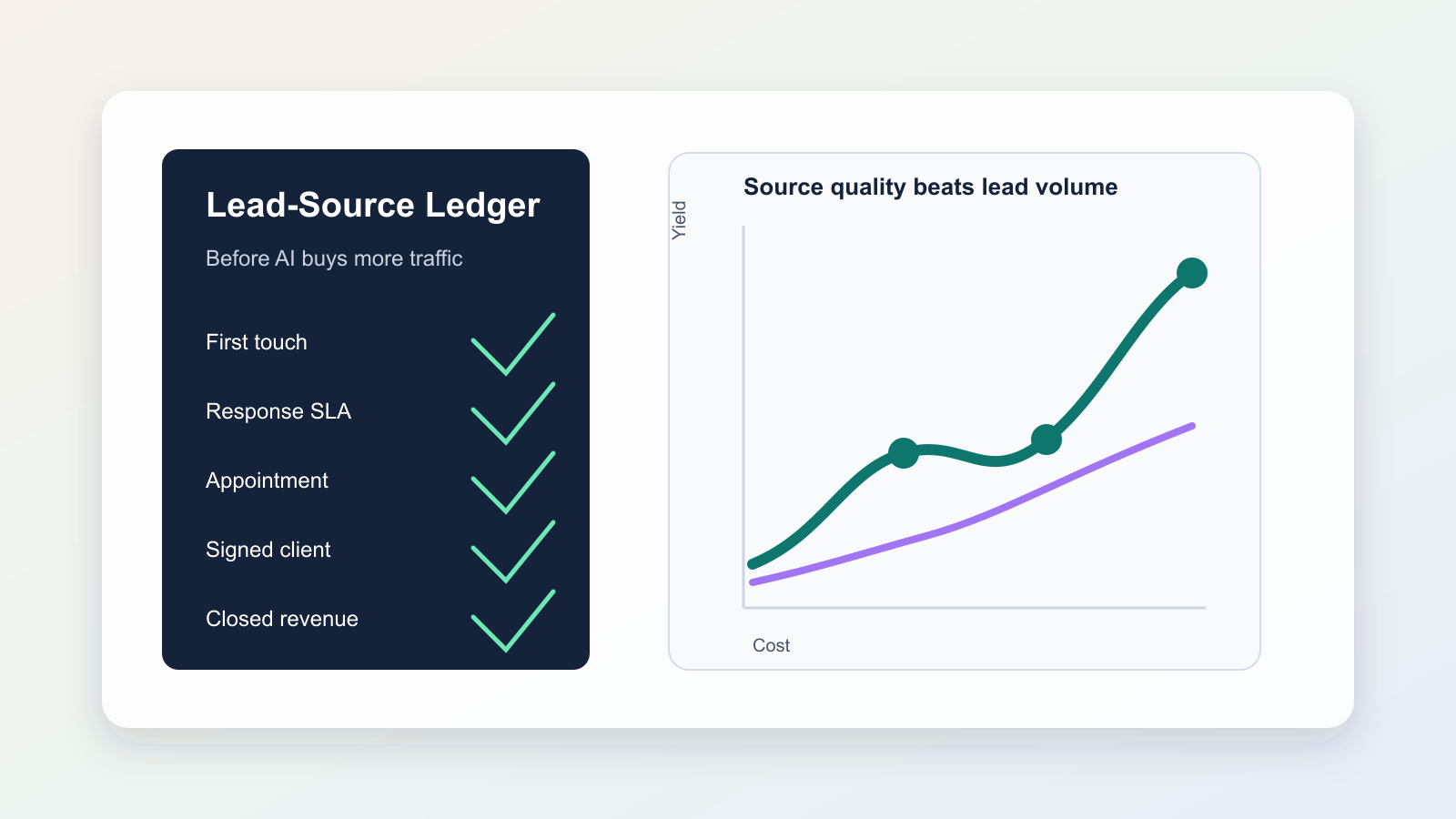
Start with fewer fields than a marketing platform would prefer, but make the fields non-negotiable. Every new inquiry should carry a first-touch source, current source, campaign or content identifier, capture channel, consent state, owner, response timestamp, appointment status, signed-client status, closed-revenue status, and loss reason when applicable. For paid traffic, attach spend period, spend owner, audience, creative family, and landing-page version. For organic or referral traffic, attach the asset, person, or partner that created the opportunity.
The important part is that the ledger follows the lead past the click. A source that produces 100 cheap leads and two weak conversations should not be scored above a source that produces twelve inquiries, eight appointments, and three signed clients. This is especially important before adding AI media buying, AI lead scoring, or AI follow-up because those tools will learn from the historical labels they can see. If the labels stop at lead volume, the automation will chase volume.
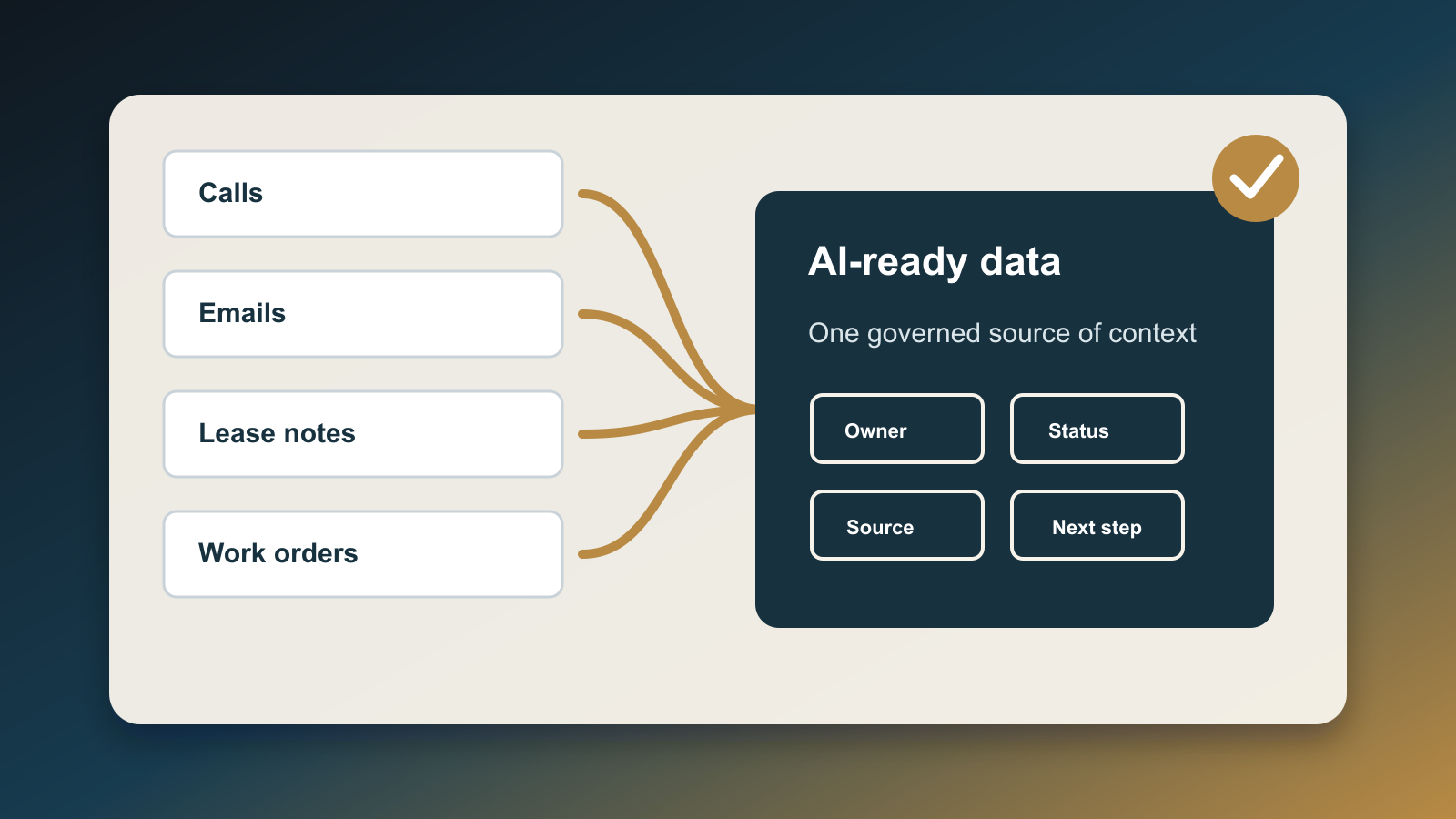
Salesforce's 2026 State of Marketing research reinforces the same operating gap from another angle. Marketers say customers increasingly expect two-way conversations, but many teams struggle to respond promptly because they cannot access the customer context they need. The report also notes that unified customer data improves the ability to respond and use AI agents. That is the ledger problem in plain language: the customer record has to carry enough context for a person or system to know what conversation they are entering.
Why this matters before AI adoption expands
Gartner predicted in January 2026 that 60% of brands will use agentic AI for streamlined one-to-one interactions by 2028, and it explicitly tied that shift to data governance, transparency, and organizational change. For a real estate business, that does not mean building a giant enterprise data platform. It means making sure AI can answer basic questions before it touches budget or client communication.
Which source creates qualified appointments? Which source produces fast replies but weak commitment? Which campaign creates seller conversations but slow nurturing cycles? Which forms have consent for SMS? Which leads require a human call before any automated sequence? Which referral partners should never be blended into generic nurture? Those are operational questions, not abstract analytics questions.
The CMO Survey's March 31, 2026 findings also make the timing practical. Marketing leaders are facing economic pressure, tighter spending, and a stronger push toward existing customers, even as AI is expected to account for more marketing activity over the next three years. When budgets tighten, attribution that only reports clicks becomes a liability. The business needs to know where durable client creation is happening.
A practical implementation pattern
Do not start by replacing the CRM. Add a ledger layer that the CRM, forms, ad platforms, and automation tools can all update. In a simple implementation, this can be a CRM custom object, a warehouse table, or a structured sheet that is synchronized daily. The key is that one contact can have many source events, while the contact profile still has a clear current lifecycle stage.
Use three levels of source identity. The first level is channel: referral, social, search, portal, email, open house, direct, partner, or repeat client. The second level is program: neighborhood content, valuation campaign, listing alert, buyer guide, relocation sequence, seminar, or retargeting. The third level is proof: exact URL, campaign ID, UTM, form ID, QR code, partner name, or content asset.
Then score source quality by stages, not by vanity metrics. Track response within SLA, meaningful conversation, appointment set, appointment held, agreement signed, transaction opened, closed revenue, and repeat or referral creation. For each stage, keep the timestamp and the owner. This makes the ledger useful to sales managers, marketers, and AI systems at the same time.
Finally, define what AI is allowed to do with the ledger. AI can summarize lead-source performance, suggest budget shifts, detect stale campaigns, identify underperforming response windows, and draft source-specific follow-up. It should not automatically increase spend, suppress sources, or change consent-sensitive messaging until the team has reviewed the reasoning and the underlying data quality.
The operating rule
A lead-source ledger is not about perfect attribution. Perfect attribution is usually too slow, too political, and too fragile for a working real estate team. The goal is decision-grade attribution: enough clean context to decide what deserves budget, what deserves human attention, and what deserves automation.
Before AI buys more traffic, make sure the business can see the difference between cheap leads and valuable demand. The ledger gives every future system a better target than lead volume. That is how marketing automation becomes a growth system instead of a faster way to misunderstand the funnel.
Sources
- IAB, "Digital Ad Revenue Climbs to Nearly $300B as IAB Celebrates 30 Year Anniversary," April 16, 2026: https://www.iab.com/news/digital-ad-revenue-climbs-to-nearly-300b-as-iab-celebrates-30-year-anniversary/
- National Association of REALTORS, "REALTOR Technology Survey," accessed May 2, 2026: https://www.nar.realtor/research-and-statistics/research-reports/realtor-technology-survey
- Salesforce, "75% of Marketers Have Adopted AI, Yet Still Use It to Send Generic Campaigns," February 19, 2026: https://www.salesforce.com/news/stories/state-of-marketing-2026/
- Gartner, "Gartner Predicts 60% of Brands Will Use Agentic AI to Deliver Streamlined One-to-One Interactions by 2028," January 15, 2026: https://www.gartner.com/en/newsroom/press-releases/2026-01-15-gartner-predicts-60-percent-of-brands-will-use-agentic-ai-to-deliver-streamlined-one-to-one-interactions-by-2028
- Duke Fuqua Insights, "CMOs Face Headwinds Even as Marketing Value and AI Impact Grow," March 31, 2026: https://www.fuqua.duke.edu/duke-fuqua-insights/CMOs-Face-Headwinds-Even-as-Marketing-Value-and-AI-impact-grow

Written by
Ben Laube
AI Implementation Strategist & Real Estate Tech Expert
Ben Laube helps real estate professionals and businesses harness the power of AI to scale operations, increase productivity, and build intelligent systems. With deep expertise in AI implementation, automation, and real estate technology, Ben delivers practical strategies that drive measurable results.
View full profile