Build a Market Signal Board Before AI Writes Local Advice
AI can now turn a housing-market update into emails, social posts, call notes, buyer FAQs, seller talking points, and CRM follow-up in a few minutes. That is useful only if the underlying market logic is current. When the market is moving unevenly by region, price band, and buyer segment, a generic AI-written update can make a real estate business sound polished while giving clients stale or oversimplified guidance.
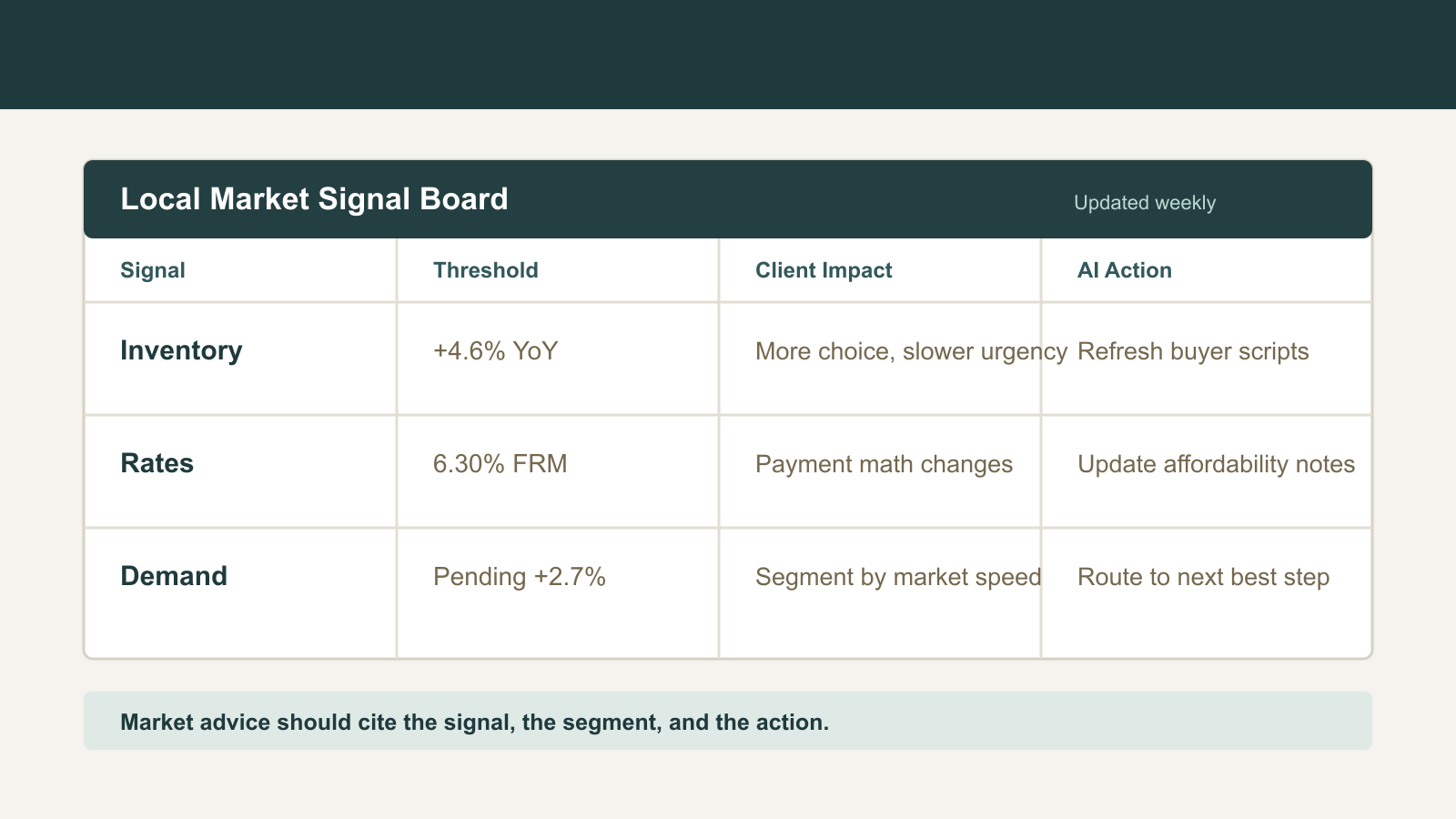
The fix is not another prompt. The fix is a market signal board: a small operating layer that says which numbers changed, which client segments are affected, what advice is allowed, what action should happen next, and which source supports the claim. Once that board exists, AI can help distribute the update. Without it, AI mostly republishes ambiguity at scale.
Why This Matters Now
The spring 2026 market is not sending one clean national message. Realtor.com reported that April active listings rose 4.6% year over year, median list prices fell 1.4% year over year, and new listings reached their strongest April level since 2022. But the same report also showed inventory still 12.5% below typical 2017-2019 levels, with regional gaps that matter for advice: Midwest and Northeast inventory growth looked stronger than the South, while the West had different pricing pressure.
NAR's March existing-home-sales release told another part of the story. Existing-home sales fell 3.6% month over month to a 3.98 million seasonally adjusted annual rate, while unsold inventory rose to 1.36 million units, or 4.1 months of supply. Median existing-home price still rose 1.4% year over year to $408,800. That combination is exactly why automated market commentary needs guardrails. Slower sales do not automatically mean buyers have full leverage, and more inventory does not mean affordability is solved.
Weekly data adds another layer. Redfin reported that pending sales rose 2.7% year over year during the four weeks ending April 26, while median days on market increased by four days and the median monthly payment was down 2.2% year over year at a 6.23% mortgage rate. Freddie Mac then reported the 30-year fixed-rate mortgage averaged 6.30% on April 30, with purchase applications more than 20% above the prior year. A business that sends the same market note to every buyer and seller is ignoring the actual operating question: who needs a new action because the signal changed?
What a Market Signal Board Tracks
A useful signal board is not a dashboard stuffed with charts. It is a decision table for client communication. Each row should have five fields.
First, track the signal. Examples include active inventory, new listings, price cuts, median days on market, pending sales, mortgage rates, payment estimates, list-to-sale ratio, and local concessions. The board should separate national context from local market facts. National data explains the backdrop. Local MLS, CRM, and transaction data should drive client action.
Second, define the threshold. A number matters when it changes behavior. If days on market rises for three straight weeks in a price band, seller scripts may need to move from urgency to price discipline. If new listings rise while pending sales also rise, buyer advice should not overstate negotiation power. If rates fall enough to change a target buyer's monthly payment, the CRM should identify paused buyers who need an updated affordability note.
Third, map the affected segment. The same signal can mean different things to first-time buyers, move-up buyers, downsizers, investors, luxury sellers, and homeowners with low-rate lock-in. A rate improvement may wake up payment-sensitive buyers. A rise in new listings may matter more to a family waiting for school-district inventory than to an investor chasing yield. AI should not decide that segmentation on its own; it should read the segment rules from the board.
Fourth, specify the allowed advice. This is where many AI market updates fail. The business needs pre-approved language for what can be said, what should be avoided, and when a human must review the message. For example: do not tell sellers that prices are falling everywhere when the actual signal is a national median list-price decline with local variation. Do not tell buyers they can negotiate aggressively just because inventory rose nationally. Tie every recommendation to a source, date, geography, and client situation.
Fifth, define the next action. A market update should produce work. It should trigger a buyer affordability refresh, seller pricing review, open-house follow-up, CMA update, vendor scheduling reminder, lender check-in, or agent call task. If the AI output does not create a next action, it is content, not operations.
How to Use AI Safely Here
Once the board is in place, AI becomes useful in three practical ways.
It can summarize the board for each client segment. Instead of asking for a generic "April housing market update," the prompt should pass structured inputs: market, segment, three approved signals, source dates, forbidden claims, and desired action. The output becomes a client-ready note tied to evidence.
It can scan the CRM for affected contacts. If rates move, the system can find buyers whose saved budget, lender status, or paused timeline makes the change relevant. If inventory expands in a target neighborhood, it can find clients with matching searches. The point is not to blast everyone; it is to route the right update to the right person.
It can create internal call notes before public content. A team should use the signal board to align agents before publishing broad commentary. If agents cannot explain what changed and why it matters, the public post will not fix the operating gap.
The Minimum Version
Start with one market, one buyer segment, one seller segment, and five signals. Update it weekly. For each signal, record the source URL, source date, current value, prior value, threshold, affected segment, approved talking point, forbidden overstatement, and next CRM action.
Then let AI draft only from that table. The prompt should say: use these signals only, cite the source date in plain language, avoid claims outside the board, and end with the next action. Review the first ten outputs manually. Keep the phrases that agents actually use. Delete the ones that sound like national filler.
This is the difference between AI content and AI operations. Content makes the business sound active. Operations change who gets contacted, what gets discussed, and what happens next. In a mixed market, that distinction matters.
Bottom Line
A real estate team does not need AI to write more market updates. It needs a market signal board that turns fresh data into segmented client action. Build the board first, then let AI help distribute it. The advice will be sharper, the CRM will become more useful, and the team will stop confusing polished commentary with operational judgment.
Sources
- Realtor.com Research, April 2026 Monthly Housing Report, April 30, 2026: https://www.realtor.com/research/april-2026-data/
- National Association of Realtors, March 2026 Existing-Home Sales Report, April 13, 2026: https://www.nar.realtor/newsroom/nar-existing-home-sales-report-shows-3-6-decrease-in-march
- Redfin, Homebuying Demand Ticks Up, Mortgage Rates Tick Down, April 30, 2026: https://www.redfin.com/news/press-releases/homebuying-demand-ticks-up-mortgage-rates-tick-down/
- Freddie Mac, Mortgage Rates Average 6.30%, April 30, 2026: https://freddiemac.gcs-web.com/news-releases/news-release-details/mortgage-rates-average-630

Written by
Ben Laube
AI Implementation Strategist & Real Estate Tech Expert
Ben Laube helps real estate professionals and businesses harness the power of AI to scale operations, increase productivity, and build intelligent systems. With deep expertise in AI implementation, automation, and real estate technology, Ben delivers practical strategies that drive measurable results.
View full profile