Build an AI Search Citation Desk Before Leads Trust the Summary
Search is no longer just a list of links that sends a buyer, seller, or client to your website. In May 2026, Google said AI Mode had passed one billion monthly active users globally and that AI Mode queries had more than doubled every quarter since launch. Google also said the average AI Mode query is triple the length of a traditional Search query, with planning-related AI Mode queries growing faster than the overall AI Mode baseline. For real estate, local services, and relationship-driven businesses, that changes the operating problem: the first conversation may begin with a synthesized answer the lead saw before they ever clicked through to you.
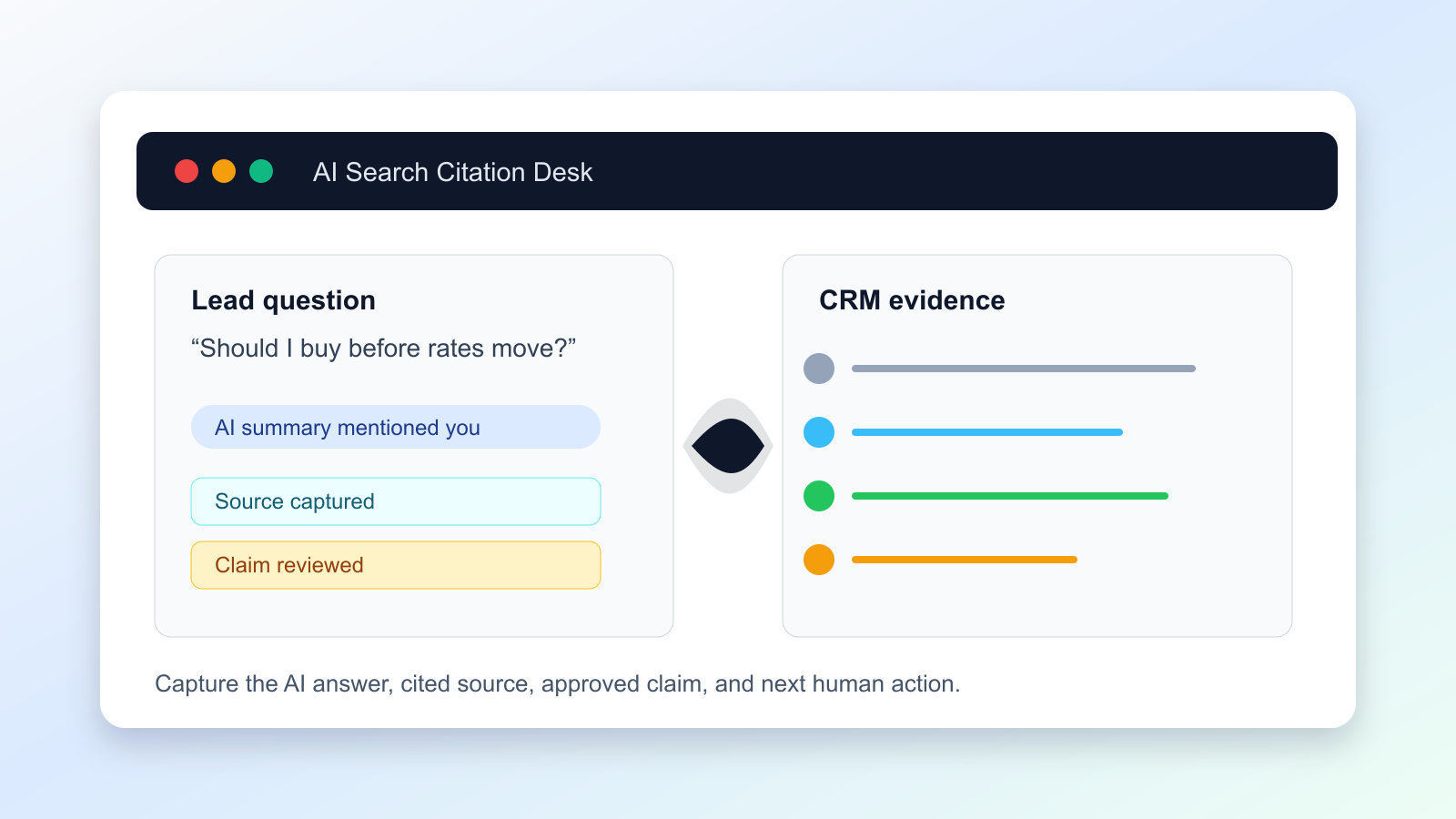
That does not mean every team needs a new buzzword program for generative engine optimization. It means the CRM needs a new evidence table. When a lead says, “Google said this neighborhood is a better investment,” “an AI answer recommended three agents,” or “I saw a summary that said your team handles relocation,” the business needs a structured way to capture what was shown, which source was cited, what claim was made, and whether that claim is safe to reuse in follow-up.
Call it an AI search citation desk. It is not an SEO dashboard. It is an operational intake point where marketing, sales, and compliance can convert AI-discovery noise into actionable customer context.
Why this moved from marketing theory to operating work
Google’s AI Search updates are becoming more agentic and more commercial. Google’s May 19 Search update described a new AI-powered Search box, follow-up questions from AI Overviews into AI Mode, background information agents, local service booking capabilities, and broader multimodal inputs. The practical consequence is simple: prospects will increasingly arrive with a question history, a source trail, and a partially formed decision.
The advertising layer is changing at the same time. Google’s May 20 Ads & Commerce update introduced tests for Conversational Discovery ads and Highlighted Answers in AI Mode, plus AI-powered Shopping ads and Business Agent for Leads. Google says these formats remain labeled as sponsored and include an AI explainer, but the experience is still more conversational than a classic search ad. A buyer may not distinguish clearly between a citation, a sponsored answer, a local result, and a brand agent unless your follow-up process is designed to ask.
Independent data points point the same direction. BrightEdge reported on May 20, 2026 that Gemini nearly tripled its AI referral share in Q1 2026 and reached 13.2% in April, while ChatGPT remained the dominant AI referral source. A May 2026 arXiv measurement study of Google AI Overviews found that AI Overviews activated on 13.7% of the measured trending queries, rising to 64.7% for question-form queries. The same study found that nearly 30% of cited domains did not appear in the co-displayed first-page results, which means teams cannot assume old organic-rank dashboards fully explain AI citation behavior.
For real estate specifically, NAR reported in February 2026 that 92% of surveyed agents were already using AI or planning to use it, while accuracy, compliance, and market-data misinterpretation were top concerns. That combination matters: agents are using AI, consumers are seeing AI answers, and the highest-risk moments are exactly where an unreviewed summary can sound authoritative.
What the desk should capture
The citation desk should be a simple CRM object, not another disconnected spreadsheet. Each record should answer seven questions.
First, what did the lead ask or see? Capture the lead’s exact language, not the team’s cleaned-up version. A phrase like “AI said I should wait until rates drop” is more useful than a generic tag like “mortgage concern.”
Second, where did the answer appear? Separate Google AI Overview, Google AI Mode, Gemini app, ChatGPT, Perplexity, social search, and a paid ad surface. If the lead is not sure, mark it as unknown instead of guessing.
Third, what source or business was cited? Save the cited URL, business name, screenshot, or copied text when available. If your own site was cited, record the landing page. If a competitor was cited, record that too. If no source was visible, that is a signal in itself.
Fourth, what claim influenced the lead? Do not store the whole AI answer as if it is approved copy. Extract the business-relevant claim: estimated value, neighborhood recommendation, service promise, timing advice, financing assumption, availability, guarantee, ranking, or comparison.
Fifth, is the claim approved, needs review, or unsafe? This is the governance field. The reviewer should be someone who understands the domain, not just the person who owns marketing analytics. In real estate, valuation language, school boundaries, fair housing issues, financing assumptions, disclosures, and market predictions should not flow into automated follow-up without review.
Sixth, what response should the team send? Approved answer, human escalation, correction script, source-request question, or no action. The desk exists to produce a better next step, not just a historical archive.
Seventh, what should change upstream? If the same confused claim appears repeatedly, update the source page, FAQ, ad copy, schema, local profile, or sales script. If a page is being cited correctly, add it to your content evidence library so it can support more buyer and seller conversations.
The workflow
Start with intake. Train agents, ISAs, admins, and sales reps to ask one low-friction question when a lead references an AI answer: “Do you remember where you saw that or what source it cited?” The goal is not interrogation. The goal is attribution evidence.
Route every captured item into one queue with three priority levels. High priority includes legal, financial, valuation, fair housing, disclosure, safety, or service-promise claims. Medium priority includes competitor comparisons, neighborhood advice, local-market summaries, and inaccurate descriptions of your service area. Low priority includes general AI-search visibility, harmless brand mentions, and content ideas.
Review high-priority items daily. Approve, correct, or block the claim. If the claim is false or risky, attach a response note the team can use with the lead. If it is true but unsupported, add or improve a page that backs it up. If it is true and already supported, map it to the page that should be cited in future follow-up.
Connect the desk to CRM follow-up. A citation record should influence the next message, task, and content recommendation. For example, a buyer who arrives from an AI answer about “best suburbs for commute and schools” should not automatically receive a generic neighborhood drip. The better path is a human-reviewed note that clarifies commute tradeoffs, points to objective school-boundary resources, and avoids steering language.
Measure the desk with operational metrics. Track repeated questions, source pages cited, unsafe claims found, corrections sent, pages updated, and lead outcomes by AI-discovery source. Do not overbuild attribution at the beginning. The first useful version is a table that shows which AI answers are shaping conversations and whether your team handled them correctly.
Guardrails that matter
Treat AI-search citations as customer-reported evidence, not legal proof. A screenshot or copied summary can be useful, but it may not represent what every user saw. Models change, location matters, personalization matters, and ads may appear differently by context.
Keep advertising transparency visible. The FTC’s native advertising guidance is not AI-specific, but its core principle applies cleanly: consumers should not be misled about the commercial nature or source of promotional content. If a lead came through an AI Mode ad, sponsored answer, or brand agent, your CRM should keep that commercial context attached to the record.
Do not let the desk become a shadow compliance system. It should trigger review and preserve evidence, but the approved response library should still live in the same controlled place your team uses for email, SMS, call scripts, and website copy.
Avoid making every citation a content emergency. Some citations are random, temporary, or too thin to act on. The useful signal is repetition: the same question, the same bad claim, the same competitor citation, or the same lead objection appearing across multiple conversations.
What to build this week
Create one CRM object called AI Search Citation. Add fields for source surface, lead phrase, cited URL, cited business, claim type, risk level, reviewer, approval status, recommended response, related contact, related deal, and follow-up owner. Add file attachment support for screenshots.
Create five claim types: pricing or valuation, neighborhood or location, service promise, timing or market advice, and competitor comparison. Keep the list short enough that people actually use it.
Create three statuses: new, reviewed, and actioned. “Reviewed” means the claim has a human decision. “Actioned” means a response was sent, a content update was made, or the issue was intentionally closed.
Add one weekly marketing review. Look for the top five repeated AI-search questions and decide whether each needs a better website page, a better local profile, a correction script, or a sales enablement note.
The businesses that win AI search will not be the ones that chase every model output. They will be the ones that turn AI-discovered claims into better evidence, cleaner follow-up, and safer customer conversations.

Written by
Ben Laube
AI Implementation Strategist & Real Estate Tech Expert
Ben Laube helps real estate professionals and businesses harness the power of AI to scale operations, increase productivity, and build intelligent systems. With deep expertise in AI implementation, automation, and real estate technology, Ben delivers practical strategies that drive measurable results.
View full profile