Give AI Outreach a Consent Ledger Before It Scales
AI follow-up is moving from draft assistance to direct participation in the customer conversation. That shift is useful, but it changes the operating risk. A person can remember that a buyer asked not to be texted. A campaign tool can suppress one list. An AI agent connected to a CRM, inbox, website chat, and SMS provider needs something more explicit: a consent ledger that tells it which channel is allowed, where the permission came from, when it changed, and what system must be updated next.
This is not a theoretical compliance concern. Real estate professionals are already experimenting with AI in day-to-day work. NAR reported in February 2026 that 92% of surveyed agents are using AI now or plan to use it, while accuracy, compliance, market-data interpretation, and fair housing concerns remain prominent. At the same time, marketers are being pushed toward two-way conversations. Salesforce's 2026 State of Marketing coverage says 83% of marketers see customers expecting reply-capable conversations across channels, but many teams still struggle to respond promptly because the needed context is scattered.
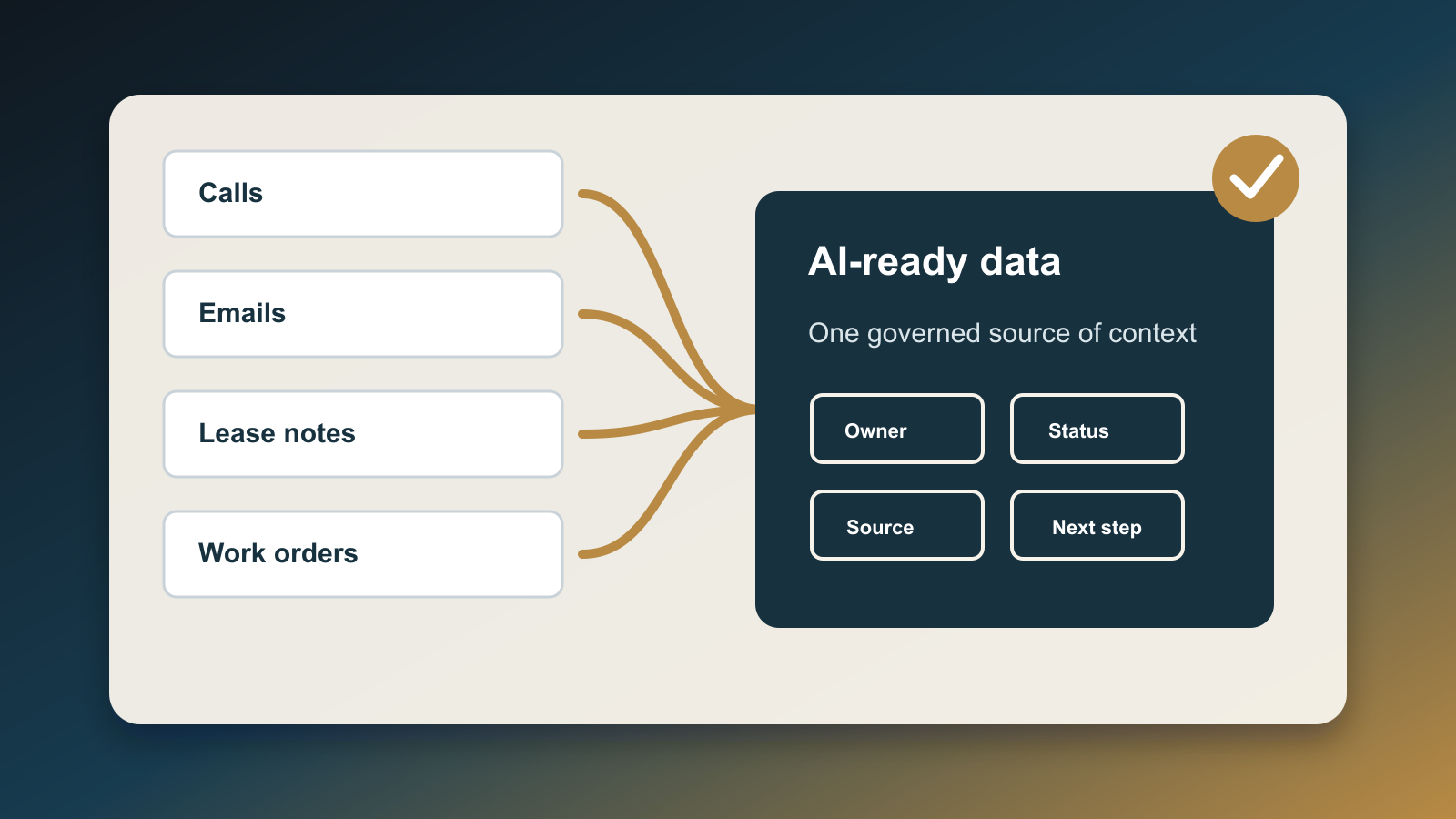
That combination creates the next implementation trap. Businesses want AI to reply faster, personalize better, and keep leads warm. But if permission state lives in one tool, unsubscribe events in another, agent notes in a third, and vendor exports in spreadsheets, the AI system has no stable answer to a simple question: may I send this message on this channel right now?
The consent ledger is an operational table, not a policy PDF
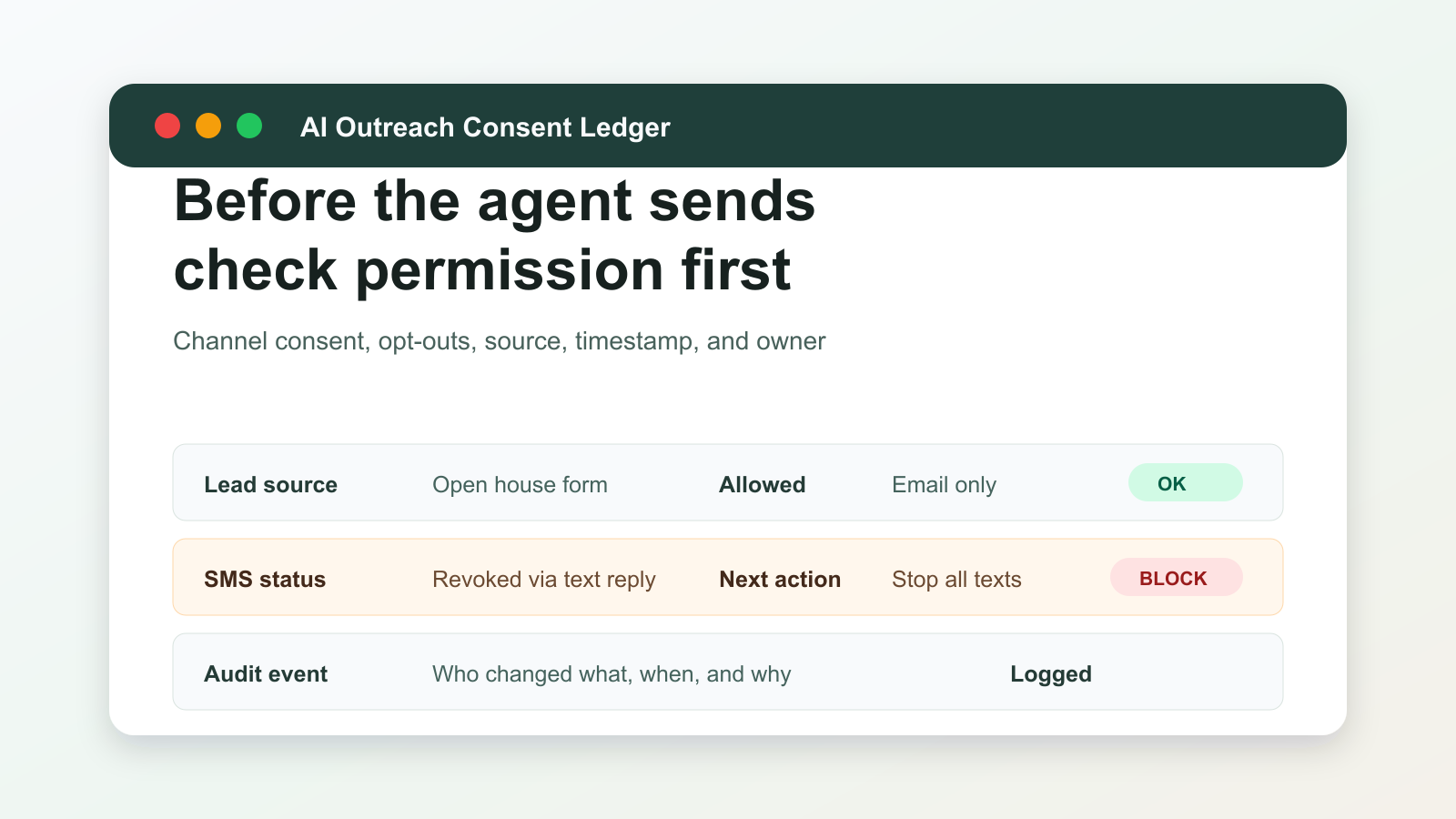
A policy explains what the business intends to do. A ledger lets software enforce it. The practical version does not need to be elaborate at first. It needs one record per person, channel, consent source, current status, timestamp, and responsible system. For a real estate team, that usually means separate permissions for email, SMS, phone, voicemail drops, website chat, retargeting audiences, and seller or buyer nurture campaigns.
The ledger should answer six questions before any automated outreach fires:
- What channel is the agent trying to use?
- What consent or business basis supports that channel?
- Where did that permission come from?
- Has the person opted out, revoked consent, or narrowed the allowed use?
- Which downstream systems need the updated state?
- Who or what changed the record most recently?
The value is not only risk reduction. It also improves the customer experience. If a lead says they prefer email because they are at work, the AI should not treat that as a loose note buried in the CRM timeline. It should become a permission and preference signal that changes future behavior.
Revocation is where weak systems show up
The FCC's TCPA consent work is a useful implementation signal even for teams that should consult counsel for their specific obligations. In an April 7, 2025 order, the FCC described rules governing how consumers can revoke consent for robocalls and robotexts and noted that consent revoked through a reasonable method must be treated as definitively revoked for covered communications. The same order delayed one cross-message revocation requirement to April 11, 2026 because affected parties needed more time to modify systems that process revocation requests across business units and vendors. The important takeaway for operators is concrete: consent is not a static field. It has to move through multiple systems quickly enough to govern future communication.
That is exactly where many real estate CRMs are weakest. A lead may reply STOP to a text provider. The CRM may still show the contact as active. A saved search email may continue from a portal account. A buyer consultation workflow may create a reminder task. A virtual assistant may draft a reactivation message from old notes. Each individual tool can look reasonable in isolation while the customer experiences the business as ignoring their preference.
The fix is to stop treating opt-out as a campaign-level setting. Make it an event that updates the ledger and pushes suppression downstream. When a revocation arrives, the system should record the raw message, normalized channel, interpreted scope, received timestamp, source system, processing timestamp, and follow-up action. If a person later opts back into a specific channel, that should be a new event, not an overwrite that erases history.
AI agents need permission checks before content checks
Most AI governance conversations start with output review: is the copy accurate, fair, on-brand, and compliant? That matters, but it is the second gate. The first gate is whether the system is allowed to send anything at all.
A useful pattern is to make every outreach agent call a permission service before it drafts or sends. The service returns one of four decisions: allowed, blocked, needs human review, or missing data. Allowed means the agent can continue under the approved playbook. Blocked means the channel is unavailable and the reason is logged. Needs human review means the consent scope is ambiguous. Missing data means the CRM is not ready for automation and the task should enter an exception queue.
This also prevents a subtle failure mode: using AI to make bad data feel operationally mature. Salesforce's 2026 marketing research points to disjointed and irrelevant data as a blocker for AI-assisted customer response, and IAB's 2026 State of Data report describes privacy regulation, signal loss, platform optimization, and fragmented data environments as pressure on measurement systems. The same fragmentation affects outreach permission. AI can generate polished personalization from messy context, but it cannot responsibly infer consent that the business failed to record.
The minimum viable ledger for a real estate team
Start with the workflows most likely to create repeated outreach: new internet leads, open house follow-up, valuation requests, seller nurture, past-client campaigns, and recruiting campaigns. For each workflow, document the current source of permission and the current source of opt-out truth. Then build one normalized table or service that the CRM, email platform, SMS provider, and AI agent can read.
The first version should include these fields:
- contact_id and normalized phone or email hash
- channel: email, sms, phone, voicemail, chat, ads audience, or postal
- status: opted_in, opted_out, restricted, unknown, or review_required
- source: form, import, manual update, text reply, unsubscribe link, call note, vendor webhook
- scope: campaign, property inquiry, buyer representation, seller valuation, past client, recruiting, or all marketing
- captured_at and processed_at timestamps
- evidence_url or evidence_record_id
- updated_by: person, integration, AI agent, or webhook
- notes for human review, kept short and factual
The ledger should be boring. It should not ask an AI model to decide whether consent exists from free-form notes. Use deterministic rules for the send/no-send decision and reserve AI for classification assistance only when a human can review uncertain cases.
How this improves marketing, not just compliance
A consent ledger makes segmentation sharper because it captures explicit preferences instead of only inferred behavior. A relocation buyer who allows email but blocks SMS can still receive useful market updates without being pushed into the wrong channel. A seller lead who opted out of valuation-drip texts can still get transactional appointment reminders if that is separately allowed and properly scoped. A past client can choose neighborhood reports but decline promotional messages.
This is where HubSpot's 2026 emphasis on business context matters. AI performs better when it understands customer history, market context, team process, and why interactions happened, not just what data fields exist. Consent and preference history are part of that context. Without them, an AI assistant can sound personal while behaving carelessly.
For real estate operators, the recommendation is direct: do not connect an AI agent to outbound email, SMS, or calling workflows until it has a deterministic permission check. The agent can draft, summarize, classify, and prepare tasks while the ledger is being built. It should not independently send customer outreach across channels that do not share opt-out state.
The implementation sequence
First, inventory every tool that can send a customer-facing message. Include the CRM, website forms, calendar reminders, property alert systems, email marketing tools, texting platforms, dialers, chat widgets, ad audiences, and any virtual assistant workflow.
Second, map every opt-out path. Include unsubscribe links, STOP replies, call requests, manual CRM edits, form preferences, email replies, and vendor-level suppression lists. If an opt-out path does not update the CRM or central ledger, label it as a break point.
Third, build the smallest shared consent record. Do not wait for a perfect customer-data platform. The first usable version can be a table plus webhooks from the systems that matter most.
Fourth, make AI agents ask before acting. Every outbound agent should receive a permission decision before it creates a send task. The decision and the final action should be logged together.
Fifth, review exceptions weekly. The exception queue will reveal where forms are unclear, imports lack source evidence, vendors do not pass suppression events, or team members are still storing preferences in notes.
AI outreach should feel faster to the customer, not harder to control. The businesses that win will not be the ones that simply generate more follow-up. They will be the ones that know, with evidence, when to speak, which channel to use, and when to stop.

Written by
Ben Laube
AI Implementation Strategist & Real Estate Tech Expert
Ben Laube helps real estate professionals and businesses harness the power of AI to scale operations, increase productivity, and build intelligent systems. With deep expertise in AI implementation, automation, and real estate technology, Ben delivers practical strategies that drive measurable results.
View full profile