Build an Open-House Intent Board Before AI Scores Visitors
Open-house leads are tempting automation fuel. The agent has a room full of visitors, a sign-in sheet or QR form, a property context, and a natural reason to follow up quickly. That makes it easy to hand the list to AI and let the CRM score, segment, text, email, and route everyone before the day is over.
That is also where the operating risk starts. Most open-house records are weak signals. A visitor may be a represented buyer, a neighbor comparing finishes, an investor looking for rent numbers, a first-time buyer who has not checked financing, or a serious buyer who is afraid to disclose too much in front of a listing agent. If the CRM only captures name, phone, email, and "hot lead," AI will fill the gaps with guesses.
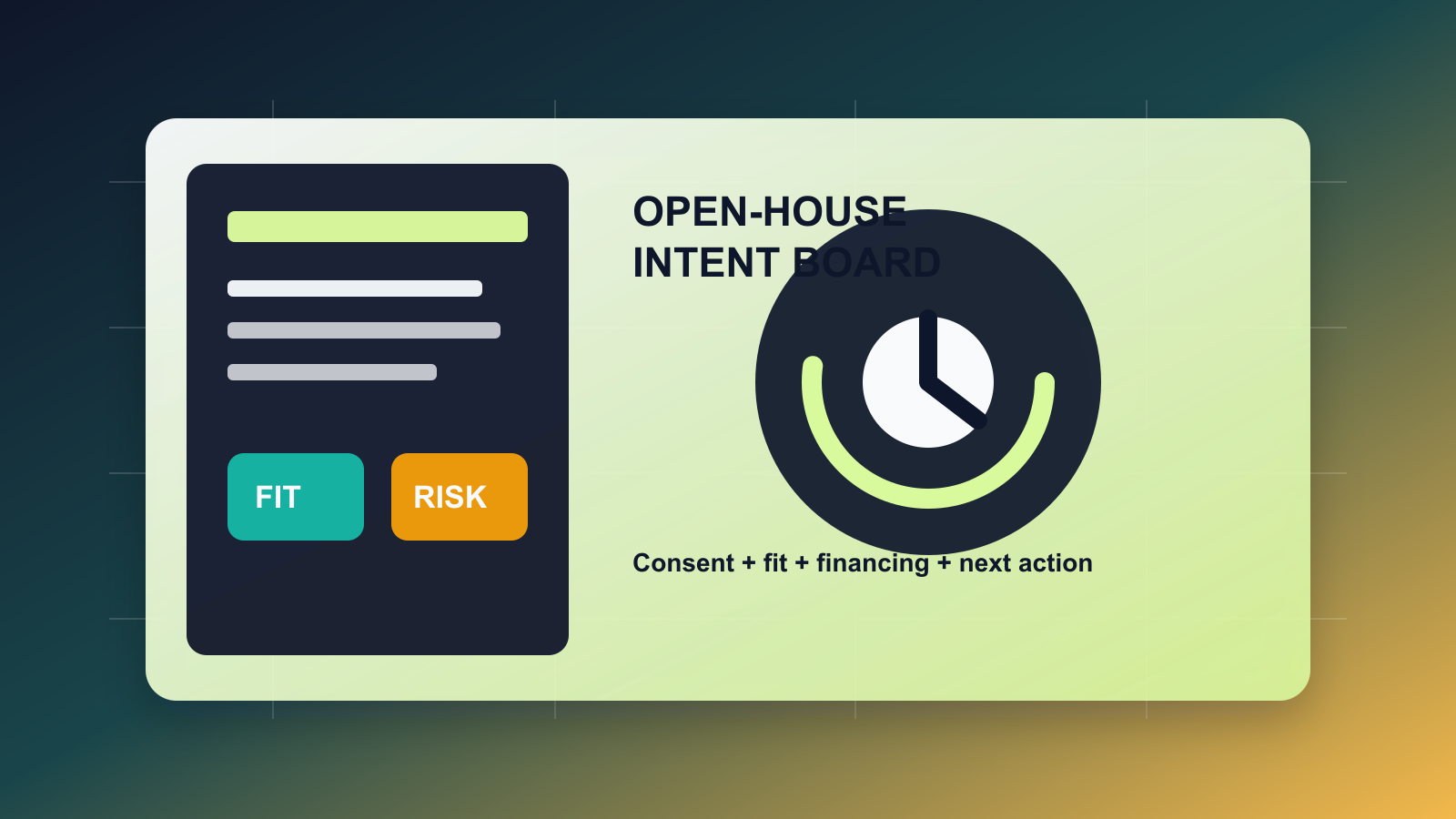
Build an open-house intent board first. It is a small control surface that turns each visitor into a verified follow-up record before AI decides who is ready for a showing, lender conversation, listing alert, pricing education, or human call.
Why the board matters now
The market is already training buyers to expect AI somewhere in the process. Cotality's April 2026 AI in housing survey found that 75% of buyers assume AI is embedded in homebuying, including with property websites, lenders, agents, and brokers. The same survey shows the trust boundary: buyers want labeling, verified information, and human review when decisions affect money, risk, or confidence.
NerdWallet's 2026 home buyer report points in the same direction. About 48% of prospective buyers say they have used or will use AI during the homebuying process, especially for estimating costs, getting guidance, and visualizing renovations. Buyers are not waiting for brokerages to decide whether AI belongs in the workflow. They are already arriving with AI-shaped expectations.
Agents are using AI too. NAR's 2025 Technology Survey reported that 46% of agents who are REALTORS use AI-generated content, and many use AI tools daily, weekly, or monthly. Clients respond positively to technology when it improves service, but that does not mean they want anonymous scoring or generic drip campaigns from a half-complete sign-in form.
Open houses sit at the intersection of these forces. NAR's buyer data shows the internet is the dominant discovery channel, while yard sign and open-house discovery is a smaller share of final purchases. That makes an open house less like a mass lead source and more like a high-context intent check. The value is not the raw count of names. The value is what the team can verify about timing, motivation, fit, constraints, representation, consent, and next action.
What belongs on the board
A useful open-house intent board should be simple enough for the hosting agent to complete before the next appointment, but structured enough for AI to use without inventing context. Start with seven fields.
First, capture source context. Was this person invited from a CRM campaign, sent by a buyer agent, found the property online, came from a sign, or followed a neighborhood referral? This keeps AI from treating a neighbor, referral, and portal lead as the same kind of opportunity.
Second, record representation status. A visitor who already has an agent needs a different workflow from an unrepresented buyer. AI should not push aggressive buyer-agent language, lender intros, or showing requests without that status.
Third, capture consent by channel. Do not let the sign-in tool become an implied permission machine. Mark whether text, email, phone, listing alerts, and market updates are permitted. Tie the first follow-up to the channel the visitor actually approved.
Fourth, define timing. Use simple ranges: now to 30 days, 31 to 90 days, three to six months, six months plus, browsing only, or unknown. If timing is unknown, AI can ask a clarifying question. It should not score the visitor as low quality just because the field is blank.
Fifth, capture property fit. Record what matched and what failed: price, neighborhood, bedrooms, school boundary, commute, condition, layout, HOA, insurance concern, repair concern, or financing fit. This gives the next message something useful to say.
Sixth, record financing confidence. Use evidence tiers, not vibes. Verified preapproval, lender conversation started, cash buyer stated, needs lender intro, affordability unknown, or not ready. This matters because AI should not advise offer strategy or urgency from open-house enthusiasm alone.
Seventh, set the next action. Examples: send disclosure packet, answer property-specific question, invite to private showing, ask buyer-consultation question, route to human call, add to neighborhood watch, or mark no follow-up. AI can draft the action, but a person should approve actions that involve agency, money, negotiation, or referral partners.
The AI permissions layer
The board should not only store facts. It should define what AI is allowed to do with each fact pattern.
Green actions are safe for automation. These include sending the property brochure, confirming receipt of a question, sharing publicly available listing details, adding a visitor to an approved neighborhood update, or reminding the agent to make a call.
Yellow actions require review. These include recommending similar homes, prioritizing a visitor for a same-day call, suggesting a lender intro, summarizing affordability questions, or drafting a buyer consultation invitation. The AI can prepare the work, but a human should approve the message or handoff.
Red actions should stay human-owned. These include interpreting representation status, advising offer competitiveness, discussing agency obligations, comparing lenders as a recommendation, handling fair housing-sensitive preferences, or telling a visitor whether they can afford the home.
This permissions layer keeps AI from converting weak data into confident advice. It also makes the CRM more useful for coaching. When a lead stalls, the question becomes specific: did we miss consent, timing, financing confidence, property fit, or next action?
How to implement it this week
Do not start by rebuilding the CRM. Start with the open-house workflow.
Create a sign-in form with the minimum required fields: name, contact, channel consent, representation status, timing range, and primary question. Keep optional fields short enough that the hosting agent can finish them after the conversation.
Add a post-event review queue. Every visitor gets one of four statuses before AI runs: ready for approved automation, needs agent review, represented buyer route, or no follow-up. This prevents a raw import from triggering a sequence before the team understands the record.
Add two proof fields. One field should store the evidence behind the score: visitor statement, agent observation, CRM history, prior inquiry, lender note, or property question. The other should store the approved next action. AI can use both fields to draft a better message, and the team can audit why the workflow fired.
Cap the first sequence. An open-house visitor should not enter a long generic nurture path by default. The first sequence should be short: thank you, answer the specific property question, offer the next appropriate step, and confirm whether ongoing updates are welcome.
Review outcomes weekly. Track how many visitors had complete intent records, how many required human review, how many received a same-day response, how many booked a consultation or showing, and how many opted into future updates. The point is not to prove that AI wrote faster messages. The point is to prove that the team captured better intent and followed up with the right level of human judgment.
The operating principle
Open-house AI should not score people from attendance alone. It should score the completeness and reliability of the operating record.
When the CRM knows source, consent, representation status, timing, property fit, financing confidence, and next action, AI can help. It can draft sharper follow-up, summarize objections, route tasks, and keep buyers from falling through the cracks.
When those fields are missing, AI should slow down, ask for review, or request one clarifying question. The best open-house automation is not the fastest sequence. It is the one that protects trust while turning a busy Saturday into useful, verified CRM context.

Written by
Ben Laube
AI Implementation Strategist & Real Estate Tech Expert
Ben Laube helps real estate professionals and businesses harness the power of AI to scale operations, increase productivity, and build intelligent systems. With deep expertise in AI implementation, automation, and real estate technology, Ben delivers practical strategies that drive measurable results.
View full profile