Why Not Everyone Should Be an AI Builder
The hype says everyone can build AI. That everyone should build AI. "No code required." "Natasha builds 80% of your app in hours." "You're the developer now."
Here's the truth: most people shouldn't build. Most people should operate.
The real bottleneck in 2025 isn't a shortage of AI builders. It's a shortage of operators who can run AI systems reliably, integrate them into workflows, and know when to buy instead of burn months building.
The Operator Gap Nobody Talks About
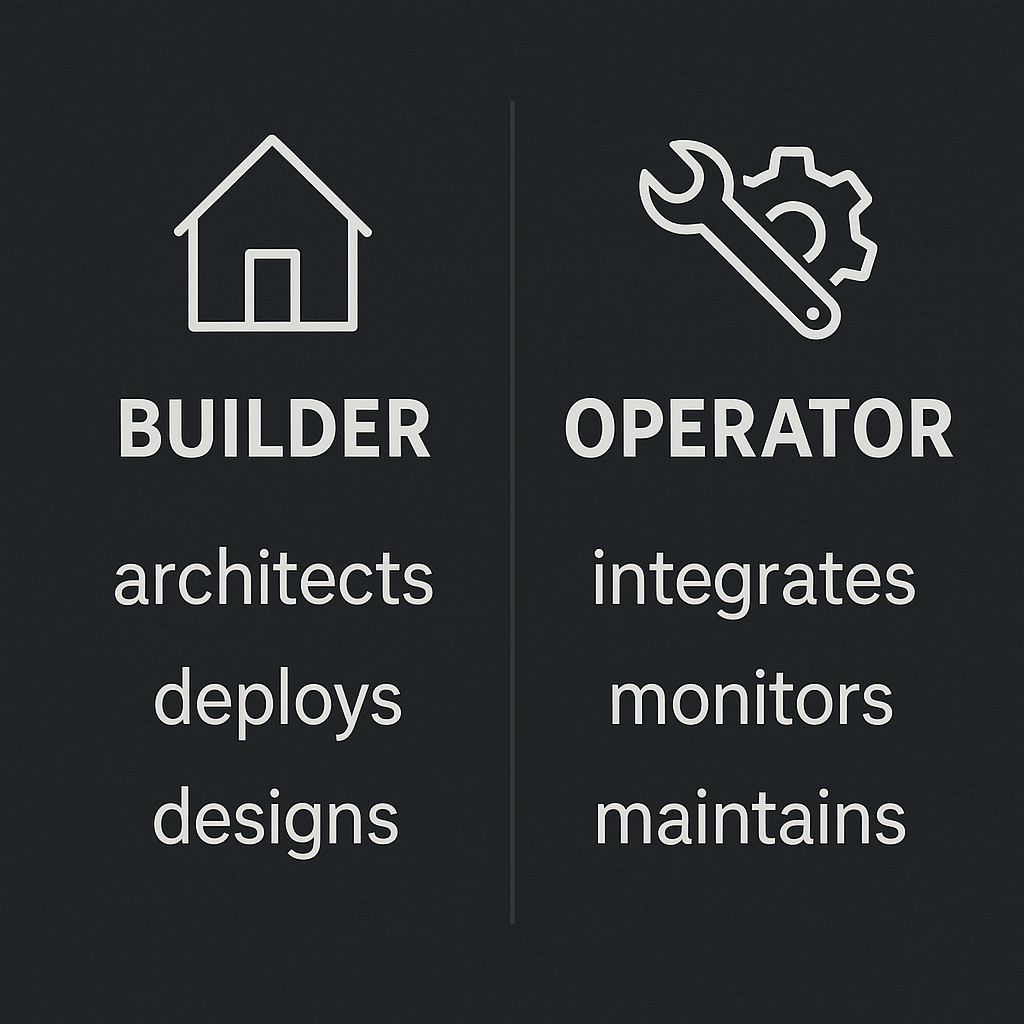
There are two kinds of AI work: design-time intelligence and runtime operations. Design-time is the heavy lifting—architecture, frameworks, pattern discovery. Runtime is execution: running the system, monitoring it, fixing it when it breaks.
The problem? Everyone's being told to become a designer. Nobody's being told to become an operator.
And operating AI systems is actually the second half of the work. Maintaining reliability, safety, and cost over time is what turns an expensive prototype into a durable capability. Most "AI builders" never get there. They ship a demo, hit the 80/20 wall—where AI excels at scaffolding but fails on edge cases and production hardening—and walk away.
The gap isn't technical. It's strategic. You need people who know when to build, when to buy, and when to skip AI entirely.
Build vs. Buy: The Numbers Don't Lie
Here's what the data says:
- 80% of enterprise AI needs are met by purchased solutions. 20% require custom builds.
- Purchased SaaS AI typically costs $67K–$180K over 5 years. Custom builds run $300K–$1.6M.
- Off-the-shelf delivers results in 2–8 weeks. Custom takes 4–12 months.
Those numbers aren't opinions. They're from analysts and practitioners who've run the experiments.
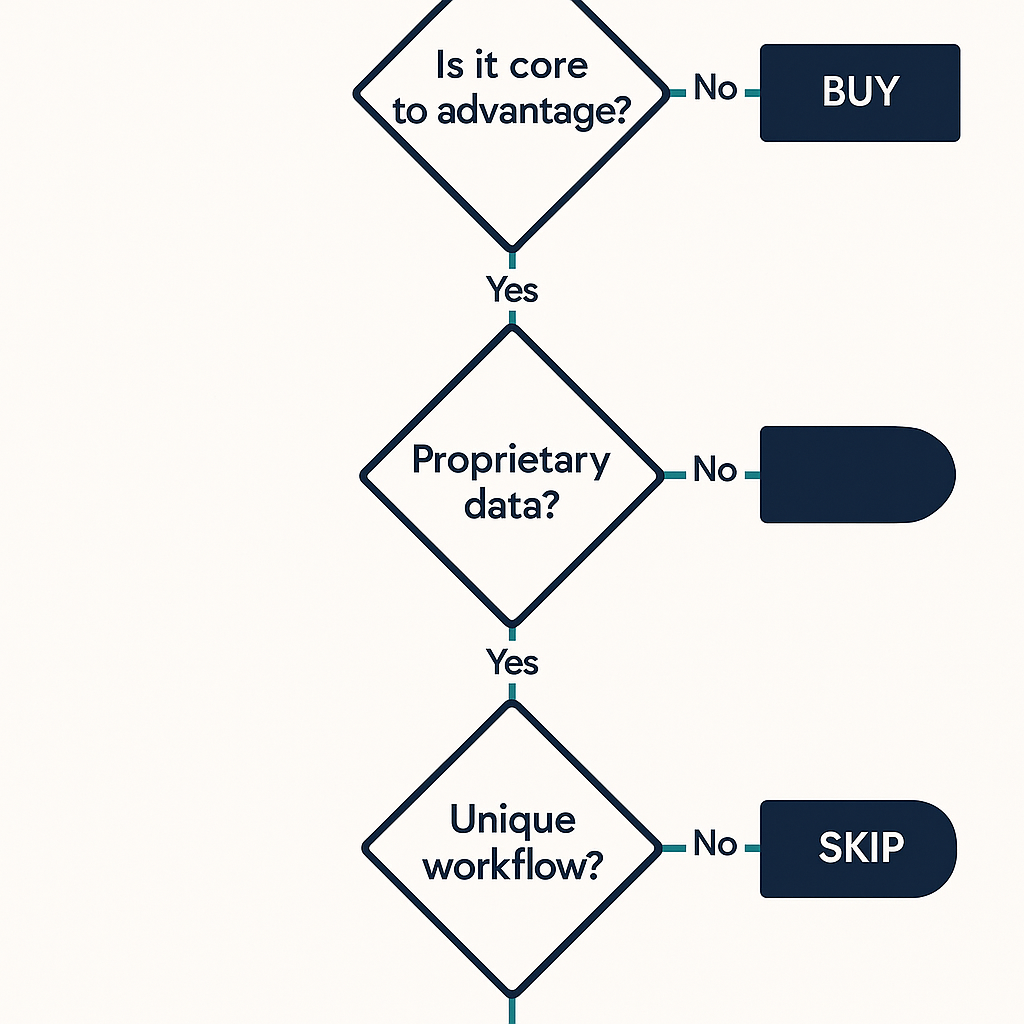
When to buy:
- The capability isn't core to your competitive advantage
- Multiple vendors already solve 80%+ of your requirements
- It's horizontal—chatbots, document processing, basic automation
- You lack engineering bandwidth to maintain custom systems long-term
When to build:
- The system is a true source of competitive advantage
- You have proprietary data off-the-shelf tools can't leverage
- Your workflow is genuinely unique to your industry
- You have team stability and bandwidth to maintain it
The smart sequence? Buy first. Build later. Validate with off-the-shelf, then invest in custom where it actually matters.
The Builder.ai Lesson
Builder.ai raised $100 million. They claimed their AI "Natasha" could build 80% of apps automatically. "The majority of the work is done in the first couple of hours," the CEO said.
They filed for bankruptcy. Behind the scenes, human "productologists" did most of the work. The AI hype masked human labor. The promise of "everyone is a developer" crashed into reality: architecture, edge cases, and production hardening still require people who know what they're doing.
That's not an isolated failure. It's a pattern. "Vibe coding" and prompt-based building hit the same wall: AI excels at initial scaffolding. It fails on maintenance, edge cases, and the unglamorous work that makes systems actually run.
The consensus from the field: prompt-based building requires actual coding knowledge to use effectively. The "no-code for everyone" promise was oversold.
AI Literacy ≠ AI Building
Here's what everyone actually needs: AI literacy.
AI literacy means:
- Understanding when AI is genuinely needed versus hype
- Interpreting outcomes correctly and spotting bias
- Making intentional, responsible choices about when and how to use AI
- Knowing your rights and limitations as a user
That's different from building. Building means understanding models, training data, APIs, deployment, and maintenance. It's a specialized skill. And it's not the only path to leverage.
The dangerous gap: operational skills (using AI tools) are eclipsing critical reasoning about them. People learn to operate tools before they learn to evaluate them. That's backwards.
You don't need to build to lead. You need to decide well. That's literacy.
Four Mindsets, Not Four Job Titles
Research from DORA and others shows that "builder" isn't a job title. It's a mindset based on intent:
- Founders use AI as their dev team to validate ideas quickly
- Optimizers vet AI for specific, reliable tasks within existing systems
- Accelerators use AI as a partner to enhance existing skills
- Learners rely on AI for foundational guidance
Each mindset needs different tools. Each has a different risk profile. Assuming everyone with a certain title should "build" is a mistake. Most people will get further by optimizing, accelerating, or learning—and knowing when to buy.
The Question You Should Ask First
Can you solve this without AI?
Most problems need better data, workflows, or UIs—not machine learning. If the value only exists because it uses "fancy technology," you're chasing innovation theater, not outcomes.
Ask:
- What's the actual bottleneck?
- Would a better process solve it?
- Would an existing tool solve it?
- Is this core to how we win?
If the answer is "no" to the last one, buy. If the answer is "yes" to all four, then—and only then—consider building.
What to Do Instead
1. Develop AI literacy, not just AI building. Understand when and why to use AI. That's table stakes for every operator.
2. Buy first. Validate with off-the-shelf solutions. Get quick wins. Prove the use case. Then build where it matters.
3. Invest in operators. People who integrate, monitor, and maintain AI systems are scarce. Train them. Value them. They're the bottleneck.
4. Know your exit ramps. When you do buy or use no-code tools, ensure exportable data, replaceable services, and feature flags. Avoid vendor lock-in.
5. Separate design-time from runtime. Don't push all cognitive work to runtime. Pre-compute decisions where possible. Make API calls cheap and fast.
The Real Question
The question isn't whether AI will change how work gets done—it will. The question is whether you'll be the one making the build vs. buy vs. skip decision with clarity, or the one chasing the next "everyone's a builder now" hype cycle.
Operate first. Build when it matters.

Written by
Ben Laube
AI Implementation Strategist & Real Estate Tech Expert
Ben Laube helps real estate professionals and businesses harness the power of AI to scale operations, increase productivity, and build intelligent systems. With deep expertise in AI implementation, automation, and real estate technology, Ben delivers practical strategies that drive measurable results.
View full profile