Build a Code Violation Intake Desk Before AI Prices Distressed Listings
A distressed listing does not need faster AI language first. It needs a clean code-violation intake desk. When a seller says the city sent a notice, the house has open citations, or a buyer asks whether a repair item is "just cosmetic," an AI assistant can easily turn incomplete facts into confident pricing, disclosure, or contractor advice. That is the wrong order. The right order is to capture the official record, label the risk, route the decision, and only then let AI help with retrieval, reminders, and plain-English summaries.
The timing matters because AI is now ordinary real estate infrastructure, not a novelty. NAR's 2025 Technology Survey reported that 46% of agents who are REALTORS use AI-generated content, while 20% use AI daily and 22% use it weekly. That level of adoption means brokerages should assume that listing copy, seller follow-up, repair notes, CRM tasks, and valuation narratives will increasingly pass through AI systems. A code-violation workflow keeps those systems from guessing about safety, legality, deadlines, liens, or required corrections.
What the intake desk captures
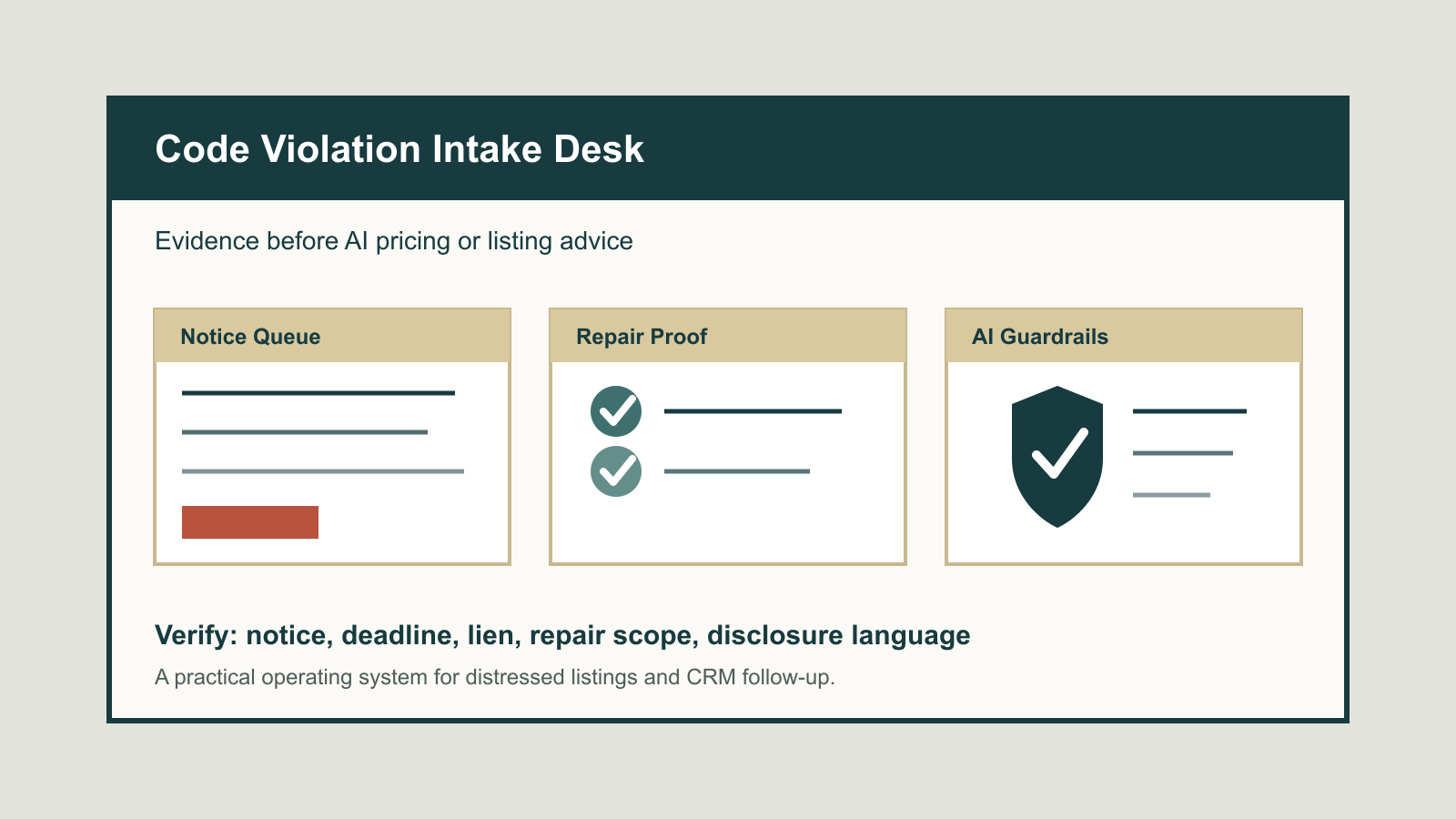
The desk starts with the official notice. Save the code-enforcement letter, inspection report, citation, correction order, hearing notice, deadline, appeal instructions, contact information, case number, parcel number, and any photos supplied by the municipality. If the seller only has a screenshot or verbal summary, mark the file as unverified and assign a human task to obtain the record from the proper city, county, township, or association source.
The second folder is property-maintenance context. Many communities use the International Property Maintenance Code or a local equivalent to set minimum standards for existing buildings. The National Center for Healthy Housing explains that the IPMC applies to existing buildings and is commonly used as part of local housing codes, while other construction codes are often triggered by permits or rehabilitation work. That distinction matters for listing operations. A missing handrail, unsafe porch, deteriorated paint, abandoned structure, or sanitation issue may not be a future remodeling idea. It may already be an active compliance problem with deadlines.
The third folder is repair and hazard evidence. For older homes, lead paint is a common example of why loose language is dangerous. EPA's current Lead Renovation, Repair and Painting page, last updated April 24, 2026, says deteriorated paint in pre-1978 homes can create lead hazards and that paid work disturbing painted surfaces in covered homes generally requires certified firms and trained workers. An AI assistant should not tell a seller to "just touch up the trim" or tell a buyer that peeling paint is minor without knowing the age of the property, occupancy context, planned work, and required professional involvement.
The fourth folder is contractor and permit risk. FTC consumer guidance warns that home-improvement scammers may pressure owners, demand full upfront payment, ask for cash, or tell the homeowner to pull required permits. In a listing workflow, that guidance becomes a practical control: record who recommended the contractor, license and insurance evidence when available, who is responsible for permits, the written scope, deposit terms, completion proof, and whether the repair actually resolves the cited issue.
How AI should use the desk
The desk gives AI a narrow job. It can summarize the status of a notice, pull the next deadline into the CRM, draft a seller-facing checklist, create a broker-review task, or prepare neutral listing-team notes. It should not decide whether an item must be disclosed, whether a property is legally habitable, whether a violation will become a lien, whether a buyer can obtain financing, or what discount fully prices the risk. Those are professional judgment calls that depend on local rules, contract language, lender overlays, and legal advice.
Use a simple status model: unverified, open, under review, correction scheduled, corrected pending inspection, closed, or escalated. Every AI-generated task should inherit that status. If a record is unverified, the assistant can ask for the official notice. If a deadline exists, it can create reminders. If a repair is complete but no reinspection or closure letter exists, it can flag the gap. If the seller asks whether the issue affects price, it should route the question to the agent, broker, attorney, or qualified contractor instead of inventing a valuation adjustment.
That structure follows the practical spirit of the NIST AI Risk Management Framework. NIST describes the framework as a way to manage risks to individuals, organizations, and society from AI systems, and its 2026 update notes continued work on trustworthy AI profiles. For a brokerage, the local version is operational: map the facts, govern who can approve language, measure whether AI stays inside approved uses, and manage escalation when the file contains legal, safety, financing, or disclosure risk.
The field list
Use one row per issue. The required fields are property address, parcel ID, municipality, case number, source document, notice date, response deadline, alleged condition, affected area, severity, occupancy status, required action, assigned owner, allowed AI use, blocked AI language, disclosure review owner, contractor status, permit status, reinspection status, closure evidence, and next reminder date.
Two fields deserve special attention. The first is "allowed AI use." Approved values might include summarize official notice, draft internal task, draft seller document request, create deadline reminder, or compare repair proof to checklist. The second is "blocked AI language." Block phrases such as safe, legal, compliant, no issue, easy fix, guaranteed closing, minor violation, no permit needed, or priced in unless a human has approved the exact statement.
The operating cadence
Run the intake desk before the listing appointment when possible. Ask the seller directly about city notices, HOA notices, condemned or unsafe-structure language, prior work without final inspections, open permits, fire or health department notices, vacant-property registration, rental inspections, and unresolved contractor disputes. Do not bury this in a general seller questionnaire. Give it its own section because the workflow touches pricing, marketing, access, repairs, buyer confidence, and legal routing.
At listing preparation, the coordinator verifies the source documents and tags every open issue. The agent reviews market impact and seller options. The broker or attorney reviews disclosure-sensitive language. The repair coordinator tracks contractor proof and municipal closure. The CRM sends reminders only from verified dates. The AI assistant can help assemble the packet, but it should never become the authority for whether the property is compliant.
What to measure
Measure the process with evidence, not optimism. Track how many listings had code-violation intake completed before pricing, how many issues were unverified at launch, how many deadlines were missed, how many repairs lacked closure proof, how many AI drafts were blocked for risky language, and how many buyer questions were answered from official records instead of memory.
A code-violation intake desk is not glamorous, but it is exactly where AI implementation becomes real. It turns scattered notices and seller recollections into a controlled operating record. It helps agents price and market distressed listings without pretending uncertain facts are settled. It protects clients from vague repair advice. And it gives AI a useful role: organizing the work, not making the call.

Written by
Ben Laube
AI Implementation Strategist & Real Estate Tech Expert
Ben Laube helps real estate professionals and businesses harness the power of AI to scale operations, increase productivity, and build intelligent systems. With deep expertise in AI implementation, automation, and real estate technology, Ben delivers practical strategies that drive measurable results.
View full profile