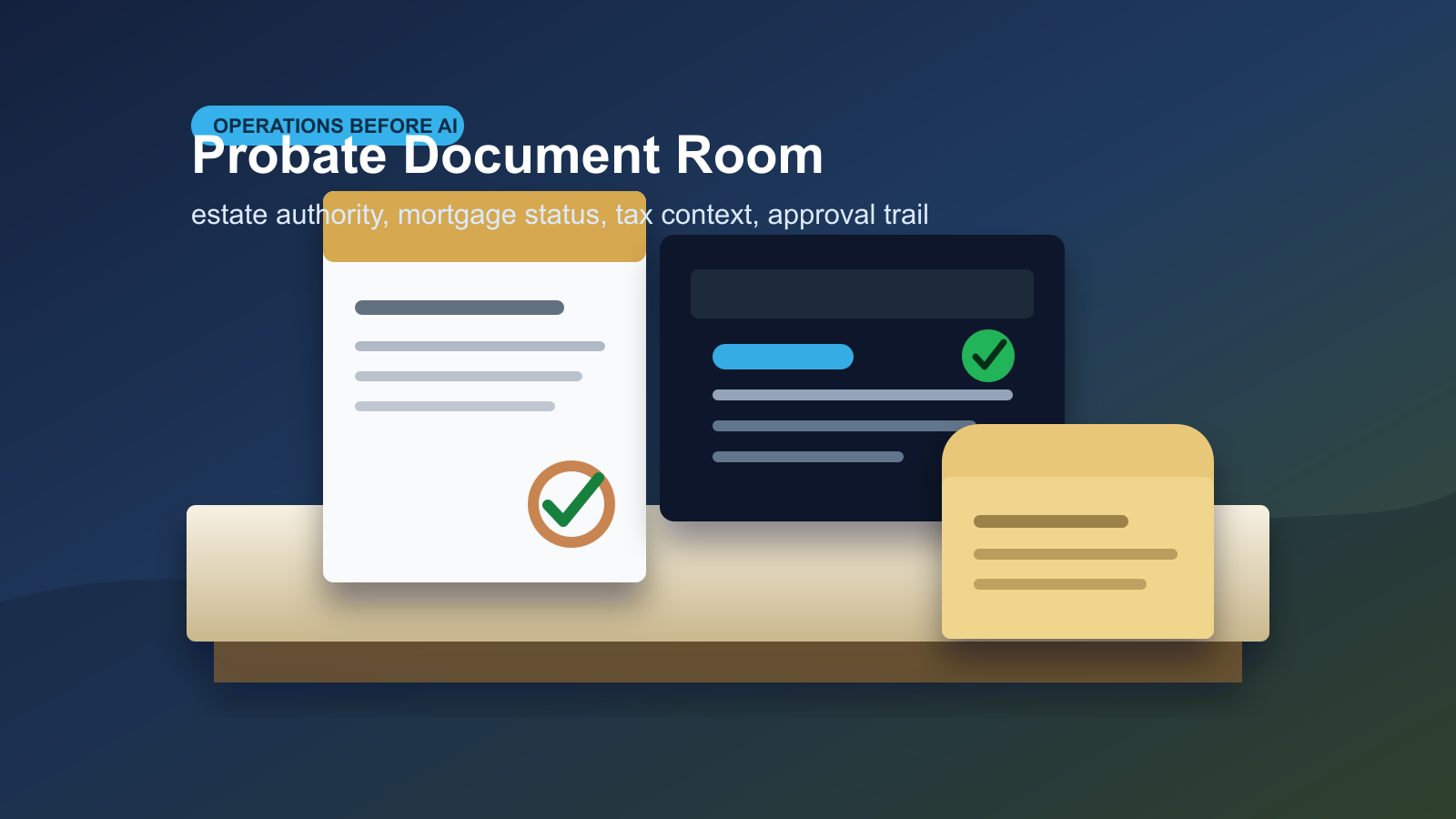
Build a Probate Document Room Before AI Answers Estate Sellers
AI can make estate-sale communication sound clean long before the file is clean. That is the problem. A real estate team may have a grieving family, an executor, multiple heirs, a mortgage servicer, an attorney, a title company, and tax questions all moving at once. If the CRM assistant answers from scattered notes, it can accidentally treat the wrong person as authorized, summarize a mortgage problem too casually, or turn a local legal issue into confident client advice.
The safer move is to build a probate document room before AI drafts seller updates, listing-prep checklists, buyer answers, or follow-up messages for an inherited property. The room does not make the agent a lawyer or tax advisor. It gives the team a verified operating layer: who can speak, what documents prove that authority, what questions must route to counsel, and what language is approved for client-facing use.
Why this belongs in the AI workflow now
Real estate teams are already using AI in client operations. NAR's 2025 Technology Survey reported that 46% of surveyed REALTORS used AI-generated content, and that many agents use AI daily or weekly in the business. That makes probate and inherited-property files a high-risk workflow, not a future edge case. The more a team uses AI for listing descriptions, follow-up, and client service, the more it needs a clean boundary around authority-sensitive transactions.
Probate files are different from ordinary seller files because the basic facts can change the permitted action. The person asking for a market update may be the heir, the surviving spouse, the court-appointed personal representative, a co-owner, or simply the relative handling logistics. The IRS describes a personal representative as the person responsible for collecting assets, paying creditors, and distributing remaining property to heirs or beneficiaries. That is not the same as every family member who has an opinion about the listing.
Mortgage servicing adds another risk layer. CFPB's December 2024 report on successor homeowners found recurring problems after death or divorce, including repeated paperwork requests, delays, and pressure to refinance instead of keeping an existing mortgage where guidelines allow it. CFPB Regulation X also treats a confirmed successor in interest as a borrower for specific servicing protections. A real estate assistant should not improvise around that. It should know when to say, "we need servicer-confirmed status and counsel-reviewed next steps before we draft guidance."
Tax context is just as sensitive. IRS Publication 559, updated April 30, 2026, explains that inherited property basis is generally tied to fair market value on the date of death or an alternate valuation date if elected by the personal representative. That does not mean an agent should calculate tax impact. It means the CRM should preserve date-of-death valuation evidence, appraisal references, closing estimates, and referral notes so the family can take them to qualified tax counsel.
NIST's AI Risk Management Framework is useful here because it frames AI as a system that needs risk management in design, use, and evaluation. A probate document room is that idea translated into real estate operations: map the risks, measure whether source records are complete, manage approvals, and govern what the assistant is allowed to say.
What the document room should contain
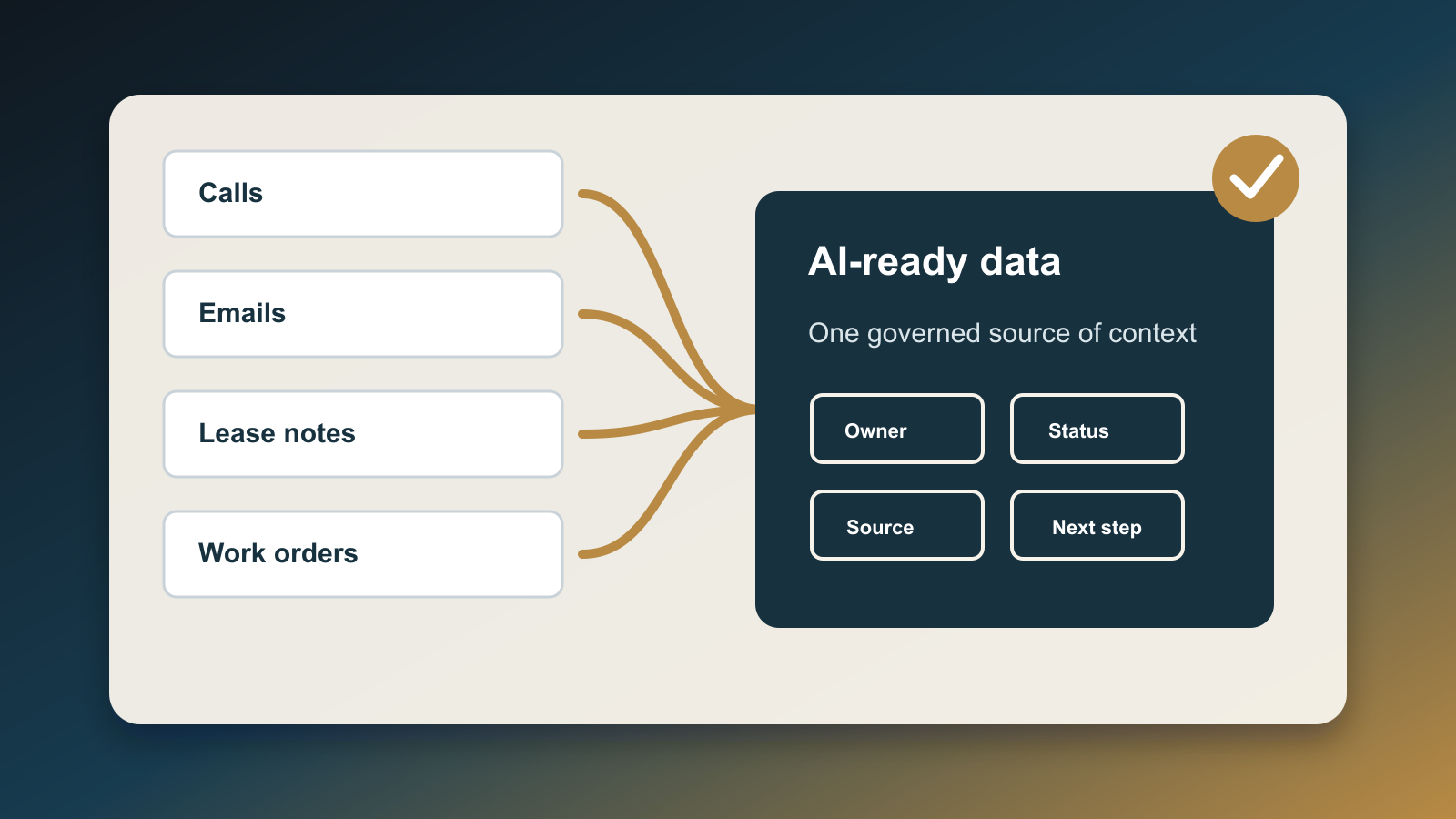
Start with authority evidence. Store the death certificate status, will or trust references where permitted, letters testamentary or letters of administration, court appointment details, executor or administrator contact information, attorney contact information, and title-company instructions. The AI should not need full sensitive documents in its prompt. It needs a structured status: verified, pending, rejected, expired, or counsel-only.
Next, create a party map. List surviving spouse, personal representative, heirs or beneficiaries, co-owners, occupants, attorney, title officer, mortgage servicer, property manager, and any person who is explicitly not approved for updates. Add the communication rule for each person: can receive scheduling updates, can approve pricing language, can approve repairs, can receive mortgage discussion, counsel only, or no direct communication.
Then add a mortgage and lien lane. Capture loan servicer, loan number redaction status, payment status known or unknown, escrow status, foreclosure or default flags, reverse mortgage flag, successor-in-interest status, and the exact owner of the next task. The AI should not draft promises such as "the family can assume the loan" unless that has been confirmed by the servicer and reviewed by the right advisor. Most of the time, the approved output is narrower: "we are waiting on servicer confirmation before discussing loan options."
Add a valuation and tax evidence lane. Keep date-of-death value references, appraisal files, comparative market analysis versions, repair estimates, carrying costs, property tax records, insurance notes, and closing-cost estimates. Tag each item by purpose: listing strategy, tax-advisor context, title context, buyer disclosure, or internal planning. This prevents AI from reusing a tax-context estimate as a public pricing claim.
Finally, add a communications lane. Store the approved short phrases the assistant can use, the topics it must route to a human, and the topics it must route to attorney, CPA, lender, servicer, or title. Probate work needs calm language, but calm language still needs source control.
The AI permissions model
Give the assistant three modes.
Mode one is intake. The AI can summarize what is missing, draft a checklist for internal review, and assign tasks. It cannot answer legal, tax, mortgage-assumption, or authority questions. It can say that the file is waiting on appointment evidence, title review, or servicer confirmation.
Mode two is approved client service. The AI can draft scheduling messages, document-request reminders, property-access coordination, and status updates from approved fields. It should cite the internal record it used: task ID, document status, owner, and approval timestamp. If a field is unknown, the message says it is unknown. It does not fill the gap with general knowledge.
Mode three is advisor handoff. The AI can prepare a question packet for the attorney, CPA, lender, title company, or mortgage servicer. It should include the known facts, the open questions, and the documents attached. It should not give the answer itself.
This permissions model is simple enough to implement in a CRM. Add fields for authority status, party role, advisor owner, document status, and approved message templates. Add automations that block outbound AI drafts when authority is pending or when a topic is marked counsel-only.
A practical build sequence
First, create the estate file template. Do not start with AI prompts. Start with the columns your team needs to avoid mistakes: authority proof, party role, verified contact, property access, mortgage status, title status, tax-context evidence, advisor owner, and outbound-message approval.
Second, add document status values. Use the same values everywhere: not requested, requested, received, verified, rejected, expired, counsel-only, and not applicable. These values matter because they let the assistant explain status without seeing sensitive document contents.
Third, write the approved language library. Include short, plain sentences for missing authority, missing servicer confirmation, valuation evidence, tax-advisor referral, and title review. Keep it boring. In probate files, boring is usually safer than polished.
Fourth, add exception triggers. Any mention of loan assumption, tax basis, estate tax, will dispute, heir conflict, reverse mortgage, foreclosure, bankruptcy, or contested authority should route to a human before the AI drafts external language.
Fifth, audit the first ten files. Compare AI drafts against source records. Look for invented authority, overconfident mortgage language, missing advisor disclaimers, and any client update that fails to name the actual next owner. Fix the data model before expanding the workflow.
The operating rule
The goal is not to make AI answer probate questions. The goal is to stop AI from answering before the business knows which facts are verified and who has authority to act. Once the document room is in place, AI becomes useful again: it can organize missing items, prepare advisor handoffs, keep family updates consistent, and reduce follow-up load without turning grief, title, mortgage, and tax complexity into improvised advice.
For estate sellers, the best automation is not the fastest message. It is the message that knows when the file is not ready yet.

Written by
Ben Laube
AI Implementation Strategist & Real Estate Tech Expert
Ben Laube helps real estate professionals and businesses harness the power of AI to scale operations, increase productivity, and build intelligent systems. With deep expertise in AI implementation, automation, and real estate technology, Ben delivers practical strategies that drive measurable results.
View full profile