Build a Tenant-Access Ledger Before AI Books Occupied Listings
AI can make showing coordination look easy. It can read a buyer's availability, compare it with calendar openings, draft a polite message, and push the appointment into a CRM before a coordinator has finished another call. That speed is useful for vacant homes and simple appointments. It is much riskier when the listing is occupied by a tenant.
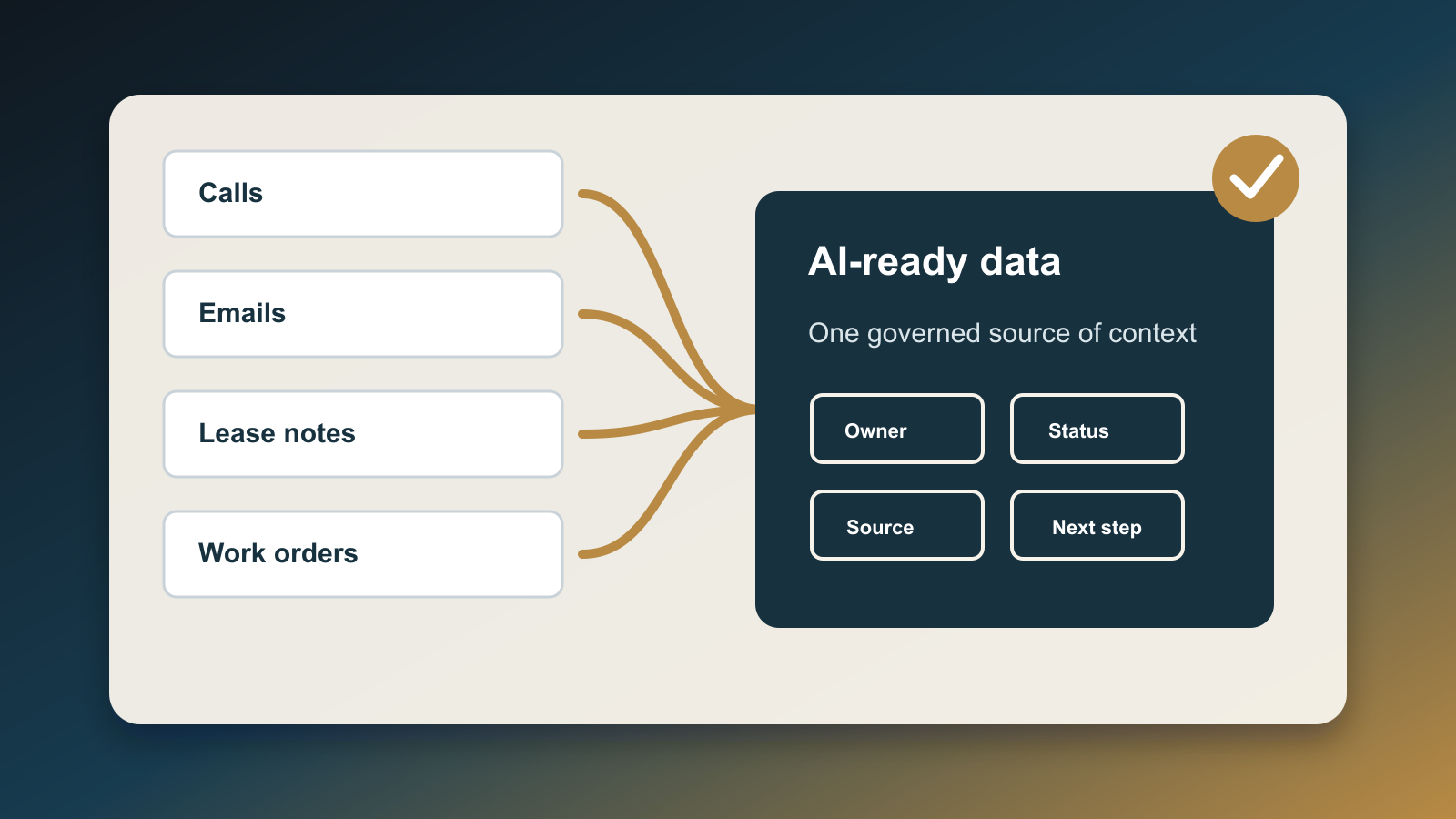
A tenant-occupied listing is not just a scheduling problem. It is someone else's home, a lease file, a seller relationship, a buyer-tour workflow, and a broker-access obligation sitting on top of local entry rules. When those facts live in text threads, scattered notes, MLS remarks, and a property manager's inbox, an AI assistant has too much room to infer. It may offer a time that was never approved, treat oral consent as durable consent, omit a required notice step, or tell a buyer's agent that access is available when the access terms are still conditional.
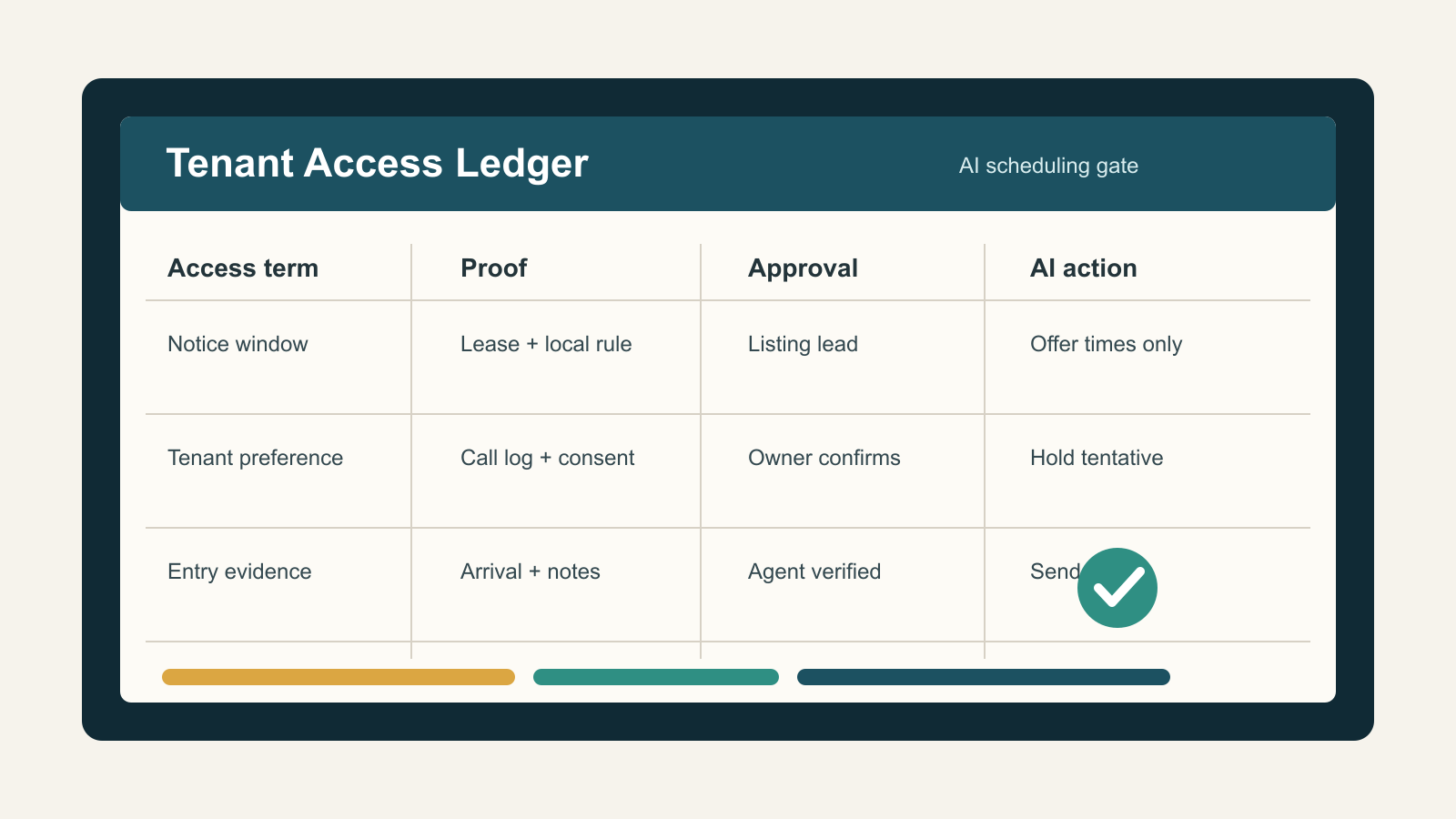
The practical fix is not to ban automation from occupied listings. The fix is to build a tenant-access ledger first, then let AI work only from the ledger. The ledger is the operational record that says who may request access, what notice is required, which time windows are tenant-approved, what evidence supports those windows, and what the AI is allowed to do next.
Why this belongs in the CRM before the chatbot
Real estate teams are already using AI and digital tools in client service. NAR's 2025 Technology Survey reported that 46% of agents who are REALTORS used AI-generated content, while eSignature and social media remained even more common digital tools. That means the real question is no longer whether AI enters the workflow. It is whether the workflow gives AI a verified source of truth before it speaks or schedules.
NIST's AI Risk Management Framework is useful here because it treats AI risk as something organizations manage through governance, measurement, and controls, not as a vague technology concern. A tenant-access workflow needs the same idea in plain operating terms: the model can draft and route, but it should not invent authority, notice, consent, or availability.
NAR's 2026 Code of Ethics also makes access accuracy more than an etiquette issue for REALTORS. Standard of Practice 3-8 says REALTORS should not misrepresent access availability for showing or inspecting a listed property. Standard of Practice 3-9 says a cooperating broker, or someone acting outside the listing broker/property manager role, should not access or enable access on terms other than those set by the owner or seller. Those standards do not replace state law, leases, brokerage policy, or property-management instructions, but they show why an AI scheduling layer needs hard access terms instead of informal memory.
Local law can be more specific. California Civil Code section 1954, for example, lists circumstances when a landlord may enter a dwelling unit, includes rules about normal business hours, references reasonable notice, and addresses showing a unit to prospective purchasers. The point is not that every market follows California's exact rule. The point is that occupied-listing access often has jurisdiction-specific conditions. A national CRM prompt should not guess them.
The ledger fields that matter
A useful tenant-access ledger is small enough for agents to maintain and strict enough for automation to trust. It should sit on the listing record or a related access object, not in a free-form note.
Start with the authority layer. Capture the seller's access instructions, the property manager contact if one exists, lease or occupancy notes that affect showings, local notice requirements as verified by the brokerage, and any brokerage-specific policy. Add a field for who verified each item and when. If no one has verified it, the value should be treated as unavailable to AI.
Next, capture the tenant communication layer. This is not a place for vague summaries like "tenant is flexible." Use structured rows: date contacted, channel used, person contacted, time window discussed, whether the window was accepted, whether the tenant requested conditions, and where the supporting evidence lives. If the tenant prefers no overlapping tours, requires a pet instruction, or only allows showings after work, that belongs in explicit fields.
Then add the showing-request layer. Each buyer-side request should record the requester, proposed time, buyer or agent identity, whether the listing side has confirmed the tenant window, and whether the request is firm, tentative, declined, or needs human review. AI can help sort and respond to these requests, but the status should be constrained.
Finally, add the entry-evidence layer. After a showing, record who entered, when they entered, whether required evidence of entry was left when applicable, whether any condition changed, and whether the tenant or owner raised a concern. This protects the next appointment from relying on stale assumptions.
What AI may do once the ledger exists
Once the ledger is structured, AI becomes safer and more useful. It can draft messages to the tenant using the verified notice window. It can suggest appointment slots that already pass the access rules. It can summarize buyer-agent requests for the listing coordinator. It can flag conflicts, such as a requested time outside normal business hours, missing owner approval, an expired 120-day oral-contact notice in a jurisdiction that uses that concept, or a tenant preference that contradicts the proposed window.
The key is to define negative permissions. AI may not confirm access unless the ledger status is approved. It may not tell a buyer's agent the property is available to show if the tenant window is tentative. It may not rewrite a local legal requirement into a friendly shortcut. It may not expose tenant details that are unnecessary for the appointment. It may not create an access code, share lockbox details, or mark a showing complete without a human-controlled event from the showing system or coordinator.
A good implementation can be simple. Use required fields, status transitions, and message templates. Treat missing proof as a blocker. Put the access record in the CRM timeline so the next person sees the same facts. Route exceptions to a listing lead, not to a more creative prompt.
The weekly operating rhythm
The ledger only works if someone owns it. During listing intake, the listing lead should classify whether the property is vacant, owner-occupied, tenant-occupied, or property-manager controlled. Tenant-occupied listings should open an access checklist before marketing copy, showing instructions, or AI scheduling rules are activated.
Before launch, the team should verify the seller's instructions, local access requirements, tenant contact path, showing windows, and message templates. During active marketing, the coordinator should review the ledger daily or whenever a new request arrives. After every showing, the team should close the loop with entry evidence and any changed condition. If the tenant changes a preference, the old value should not be overwritten silently; keep an audit trail.
This rhythm keeps AI in its best role. It handles repetition, drafting, reminders, and queue management. Humans handle authority, exceptions, relationship judgment, and legal escalation.
A practical build sequence
Start with one tenant-occupied listing rather than a full platform rebuild. Add a required occupied-status field. Add a related access-ledger table with authority, communication, request, and entry-evidence sections. Create three statuses: blocked, tentative, and approved. Let AI draft only from approved fields. Log every outbound message. Require a human approval event before any external confirmation.
Then connect the ledger to the showing workflow. If a buyer-side request arrives, the CRM should check the ledger before AI responds. If the request fits an approved window, AI can draft the confirmation for review or send it under rules the broker has approved. If it does not fit, AI can draft a decline or alternate-time message, but it should cite the internal reason from the ledger, not invent a client-facing explanation.
The payoff is operational clarity. Sellers get fewer surprises. Tenants get more consistent notice handling. Buyer agents get cleaner appointment responses. Coordinators spend less time reconstructing what happened. AI becomes a controlled accelerator instead of an unsupervised scheduler sitting on top of fragmented access facts.
For occupied listings, that distinction matters. The fastest appointment is not always the best appointment. The best appointment is the one the team can prove was allowed, communicated, and completed under the terms that actually govern access.
Sources
- National Association of REALTORS, 2025 Technology Survey news release, published September 18, 2025: https://www.nar.realtor/newsroom/realtors-embrace-ai-digital-tools-to-enhance-client-service-nar-survey-finds
- National Association of REALTORS, 2026 Code of Ethics and Standards of Practice, Standard of Practice 3-8 and 3-9, accessed May 13, 2026: https://www.nar.realtor/about-nar/governing-documents/code-of-ethics/2026-code-of-ethics-standards-of-practice
- NIST AI Risk Management Framework page, including April 7, 2026 update notice, accessed May 13, 2026: https://www.nist.gov/itl/ai-risk-management-framework
- California Legislative Information, Civil Code section 1954, accessed May 13, 2026: https://leginfo.legislature.ca.gov/faces/codes_displaySection.xhtml?lawCode=CIV§ionNum=1954

Written by
Ben Laube
AI Implementation Strategist & Real Estate Tech Expert
Ben Laube helps real estate professionals and businesses harness the power of AI to scale operations, increase productivity, and build intelligent systems. With deep expertise in AI implementation, automation, and real estate technology, Ben delivers practical strategies that drive measurable results.
View full profile