Build a Transaction Version Log Before AI Summarizes Deals
Real estate teams are starting to ask AI for the thing every busy transaction needs: "Tell me where this deal stands." That request sounds harmless until the model summarizes the wrong draft, misses a countered addendum, cites a stale disclosure, or blends a lender document with an internal negotiation note.
The fix is not a bigger prompt. It is a transaction version log: a small control layer that tells the AI which document is current, which version is superseded, which changes need human review, and which facts are safe to repeat to a client, lender, co-broker, vendor, or closing team.
This is the difference between using AI as a transaction assistant and letting it become an accidental source of record.
Why this belongs before the assistant
The 2025 NAR Technology Survey release shows why this problem is moving from theoretical to operational. NAR reported that eSignature is used by 79 percent of agents surveyed, while 46 percent report using AI-generated content and 42 percent use AI tools daily or weekly. In other words, the same workflow now contains signed electronic documents, message threads, PDFs, CRM notes, and AI-generated explanations.
That is useful, but it creates a version-control gap. A transaction may include a purchase agreement, counteroffer, inspection addendum, repair amendment, seller disclosure update, HOA packet, appraisal condition note, closing disclosure, wire instruction confirmation, and several email clarifications. If those items live as loose files and AI can read all of them, the model has no reliable way to know what supersedes what.
The CFPB's closing guidance tells buyers to review the Closing Disclosure and other key closing documents in advance, including the promissory note, mortgage or deed of trust, and deed. It also warns consumers not to sign until they have checked that the documents are correct. That same operating principle applies upstream: before AI summarizes the transaction, the team has to know which document set is correct.
What the log controls
A transaction version log is not a document vault. The vault stores files. The log stores authority.
Each row should answer six questions.
First, what is the document? Use a controlled document type such as purchase agreement, seller disclosure, inspection addendum, appraisal addendum, commission agreement, repair invoice, lender condition, title commitment, closing disclosure, or deed.
Second, what is the current version? Store the version label, upload timestamp, signer status, source system, and the person who marked it current. Do not rely on filename order or email timestamps alone.
Third, what did it replace? Link the superseded version and require a short change note: price changed, deadline extended, repair credit added, inspection response countered, disclosure corrected, lender fee updated, or title exception cleared.
Fourth, who approved the change? The answer might be the client, listing agent, buyer agent, broker, transaction coordinator, attorney, lender, title company, or settlement agent. If approval is missing, the log should block AI from treating the document as settled.
Fifth, what can AI say? Separate internal notes from approved client-facing facts. A repair negotiation may be visible to the coordinator but not ready for a buyer update. A seller disclosure correction may be citeable only with the exact current document attached. A closing disclosure may be summarized only after lender or settlement-agent confirmation.
Sixth, when does it expire? Some instructions are temporary. A counteroffer expires. A repair estimate changes. A lender condition gets cleared. A closing disclosure can be revised. AI should not reuse an old answer after the status changes.
The high-risk failure modes
Version mistakes usually look mundane at first.
The assistant tells a buyer that the inspection deadline is Friday because it read the original contract, even though an amendment moved the deadline to Wednesday. It says the seller agreed to a repair credit because it read a draft addendum that was never signed. It summarizes the wrong HOA document because the resale packet was replaced after a special-assessment update. It answers a seller's question from an old net sheet, even though the latest closing-cost estimate changed. It treats a preliminary closing document as final because the filename contains "final".
Those are not model-quality problems. They are authority problems.
NAR's 2026 Code of Ethics reinforces why authority matters in real estate communication. Article 2 says REALTORS should avoid exaggeration, misrepresentation, or concealment of pertinent facts relating to the property or transaction, while also recognizing limits around latent defects, matters outside the license scope, and confidential facts. Article 12 requires real estate communications and representations to present a true picture. AI cannot help satisfy that standard if it is allowed to summarize from stale, draft, or unauthorized documents.
The AI access rule
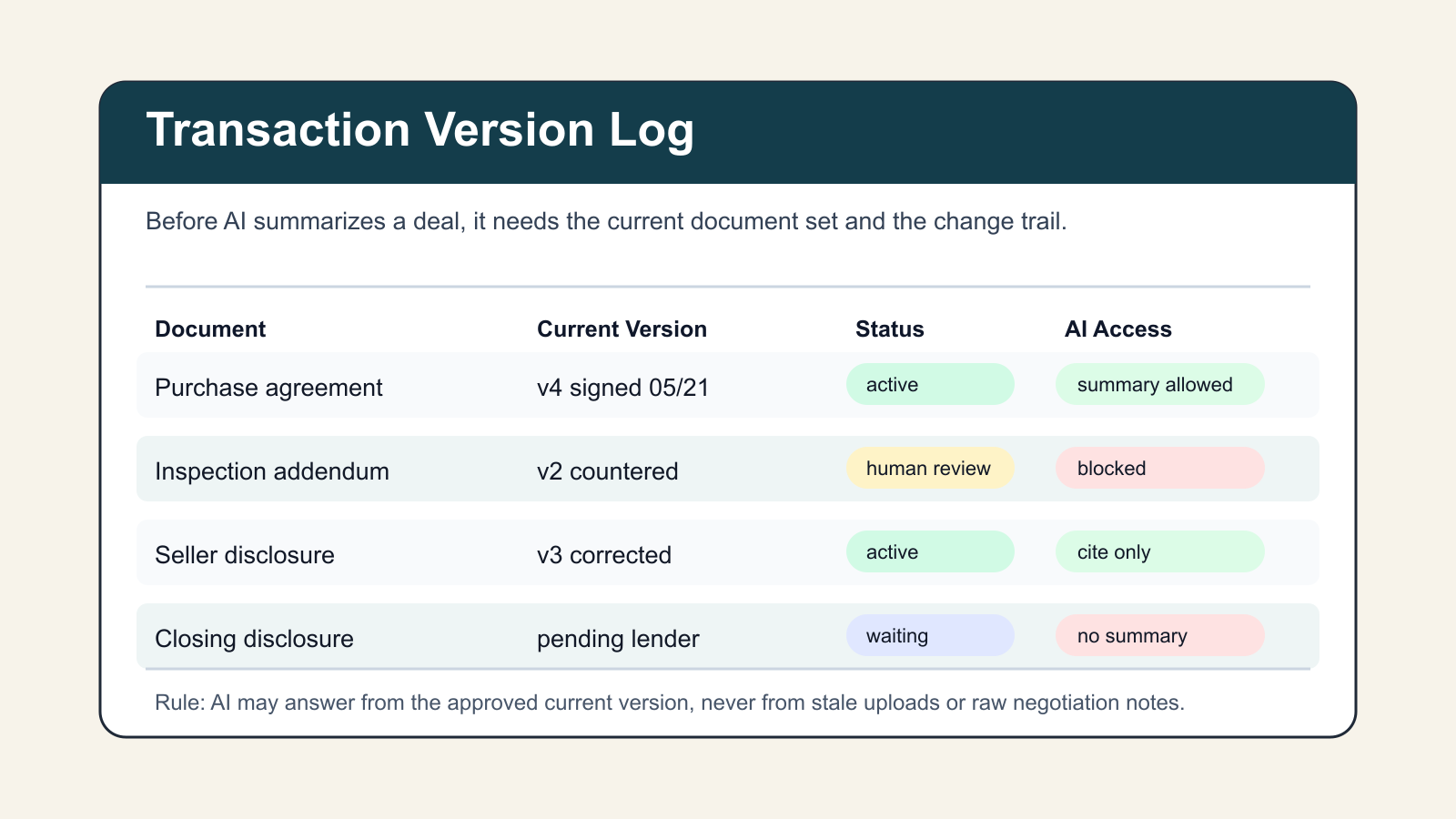
The simplest rule is this: AI may read the approved current-version summary, not every raw document by default.
For each document type, the log should expose a narrow structured view:
- Current version ID and file link.
- Document status: draft, sent, countered, signed, superseded, void, pending review, or final.
- Approved summary written or reviewed by a human.
- Client-facing facts the assistant may repeat.
- Internal-only facts the assistant must not repeat.
- Open questions that require a human owner.
- Related deadlines or dependencies.
If the log says pending review, AI can say that the item is under review and route the question. It should not infer the answer from the latest PDF in the folder. If the log says superseded, AI should ignore the file except when a human asks for history. If two current versions conflict, the workflow should fail closed and ask the coordinator to reconcile the record.
This aligns with the NIST AI Risk Management Framework's practical emphasis on mapping deployment context, measuring performance and risks, managing identified risks, and governing who owns the system. NIST's framework also emphasizes documentation, monitoring in production, and tracking risks over time. A version log gives the business the evidence it needs to do those things in a transaction workflow.
Electronic records need retention, not folklore
Many real estate teams already rely on electronic signatures and electronic delivery. The FDIC's E-Sign Act examination guidance explains that electronic records can satisfy writing requirements when consumer consent and other requirements are met, and it highlights consumer access, retention, and reproduction concerns.
The operational takeaway is straightforward: a team should not treat a signed PDF as just another attachment. It needs to retain the right record, keep it accessible, and preserve enough context to show what was signed, when, by whom, and what later replaced it. The AI layer should inherit that discipline rather than inventing its own history from document names.
Implementation pattern
Start with one table or CRM object called Transaction Version Log. Give every row a transaction ID, document type, version label, status, source URL, uploaded-by field, approved-by field, effective date, supersedes field, AI access level, and approved summary.
Use four AI access levels.
Blocked means the assistant cannot summarize or answer from the document. Internal means the assistant can use the row for staff routing but not client messages. Cite-only means the assistant may answer only when it links or references the approved document. Summary allowed means the assistant may use the approved summary for routine updates.
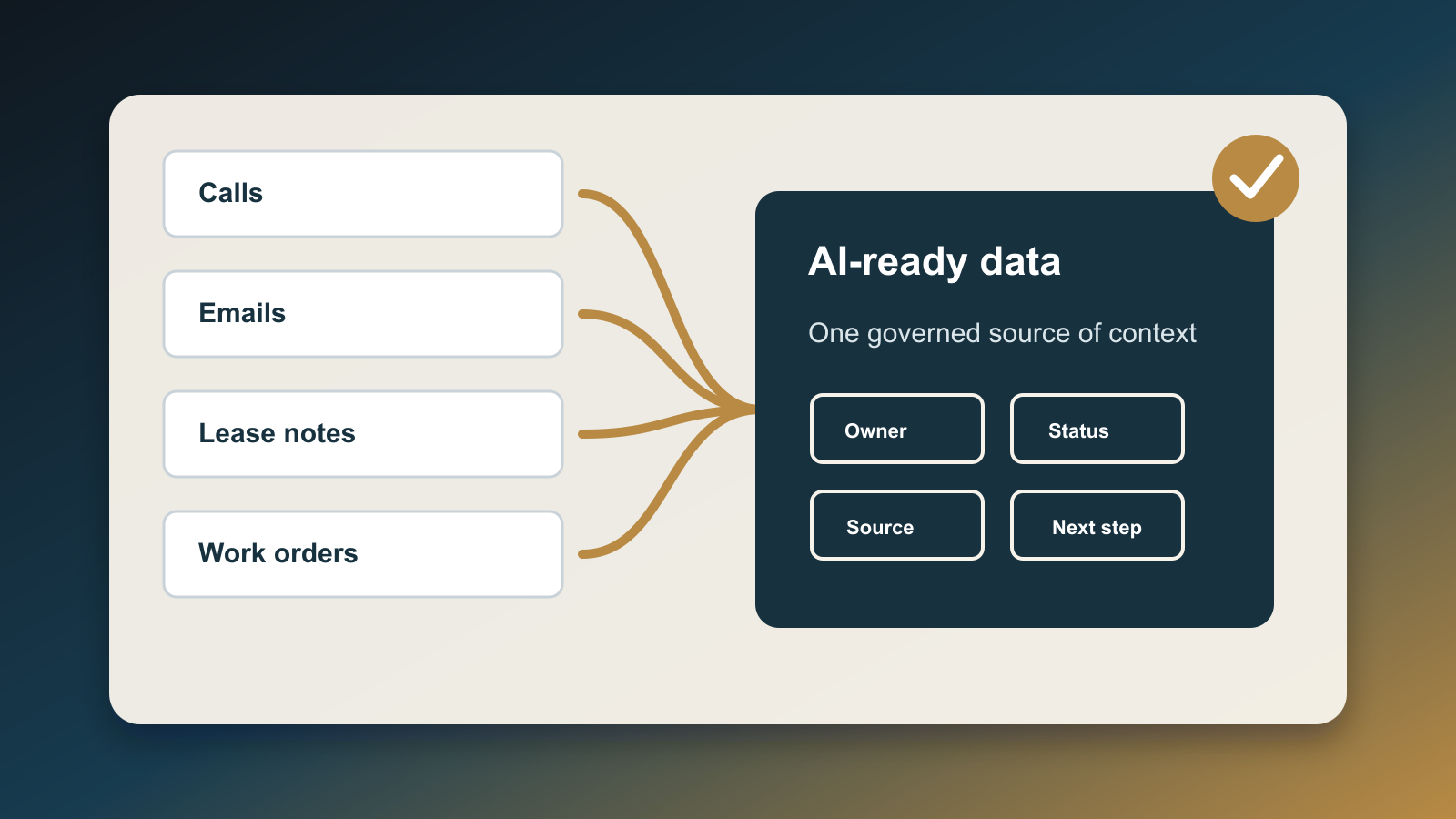
Then connect the log to the file vault, e-signature system, transaction-management platform, and CRM. The point is not to replace those systems. The point is to create one authority layer that tells automation which version is current.
Add three automation checks:
- Before sending a transaction update, confirm every referenced document has current status and an AI access level that allows the answer.
- Before summarizing a deal, scan for conflicting current versions, expired counteroffers, pending signatures, and unresolved review statuses.
- After a new document arrives, mark related prior versions as superseded only when a human or trusted integration confirms the replacement.
The operating test
A useful version log passes five tests.
A coordinator can identify the current signed agreement in less than 30 seconds. A buyer update never cites a superseded addendum. A seller question about terms routes to the current approved summary, not a negotiation thread. A broker can reconstruct who approved an AI-visible summary. A stale file can remain in the vault without becoming part of the assistant's answer.
If the team cannot pass those tests manually, AI will not make the transaction cleaner. It will make the confusion faster.
Build the log first. Once the authority layer is clear, the assistant can summarize, route, remind, and explain with much less risk.
Sources

Written by
Ben Laube
AI Implementation Strategist & Real Estate Tech Expert
Ben Laube helps real estate professionals and businesses harness the power of AI to scale operations, increase productivity, and build intelligent systems. With deep expertise in AI implementation, automation, and real estate technology, Ben delivers practical strategies that drive measurable results.
View full profile