Build a Seller Disclosure Revision Desk Before AI Answers Buyers
Seller disclosures are not a place for AI to improvise from memory. They are a place where changed facts, source documents, timing, and approved language have to stay together.
That becomes harder once a team starts using AI to draft buyer updates, summarize inspection responses, prepare listing notes, or answer questions pulled from CRM history. A disclosure that was accurate on Monday can be incomplete by Friday. A seller may remember a prior leak, a contractor may send a new repair invoice, an inspection response may change the practical context, or a listing agent may need to separate what the seller knows from what a buyer, inspector, attorney, or specialist still needs to verify.
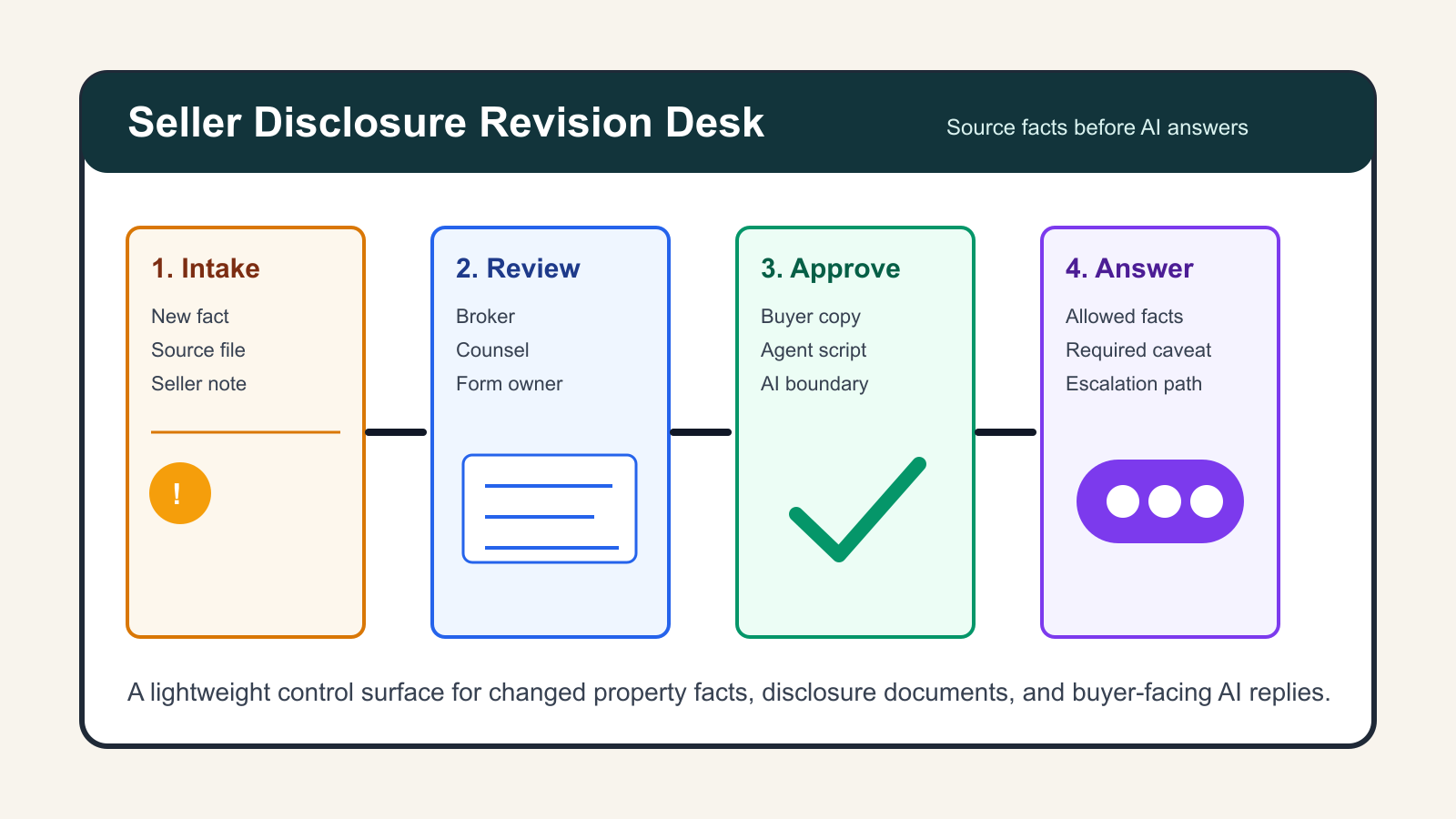
A seller disclosure revision desk gives the team one operating surface for those changes before AI touches the conversation.
Why this deserves its own workflow
Most teams already have transaction checklists, document storage, and message templates. The weak point is the moment after a disclosure is issued and before the next client-facing answer goes out. That is where a loose note can become a confident AI summary.
The risk is not only that the model says the wrong thing. The operational risk is that nobody can explain which version of the disclosure, repair record, seller statement, or broker review supported the answer.
NAR's 2026 Code of Ethics keeps the core duty plain: real estate professionals should avoid exaggerating, misrepresenting, or concealing pertinent property or transaction facts. NAR's ethics guidance also frames a pertinent fact around whether it could affect a reasonable purchaser's decision. That is a strong reason to keep changed disclosure facts out of general CRM notes until they have been reviewed, versioned, and approved for use.
Federal lead-based paint rules show the same pattern in a narrow but important area. EPA explains that sellers, landlords, agents, and property managers must provide specific known lead information before a buyer or renter signs, and must keep a signed copy of those disclosures for three years after the sale or lease begins. Even if your daily issue is not lead paint, the operating lesson is useful: sensitive property facts need source records, timing, acknowledgments, and retention.
The desk is not a legal opinion engine
The desk should not decide what the law requires. That remains a broker, attorney, compliance, and local-form question.
Its job is smaller and more practical:
- Capture the changed fact before it spreads through email, text, CRM notes, and AI memory.
- Attach the source that created the change.
- Identify who reviewed it.
- Record which disclosure document or buyer-facing answer is now current.
- Tell AI what it may summarize, what it must not answer, and when to route the question to a human.
That last point matters because AI adoption is no longer hypothetical in real estate. NAR's 2025 technology survey reported positive client response to technology in the buying and selling process, and real estate teams are spending real monthly budget on tools. The practical question is no longer whether teams will use AI. It is whether the operating layer around AI is good enough for sensitive transaction facts.
Minimum fields for the revision desk
Keep the first version boring. A shared board, CRM custom object, Airtable base, or transaction-management view is enough if it creates a reliable audit trail.
Start with these fields:
Property and transaction: address, MLS or internal transaction ID, seller, buyer side if applicable, and transaction stage.
Original disclosure reference: document name, version date, storage link, and who received it.
Changed fact: short description of the new or corrected fact. Do not ask AI to rewrite this field. Keep it close to the source.
Source type: seller statement, inspection report, contractor invoice, permit record, HOA document, insurance record, prior repair documentation, broker note, attorney instruction, or other source.
Source link: the actual document, email, image, recording summary, or signed form that supports the entry.
Materiality review: not a legal conclusion, but a routing flag: routine update, broker review required, counsel review required, lender/title/HOA review required, or do-not-answer.
Current answer status: draft, under review, approved for buyer answer, revised disclosure sent, superseded, or closed.
Approved language: the exact client-facing statement AI is allowed to reuse, if any.
AI permission: summarize approved language only, answer with source caveat, ask human owner, or block.
Acknowledgment: who was sent the revised disclosure or update, when, by what channel, and where the signed or written acknowledgment lives.
How AI should use it
AI should treat the desk as a permissioned retrieval layer, not as a creative writing prompt.
For example, a buyer asks, "Did the seller ever have roof work done?" If the CRM only has old notes, the assistant should not answer from memory. It should check the revision desk first. If there is an approved entry, it can say the team has a reviewed disclosure update and route the exact approved language. If the entry is under review, it should say the team is checking the file and assign the human owner. If there is no entry, it should ask whether the question should be routed to the listing agent, broker, or seller rather than filling the gap.
That approach lines up with NIST's AI Risk Management Framework: trustworthy AI requires governance, measurement, management, and clear treatment of system limitations. For a real estate team, that does not need to become a giant policy program. It can be a simple rule: AI can only answer disclosure-sensitive questions from reviewed source records.
Where the desk fits in the transaction
Put the desk in four places.
First, connect it to listing intake. When the seller first completes disclosure forms, the team should create the baseline record and store the current source links.
Second, connect it to inspection and repair negotiation. Inspection reports, repair invoices, credits, contractor comments, and seller clarifications often create new context. The desk should decide whether that context changes the disclosure packet, a buyer answer, or both.
Third, connect it to marketing and listing updates. Listing descriptions, social posts, showing notes, and AI-generated FAQs should not keep repeating old property-condition language after a revised fact is approved.
Fourth, connect it to closing and post-closing retention. If a question comes back later, the team should be able to identify what was known, when it was reviewed, what was sent, and which language was approved.
A simple weekly control
Once a week, run a 15-minute disclosure revision review. Pull every entry that is under review, every entry with no source link, every AI-permission field set to anything other than approved, and every property with a changed fact but no acknowledgment record.
The meeting has only four decisions:
- Close entries that are fully documented.
- Escalate entries that need broker, attorney, lender, title, HOA, or specialist review.
- Update the approved language library.
- Remove stale AI answers from templates, CRM snippets, listing FAQs, and marketing drafts.
That last step is where many teams miss the benefit. A disclosure revision desk is not only a compliance backstop. It is also a content hygiene system. It prevents AI from making old listing copy, old showing notes, or old transaction summaries sound current.
What to measure
Track a few practical numbers:
- Changed facts captured before buyer-facing response.
- Entries missing a source document.
- Entries waiting on broker or counsel review.
- Revised disclosures sent with acknowledgment.
- AI answer attempts blocked or routed because the fact was not approved.
- Time from changed fact to approved client-facing language.
These metrics tell you whether AI is speeding the process or simply making weak documentation more visible.
The implementation principle
Do not start by asking the model to be careful. Start by narrowing what the model can see and say.
A seller disclosure revision desk turns changed property facts into structured workflow: source, review, version, approval, acknowledgment, and AI permission. Once that exists, AI can help draft cleaner updates and route buyer questions faster. Without it, the team is asking automation to make judgment calls from scattered notes.
That is backwards. Build the revision desk first. Then let AI answer from the part of the file the team is willing to stand behind.
Sources

Written by
Ben Laube
AI Implementation Strategist & Real Estate Tech Expert
Ben Laube helps real estate professionals and businesses harness the power of AI to scale operations, increase productivity, and build intelligent systems. With deep expertise in AI implementation, automation, and real estate technology, Ben delivers practical strategies that drive measurable results.
View full profile