Build a Survey Evidence Room Before AI Answers Property-Line Questions
AI can make property-line questions sound clean long before the transaction file is clean. A buyer asks whether a fence is inside the line. A seller asks whether the shed can stay. A listing assistant summarizes an easement as if it is harmless. A CRM agent drafts an update that says access is resolved because one document mentions a driveway.
That is exactly the wrong moment to let automation improvise. Survey, easement, access, and encroachment facts are not just descriptive details. They can affect title review, appraisal marketability, financing, insurance conversations, negotiations, and closing timing. If a team wants AI to help with real estate operations, the first control is not a better prompt. It is a source-controlled evidence room that tells the system what is known, what is not known, and who has authority to interpret it.
The timing matters because the survey standard itself just changed. The 2026 ALTA/NSPS Minimum Standard Detail Requirements for Land Title Surveys became effective on February 23, 2026, replacing prior versions. The standard says an ALTA/NSPS Land Title Survey includes fieldwork, a plat or map tied to documents provided to or obtained by the surveyor, requested Table A items, and certification. It also says requests should specify the 2026 survey and identify optional Table A items. For unusual property interests such as easements, leases, mineral interests, or other non-fee simple interests, scope should be discussed and agreed in writing before work starts.
That is not a prompt-engineering detail. It is a workflow design requirement.
Why property-line answers need a separate control
Most teams already keep title commitments, disclosures, inspection reports, and appraisal files somewhere. The failure is that they are usually stored as documents, not as operational facts. The CRM knows a file exists. The transaction coordinator knows who ordered the survey. The agent remembers a fence issue from the walkthrough. The AI assistant sees a note saying "driveway easement OK" and treats that note as a final answer.
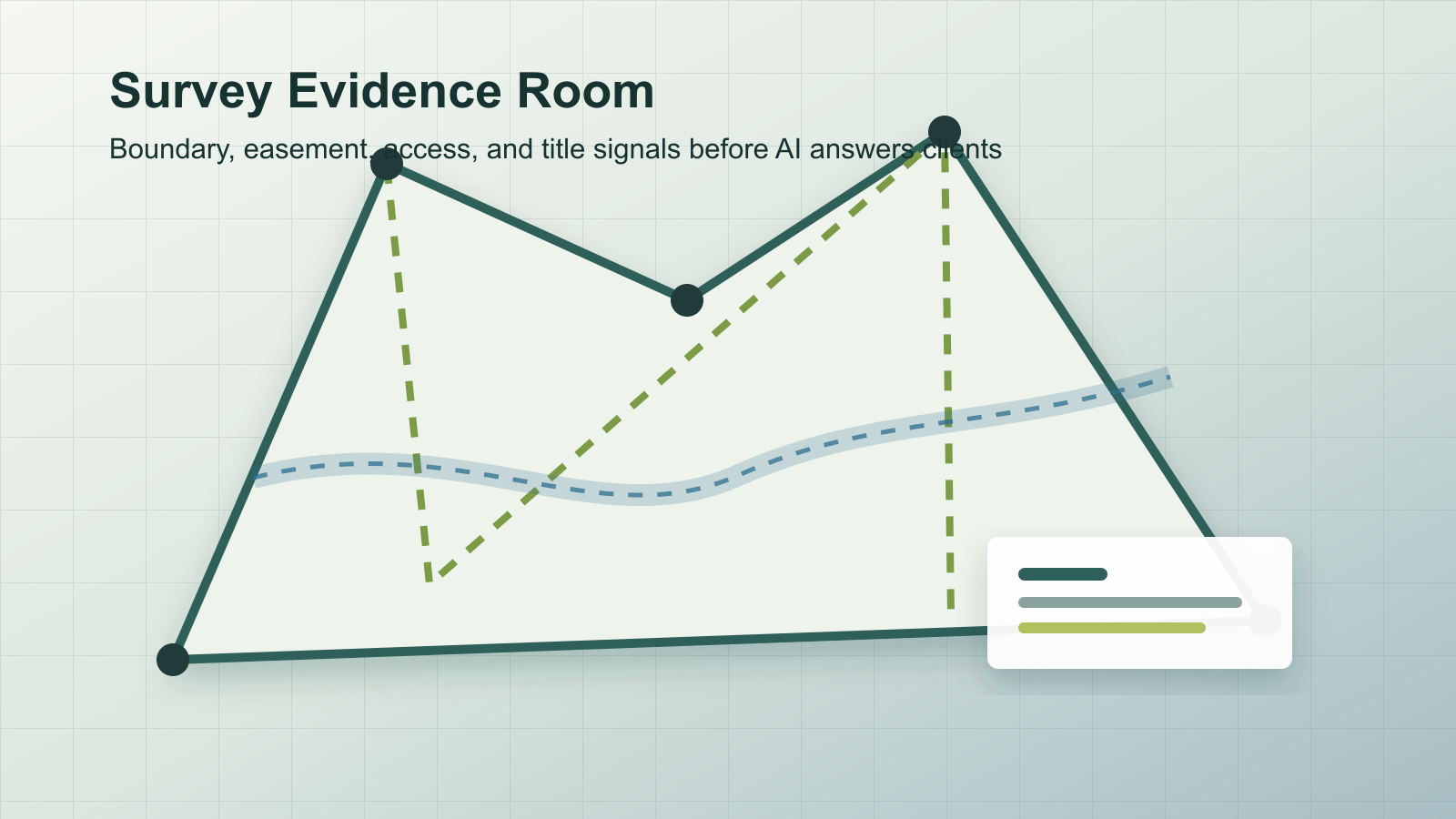
A survey evidence room turns that scattered memory into a structured decision surface. It should not replace the surveyor, title company, attorney, appraiser, lender, or broker. It should prevent AI from speaking past them.
The National Association of REALTORS reported in its 2025 Technology Survey that agents are already using AI and other digital tools in regular client service. NAR reported that 46% of agents used AI-generated content, and 20% used AI tools daily. That adoption means property-specific answers are no longer staying inside one person’s inbox. They are being summarized, routed, reused, and converted into client-facing language faster than most transaction files are reconciled.
The survey room is the control layer between "we have a document" and "the system may answer."
What belongs in the room
Start with four inventories.
The first is the survey-document inventory. Track the survey type, survey date, standard used, fieldwork completion date, requested Table A items, revision history, surveyor contact, and whether the file is draft, final, recorded, superseded, or rejected. The system should never treat an old survey, an unsigned draft, or a client-uploaded sketch as equivalent to a current professional survey.
The second is the title-and-easement inventory. Pull in the title commitment, Schedule B exceptions, recorded easements, access agreements, maintenance covenants, shared driveway agreements, utility easements, right-of-way references, and any title-company comments about whether an item is plottable, blanket, released, terminated, extinguished, unresolved, or outside the survey scope. The 2026 ALTA/NSPS materials matter here because the updated standard is explicit about coordinating survey scope, title evidence, and easement-related property interests.
The third is the physical-condition inventory. Capture fences, walls, sheds, pools, driveways, patios, utility poles, visible utility markings, drainage features, private roads, gates, and other improvements that might matter to a buyer’s use of the site. Do not ask AI to decide whether something is an encroachment. Ask it to identify that a physical feature exists, link it to the evidence, and route the question to the right reviewer.
The fourth is the interpretation inventory. This is the most important one. Store the current status of each issue as unreviewed, needs surveyor, needs title, needs legal review, needs lender review, needs seller disclosure, client-facing summary approved, or closed. Each status should have an owner, timestamp, source document, and approved language.
The Fannie Mae appraisal angle
Even when a transaction is not using an ALTA survey, boundary and easement facts can still show up in financing and valuation. Fannie Mae’s Selling Guide section on the site portion of the appraisal report says amenities, easements, and encroachments may detract from or enhance marketability and must be reflected in the appraiser’s analysis. It also requires appraisers to comment on adverse site conditions and assess effects on value and marketability.
That should change how real estate teams prepare AI systems. The model should not say "the easement should not affect value" because a prior client said the same thing about another property. It should say: "The file includes an easement reference. Marketability or value effect has not been reviewed in the current appraisal/title context." That answer is less exciting, but it is operationally safer and more useful.
The same applies to access and private-road issues. Fannie Mae’s guide discusses community-owned or privately maintained streets and the need for adequate, legally enforceable maintenance agreements or covenants in certain cases. If your automation drafts buyer updates, seller prep notes, or listing remarks, it needs to know when access documentation is verified and when it is still a transaction condition.
Build the AI permission model around evidence state
A simple permission model works better than a complex prompt library.
If a property-line issue is unreviewed, AI may only summarize the question and list missing documents. If a survey is present but title has not reconciled Schedule B items, AI may mention that a survey exists but cannot summarize easement impact. If title, survey, and broker review are complete, AI may use approved client-facing language. If the issue could affect value, marketability, access, reconstruction rights, disclosures, or legal interpretation, AI must route instead of answer.
This maps well to the NIST AI Risk Management Framework. NIST describes the AI RMF as voluntary guidance for improving how organizations incorporate trustworthiness considerations into the design, development, use, and evaluation of AI systems. For a real estate team, trustworthiness is not abstract. It means the model can prove which document supported an answer, whether the document was current, whether an expert reviewed it, and whether the answer was allowed for a client.
The room should log each AI use of survey evidence: who asked, what document or field was used, what the system answered, what permission state allowed it, and whether a human approved or corrected the output. That log becomes the feedback loop for your templates, training, vendor rules, and brokerage policy.
The operating checklist
Create one record per property, not one folder per document. Give the record fields for parcel identifiers, address, transaction side, survey status, title status, access status, easement status, encroachment status, appraisal status, and approved-language status.
Require every source to have a document date, received date, owner, and confidence level. Store the direct file link, but do not make the file link the only control. The AI system needs structured labels it can use before it opens or summarizes anything.
Make stale evidence visible. A prior survey can be useful background, but it should carry a freshness flag and a warning when improvements, fences, access routes, additions, lot splits, or neighboring conditions may have changed.
Separate facts from interpretations. "Fence visible along west side" is a fact if it is supported by field notes, photos, or a survey. "Fence encroaches" is an interpretation that belongs to the qualified reviewer and supporting document. "Seller can leave the fence" is a transaction position that may need legal, title, buyer, lender, or broker review.
Prewrite safe responses. The safest AI answer is often a routing answer: "The file includes survey/title evidence that needs review before we summarize property-line impact. I have routed this to the transaction owner and will update the client-facing summary after approval."
The business result
A survey evidence room will not make boundary questions simple. It makes them governable. It lets automation move faster on intake, reminders, document requests, and status updates without pretending that the model can resolve property rights.
That is the implementation pattern that matters: AI handles the repeatable work around the issue, while the decision stays attached to the right evidence and the right human authority. For real estate teams, that is the difference between a useful operating system and a fast way to create closing surprises.

Written by
Ben Laube
AI Implementation Strategist & Real Estate Tech Expert
Ben Laube helps real estate professionals and businesses harness the power of AI to scale operations, increase productivity, and build intelligent systems. With deep expertise in AI implementation, automation, and real estate technology, Ben delivers practical strategies that drive measurable results.
View full profile